
NEWS
Measles Hits a 35-Year High, and Infants Pay First
US measles cases reached 5,182 in 2026, the most since 1991, with infants too young to vaccinate and 280,000 kindergartners without MMR proof absorbing the harm.

The United States has confirmed 5,182 measles cases in 2026, the most in a single year since 1991, according to the Centers for Disease Control and Prevention. That total, logged as of Nov. 5, is more than double the 2,289 cases recorded in all of 2025.
State health departments have confirmed eight measles-linked deaths, including infants too young for a routine shot. The CDC’s own table lists four, a gap that has become part of the outbreak.
The Worst Cases Are in Kids Who Could Not Be Vaccinated
The CDC’s update counts 5,182 confirmed measles cases from 47 jurisdictions, plus 18 infections in international visitors. Of those 5,182 people, 96% were unvaccinated or had unknown vaccination status, 2% had one MMR dose, and 2% had two.
Age tells a harder story than the headline total. Children under 5 make up 908 cases, or 18%. School-age children and teens, ages 5 to 19, make up 2,104 cases, or 41%. Adults 20 and older make up 2,132 cases, also 41%. Age was unknown for 38 people.
Hospital care is not spread evenly. The CDC says 562 people, or 11% of confirmed cases, have been put in the hospital. Among children under 5, that share is 17% (154 of 908). Among adults 20 and older it is 15%. Among ages 5 to 19 it is 4%.
WHO GOT MEASLES IN 2026
| Age group | Cases | Share of cases | Put in hospital |
|---|---|---|---|
| Under 5 years | 908 | 18% | 17% (154 of 908) |
| Ages 5 to 19 | 2,104 | 41% | 4% (94 of 2,104) |
| Ages 20 and older | 2,132 | 41% | 15% (313 of 2,132) |
| Age unknown | 38 | 1% | 3% (1 of 38) |
| All ages | 5,182 | 100% | 11% (562 of 5,182) |
The first routine MMR dose is given at 12 to 15 months, so babies younger than that cannot meet the standard schedule even if their parents want the shot. In an outbreak, clinicians may give an extra dose from 6 months of age, then still give two doses after the first birthday. Until then, those infants depend on everyone around them.
Adam Ratner, a pediatric infectious disease specialist, put the imbalance in one line: “The burden of these diseases will fall on children, who are not the ones who are making these decisions.”
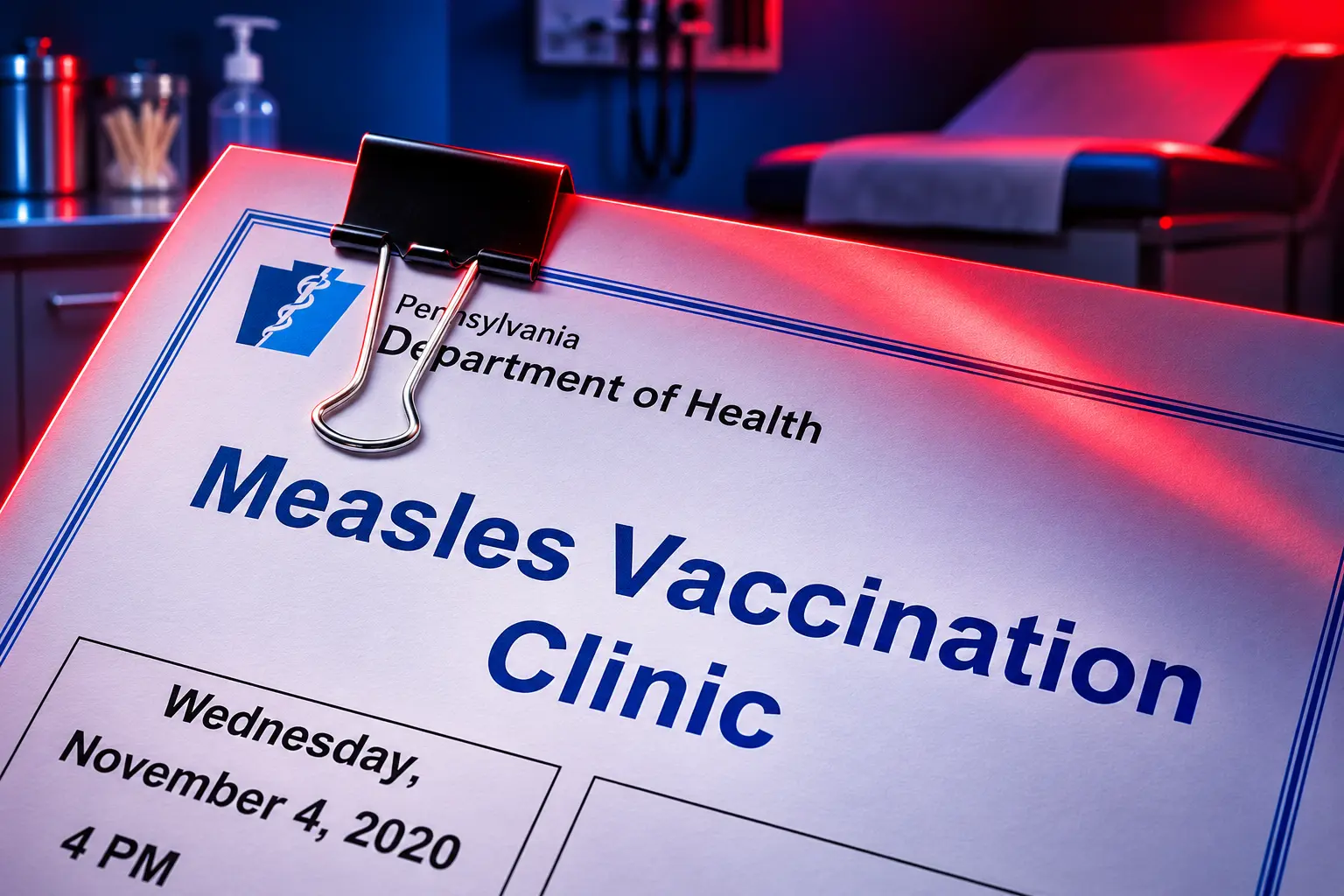
Last School Year, 280,000 Kindergartners Lacked MMR Proof
Measles spreads in air and can infect about 9 in 10 unvaccinated people who share a room with someone who has it. Health agencies have long treated 95% two-dose coverage as the level that keeps the virus from taking hold in a school or town.
National kindergarten MMR coverage for the 2025-2026 school year was 92.4%, the CDC’s SchoolVaxView system found, with DTaP at 92.0% and polio also at 92.4%. That is down from 95.2% MMR coverage in 2019-2020, before the COVID-19 pandemic scrambled well-child visits.
The same school-year file says about 280,000 kindergartners without MMR proof started class last year. Exemptions from one or more vaccines rose to 4.2% from 3.6%, covering about 155,000 children, and climbed in 41 states plus Washington, D.C. Twenty-four states posted exemption rates above 5%, a line that makes a 95% coverage target mathematically out of reach.
Idaho’s kindergarten MMR coverage was 75.2%. That is a local hole, not a rounding error, and it is the kind of hole measles exploits. Andrew D. Racine, president of the American Academy of Pediatrics, said more than a quarter of a million children started kindergarten last year without protection from the MMR vaccine, and that even a small drop can seed outbreaks because measles needs very high coverage to stay out of classrooms.
Two doses of MMR are about 97% protective against measles, Wisconsin health officials note. The 2% of 2026 patients who had both doses show the shot is not perfect. They also show how rarely it fails when people actually get it.
Six Pennsylvania Deaths Sit Outside the CDC Count
Pennsylvania is the center of the 2026 wave. The Pennsylvania Department of Health said on Nov. 9 that cases had reached 1,505 across 45 counties. On Nov. 4 the department confirmed its sixth confirmed measles-associated death, in an unvaccinated Jefferson County resident, and said the six deaths were among residents of Lancaster (3), Jefferson (2), and Mifflin (1) counties.
The department’s definition counts a measles-associated death when a person with lab-confirmed measles dies within 30 days of symptom onset from a cause that is not clearly unrelated, such as a car crash. That is modeled on how the state already counts flu and RSV deaths. As of Nov. 4, the department said five of 1,467 cases at that snapshot were in vaccinated people, less than 1%.
Nurses and clinics in Pennsylvania gave more than 61,000 MMR doses in October, more than double a typical month. An HHS spokesperson, Emily Hilliard, said the CDC has provided $100 million in extra funds for measles and other vaccine-preventable disease response through most of 2027, and that Health Secretary Robert F. Kennedy Jr. and CDC Director Erica Schwartz “have consistently made clear that the MMR vaccine is the most effective way to prevent measles.”
Kennedy, a long-time vaccine critic before he took the HHS job, publicly questioned Pennsylvania’s early death reports and pressed for a slower federal count. The CDC now leans on National Center for Health Statistics death records and a still-unfinished case definition from the Council of State and Territorial Epidemiologists, rather than posting every state-confirmed measles-associated death in real time.
WHAT WE KNOW
- State total: Pennsylvania, New York, and Wisconsin have confirmed eight measles-linked deaths in 2026 (six, one, and one).
- Federal total: The CDC table lists four measles deaths in 2026, marked as subject to change, and three in 2025.
- Pennsylvania rule: The state counts a death within 30 days of confirmed measles if it is not from an unrelated cause.
WHAT IS UNCONFIRMED
- Which four: The CDC has not said which of the eight state-confirmed deaths are in its four.
- Franklin County: Pennsylvania is still investigating a reported October death there and has not added it to the six.
- National standard: CSTE has not finished a shared definition for measles deaths, so state and federal tallies can keep diverging.
The argument is about forms. The people on those forms include infants who never filed an exemption.
Wisconsin’s First Infant Measles Death Since 1990
On Nov. 5, the Wisconsin Department of Health Services said an infant in the southwestern part of the state had died in the outbreak, the first such death in Wisconsin since 1990. The coroner listed measles as the immediate cause of death. As of Nov. 3, the department had 431 cases in 13 counties, the most in more than 35 years, with nine people in the hospital.
It is with a heavy heart we are reporting the first death of an infant connected with a measles outbreak in Wisconsin in many years. My heart is broken for the family. Any death of a child is a tragedy and even more so when it is related to a vaccine-preventable disease.
Kirsten Johnson, Secretary, Wisconsin Department of Health Services
Since Aug. 1, Wisconsin officials said they had sent 2,000 MMR doses to local health departments in affected counties, and providers had given more than 42,000 doses in that stretch.
New York’s health department reported a child’s measles-associated death in early November, the first the state has recorded in 30 years. New York has 210 cases among residents in the CDC’s Nov. 5 map, with seven more in New York City. Governor Kathy Hochul had already declared a disaster emergency so the state could move vaccine and testing faster.
Some local replies to the Wisconsin announcement treated it as another round of pandemic-era messaging. That reflex is now sitting next to a coroner’s ruling that names measles on an infant death certificate, which is a different fact than a slogan.
One in 20 Children With Measles Gets Pneumonia
Measles is not a three-day rash. The CDC says symptoms start 7 to 14 days after contact, usually with a high fever that may spike above 104 F, cough, runny nose, and red watery eyes. Tiny white Koplik spots may appear inside the mouth, and the rash typically begins on the face at the hairline 3 to 5 days after the first symptoms, then moves down the body.
The groups most likely to get very sick are children younger than 5, adults older than 20, pregnant people, and anyone with a weak immune system, including from leukemia or HIV. That matches this year’s hospital table, where the youngest and the oldest, not school-age kids, fill the beds.
WHAT MEASLES CAN STILL DO
- Ear infection: About 1 in 10 children with measles gets an ear infection.
- Pneumonia: As many as 1 out of every 20 children with measles gets pneumonia, the most common cause of measles death in young children.
- Brain swelling: About 1 child in 1,000 develops encephalitis, which can cause seizures and lasting hearing or thinking problems.
- Death: Nearly 1 to 3 of every 1,000 children who get measles die from lung or brain complications.
- Pregnancy: Measles in pregnancy can bring premature birth or a low-birth-weight baby, and congenital measles has already appeared in this outbreak’s death reports.
- Immune amnesia: The virus can damage immune cells that remember other germs, raising the risk of other infections for months and sometimes a few years after the rash is gone.
- SSPE: A rare, always-fatal brain disease can appear 7 to 10 years later. After the 1989 to 1991 U.S. resurgence, about 7 to 11 of every 100,000 people with measles were estimated to be at risk, with higher risk if measles came before age 2.
CDC’s general teaching figure is that about 1 in 5 unvaccinated people in the United States who get measles is hospitalized. This year’s confirmed-case share is 11%, because the denominator includes every reported infection, not only unvaccinated patients in older studies. For children under 5, 17% is already close to that older 1-in-5 line.
Before the measles vaccine arrived in 1963, CDC estimates put yearly U.S. illness at 3 to 4 million cases, with 400 to 500 deaths, 48,000 hospital stays, and 4,000 cases of encephalitis.
The 1989 Resurgence Came From Shots That Never Reached Toddlers
The last time annual U.S. measles counts looked like this, the country was in a three-year surge that public-health records still treat as the warning that made a two-dose school schedule standard.
FROM VACCINE TO ELIMINATION, THEN BACK
- 1963: The first measles vaccine is licensed in the United States.
- 1989 to 1991: A resurgence produces 55,622 reported cases. CDC historical summaries and a Journal of Infectious Diseases review count more than 55,000 cases and 123 deaths, with about 11,000 hospitalizations. Almost half the deaths were in children under 5, and about 90% of those who died had not been vaccinated. The main failure was preschoolers, many in large cities, who missed a timely first dose.
- 1989: CDC moves to a routine two-dose measles schedule to close gaps in school-age children who had received only one shot.
- 2000: The United States declares measles eliminated, meaning no continuous domestic spread for 12 months or more. Later cases were treated as imports with limited local chains.
- 2024: CDC records 285 cases and 16 outbreaks.
- 2025: Cases jump to 2,289 across 48 outbreaks, with three deaths.
- 2026: As of Nov. 5, 5,182 cases, 43 outbreaks, and 96% of infections tied to outbreak chains, including 1,385 cases still linked to outbreaks that began in 2025.
The 1989 to 1991 wave was, in large part, a delivery problem. Shots were recommended and not reaching toddlers on time. The 2026 wave is running through a different hole. Kindergarten MMR is 92.4%, exemptions are at 4.2%, and 96% of patients this year had no documented shots. School-age children and adults each make up 41% of cases, a split that looks more like communities that declined the vaccine than like inner-city clinics that could not stock it.
South Carolina has 670 cases in the CDC map, Kentucky 204, Ohio 202. Those are separate fires, not one Pennsylvania plume. The CDC has logged 43 outbreaks, defined as three or more related cases. Elimination status depends on whether chains like those keep burning past a year.
What Can Parents of Babies Under 12 Months Do?
Infants usually get the first MMR dose at 12 to 15 months, so babies younger than that have no routine shot to fall back on. In a community outbreak, or before international travel, CDC guidance allows an extra MMR dose from 6 through 11 months; those children still need two doses after their first birthday for full protection. Pennsylvania issued similar 6-month guidance in July for its own outbreak. That early dose is for a fire already burning. It does not replace the regular series.
Anyone who thinks they were exposed should call a clinic before walking into a waiting room, because measles hangs in air and infects other patients. Isolation, testing, and, for some contacts, vaccine or immune globulin given quickly can still change the course. Two documented MMR doses, or lab evidence of immunity, is the protection schools and hospitals ask for.
A Pan American Health Organization committee is meeting Nov. 10 to 13 in Washington to review whether the United States has lost the measles elimination status it has held since 2000. The test is whether measles has been spreading continuously for 12 months or more. With 1,385 of this year’s cases still tied to 2025 outbreak chains, and with only 18 of 5,182 cases in visitors, the review is not about a few imported sparks.
Paul Offit, a vaccine scientist, said measles will keep coming back next year and the year after that until the country raises vaccination. The people who cannot wait for that argument to end are the ones who cannot yet roll up a sleeve: a 6-week-old, a newborn whose mother was sick, a 7-month-old in a county with a hole in kindergarten coverage, an infant in southwestern Wisconsin whose death certificate names a disease the United States spent 40 years pushing out.
Disclaimer: This article is news reporting and analysis of CDC and state health department data on measles in 2026. It is for information only and is not medical advice, a diagnosis, or a recommendation about whether any person should receive, delay, or decline a vaccine. Readers should talk with a licensed physician, pediatrician, or other qualified clinician about MMR timing, outbreak doses for infants, pregnancy, and immune conditions before making a health decision. Case counts, hospital figures, and death totals reflect the CDC update dated Nov. 5, 2026, and state reports through Nov. 9, 2026, and those numbers can change as investigations and laboratory reviews continue.

Falling Shot Rates Cost the U.S. Measles Elimination Status

NHS Record Snooping Gives Patients a Reason to Withhold

FDA Rejects Ivonescimab After the HARMONi Survival Miss

The Medicaid Work Delay Leaves January Checks Intact

Pelacarsen Cut Lp(a) 78%, and Heart Attacks Did Not Fall

Pennsylvania Measles Deaths Collide With Falling MMR Coverage

FDA Approves XFG COVID Vaccines While the Advice Panel Is Frozen

Progranulin and JAK2 Split the Macrophages That Heal

Alnylam Defends Amvuttra After Wainua’s ATTR-CM Trial Miss

Muscle-Boosting Drugs Near Approval for Children With SMA
-
 NEWS3 months ago
Pennsylvania Measles Deaths Collide With Falling MMR Coverage
-
 NEWS3 months ago
FDA Approves XFG COVID Vaccines While the Advice Panel Is Frozen
-
 NEWS3 months ago
Progranulin and JAK2 Split the Macrophages That Heal
-
 FITNESS3 months ago
Muscle-Boosting Drugs Near Approval for Children With SMA
-
 NEWS3 months ago
Alnylam Defends Amvuttra After Wainua’s ATTR-CM Trial Miss
-

 MENTAL HEALTH3 months ago
After the ADHD Invoice, GPs and Waiters Carry the Cost
-
 NEWS2 months ago
Rasonque’s List Price Shifts the Pancreatic Cancer Bill
-

 NEWS3 months ago
FDA Flagged This Sprout Plant 16 Months Before the Outbreak