
MENTAL HEALTH
NHS Boards Set Two-Year Minimum Waits for ADHD and Autism
NHS boards have turned Right to Choose into a two-year lock for ADHD and autism assessments as a government review slips to October.

Four NHS boards in England have set a minimum wait of up to two years for ADHD and autism assessments with independent clinics. The rule is a budget cap dressed as a queue, and it lands on a legal right the boards cannot repeal.
West Yorkshire has gone furthest. Fifteen of 36 integrated care boards now cap, pause or slow Right to Choose referrals, while a 700-page government review of the same diagnostic boom has slipped into October 2026.
West Yorkshire’s Two-Year Floor for Independent Assessments
NHS West Yorkshire Integrated Care Board says it has agreed a minimum waiting time for all autism and ADHD assessments for patients under the care of independent providers, currently two years from the date of referral. The floor covers the 2.4 million people whose care it commissions in Leeds, Bradford, Kirklees, Calderdale and Wakefield, including the Pontefract, Castleford and Knottingley seat of health secretary Yvette Cooper.
The board’s own reason is money. It spent £7m on assessment and medication for neurodiversity in 2023-24 and expected to spend three times that, £21m, by the end of 2025-26. That growth, it says, cannot be sustained. It has told non-contracted providers not to deliver more appointments than they did in 2024-25, and it uses an Indicative Activity Plan, a yearly cap on how much activity the NHS will fund, to hold the line.
Urgent cases can still jump the floor. The board will consider a faster assessment when there are serious risks to safety, physical health, mental health or education, an earlier assessment would have a clear and immediate effect, and the person is well enough to consent and take part. Those patients should be seen as soon as is clinically right, with an aim of 12 weeks. People already diagnosed with ADHD and waiting for medication are a further priority group.
No, an activity plan does not restrict patient choice. Patients can still choose to be referred, and the provider must accept that referral under the terms of their contract. However, if the provider has reached the threshold of their activity plan and do not have any further capacity commissioned by the NHS in West Yorkshire, the wait for an assessment will increase.
NHS West Yorkshire Integrated Care Board, activity-plan FAQ
That is the bind in the board’s own words. The referral still goes through. The clinic still has to accept it. The assessment does not happen until the calendar, and the funded envelope, allow it. Independent clinics that still advertise spare Right to Choose slots for patients in other parts of England are told to apply the two-year floor to West Yorkshire referrals.
The Legal Right Still Exists on Paper
Right to Choose is the England-only rule that lets a patient, after a GP agrees an assessment is clinically appropriate, name any clinically appropriate provider that holds a qualifying NHS contract for that service. The patient does not pay. The NHS does. The legal hook is regulation 39 of the NHS Standing Rules, and Finally Seen, which tracks restrictions on the pathway, says it found nothing in those rules that lets an ICB suspend the right.
In a written answer on 28 April 2026, the government said it was “absolutely clear” that activity plans “must not restrict patients’ choice of provider.” Providers, it said, are not asked to close referrals. Once planned activity is used up, they are asked to hold new referrals on a waiting list until they have room inside the contracted envelope. Choice of name survives. Choice of date does not.
Independent clinics now carry out half of NHS-funded ADHD assessments and a third of those for autism, because patients used the right when local NHS lists ran long. That is why the bill rose, and why boards are reaching for activity plans they cannot legally dress as a ban. A two-year floor is not the same thing as a two-year backlog. In areas where a clinic could still offer a slot in weeks, the commissioner has now forbidden that slot from being used until the dated wait has run.
Families who can pay several thousand pounds step off the NHS pathway and buy a private assessment outright. Families who cannot pay sit on the lock. Local NHS lists in some services already run longer than two years, so the new move is not that waits are long. It is that a shorter independent slot is no longer allowed to be shorter.
78 Weeks in the North East, 14 in Devon
Finally Seen checked board pages and provider notices on 23 September 2026 and found 15 of 36 ICBs capping, pausing or slowing Right to Choose ADHD or autism assessments. Ten say so themselves, or in a message published on their behalf. Five show up only in provider notices. Four have published a numbered minimum wait. The length is a local budget tool, not a national clinical standard, which is why Devon’s floor is weeks and West Yorkshire’s is years.
PUBLISHED MINIMUM WAITS
| Board | Published floor | Who it applies to |
|---|---|---|
| West Yorkshire | 2 years from referral | Independent providers |
| North East and North Cumbria | About 78 weeks (18 months) | Providers it funds in 2026/27 |
| Somerset | 52 weeks | New adult ADHD and autism assessments |
| Devon | 14 weeks, up to 52 weeks | NHS Devon referral guidance |
North East and North Cumbria tells recent referrals it is unlikely they will be offered an assessment in the current financial year. Kent and Medway says a routine referral is unlikely to be seen before April 2027. Greater Manchester has dropped first come, first served, so providers “will only be able to assess those with the most urgent clinical need.” Cheshire and Merseyside says it will buy fewer adult ADHD assessments than it did in 2025/26. In most of these areas a GP can still refer. What stops is the assessment once the clinic has used the number of slots the board will fund.
Hampshire Pushes Most Right to Choose Cases Into 2027
Hampshire and Isle of Wight is not running a two-year numbered floor. It is running a later calendar and a priority test it has not published. In its September 2026 update, the board said people already waiting on Right to Choose will only be offered an assessment in 2027 if they meet prioritisation criteria, and that the same approach will apply to new referrals in 2026/27.
It says Right to Choose accounts for around 27% of people currently waiting, and that those patients have typically waited less than people on local NHS lists. Aligning the two routes, it argues, treats everyone more evenly. Its FAQ also says no formal, standardised priority criteria are held centrally by the board, and that Right to Choose providers set their own tests, which may vary. Finally Seen notes that a December 2025 freedom of information response from the board said no legal advice was sought on its activity plans.
WHAT HAMPSHIRE SAYS IT WILL STILL DO
- Medication already started: Ongoing reviews continue for people who already have an ADHD diagnosis and are on treatment.
- New titration: The board will still start medication titration for people who already have a diagnosis.
- Priority assessments: A small number of new referrals that meet unpublished clinical priority rules can still be assessed and treated.
- Children’s teams: From 2026/27, every area is due to have a children’s neurodiversity team that can advise families without a diagnosis.
- Adult hubs: Information and peer support hubs are listed in Andover, Havant, Southampton, the Isle of Wight and Portsmouth, again without a diagnosis first.
Help without a label is the board’s answer to a locked diagnostic door. Mel Merritt, head of policy and influencing at the National Autistic Society, says that still leaves a hole, because a diagnosis is, in practice, what unlocks school plans and other support, even when it should not be.
Almost a Million People Are Waiting for ADHD Assessments
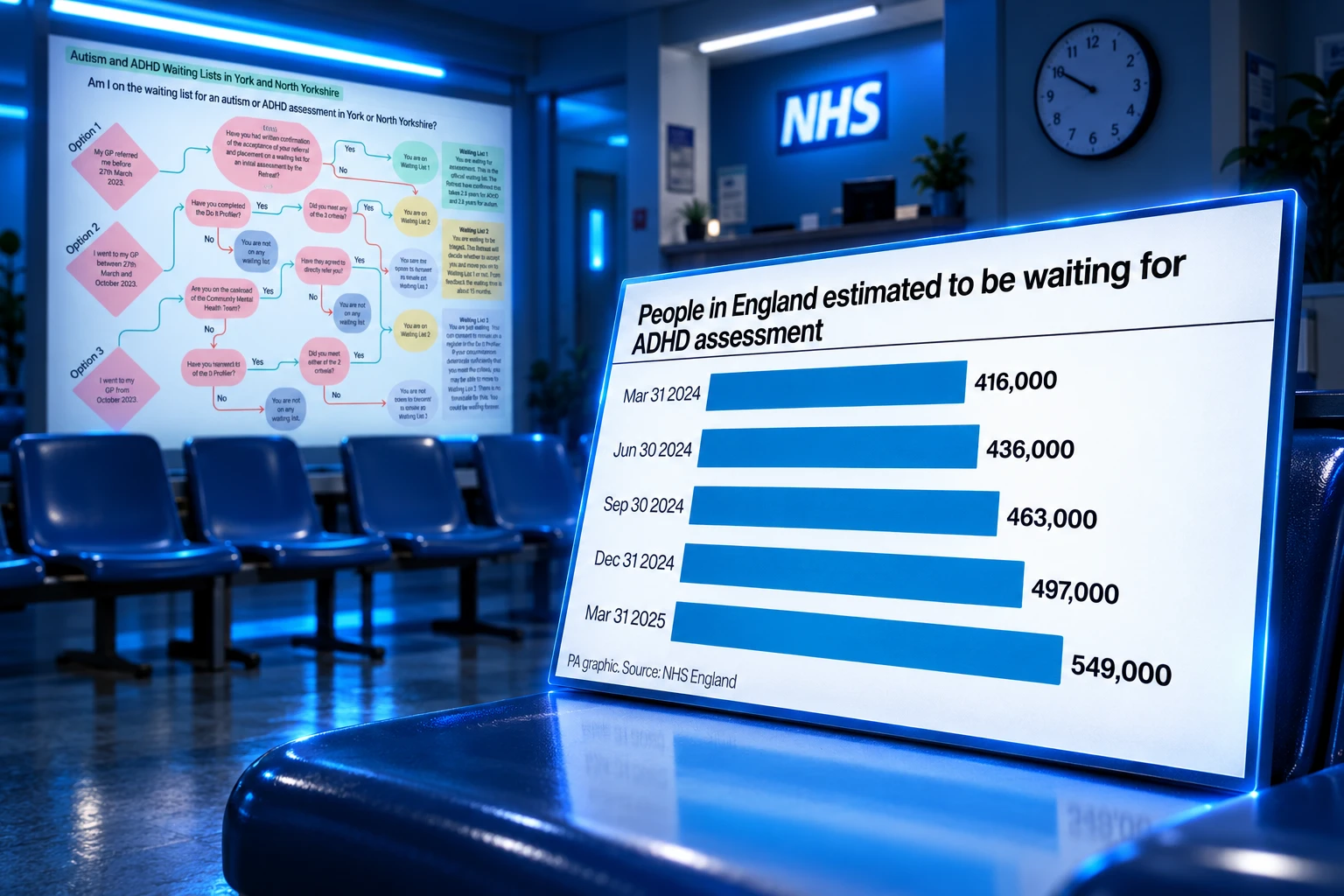
The floors sit on lists that were already long. A House of Commons briefing that draws on NHS Digital figures says that at the end of August 2026 there were 780,405 open referrals for a possible ADHD diagnosis in England, 572,570 of them adults and 207,835 of them children aged 0 to 17. A further 179,232 people aged five to 24 may be waiting after referral through community health services, which would put the queue at up to 959,637. NHS Digital has estimated that around 2.5 million people in England have ADHD, including those without a formal diagnosis, about 614,000 of them children aged 0 to 17.
THE AUGUST ADHD QUEUE
- New referrals: 37,105 people were newly referred in August 2026, including 10,170 children.
- Short waits: 11.7% of adults and 12.9% of children had been waiting less than 13 weeks.
- Waits over a year: 56.3% of adults and 62.2% of children had been on a list for more than a year.
- The 13-week target: NHS figures still treat under 13 weeks from referral to first contact as the aim.
Autism lists are published on a different cycle. NHS Digital recorded 294,792 patients with an open autism referral in June 2026. Of those, 256,017, or 86.8%, had a referral open for at least 13 weeks. Only 3.8%, 9,833 people, of that long-wait group had had a first appointment within the recommended 13 weeks. There were 17,509 new autism referrals that month.
NICE guidance on autism in under-19s says teams should start the autism diagnostic assessment within 3 months of referral to the autism team. A two-year independent-provider floor is eight times that span. Sean Phillips, head of policy at the Independent Healthcare Providers Network, said extra months or years without a diagnosis can hit mental health, school, work and family life, and argued that the NHS should use spare independent capacity rather than leave more than a million people waiting.
What a Delayed Diagnosis Does at School
For children, the wait is not only a clinic date. It is time in class without a formal description of need, and without the plan that schools still often require before they will put support in writing. Merritt said restricting autism assessments denies people support because, while it should not be the case, a diagnosis is needed to get help, and for children that can mean years of wasted school plus further waits for a plan.
Henry Shelford, chief executive of ADHD UK, called the two-year minimum wait scandalous, and said it denies people care that is needed and available, including the assessment that helps people hold down jobs, stay in education and stay out of crisis services.
A minimum wait is heartless and dangerous. It is institutionalised cruelty.
Henry Shelford, Chief Executive, ADHD UK
Finally Seen put the same point in calendar terms, calling a two-year minimum wait a locked door with a date on it, and saying the right still exists on paper while being rationed by the calendar. Rebecca Gray, director of the NHS Alliance’s mental health network, said local NHS leaders know the frustration and are trying to cut delays, but that the need to balance budgets and the pressure of soaring demand have, in some places, led to minimum waits or even the closure of waiting lists. She called the present arrangement unsustainable, and a bad deal for patients and taxpayers.
The Jump in Boys’ Diagnosis Rates Since 2000
The activity plans are a response to a long rise in recorded diagnosis, not only to a short-term spike in Right to Choose bills. Figures from the Clinical Practice Research Datalink, cited in briefing on the unpublished Fonagy review, show large increases among boys between 2000 and 2025. Those rates are what schools, employers and benefit offices now have to live with, and they are what ICBs say they cannot assess at the speed patients want.
RECORDED PREVALENCE IN BOYS, CPRD
| Group | 2000 | 2025 |
|---|---|---|
| Autism, ages 7 to 18 | 0.2% | 4.7% |
| Autism, ages 6 to 11 | 0.4% | 6.3% |
| ADHD, ages 7 to 18 | 0.4% | 5.1% |
| ADHD, ages 6 to 11 | 0.7% | 3.8% |
The 6-to-11 autism figure is a 16-fold rise. The 7-to-18 ADHD figure is an almost 13-fold rise. The 6-to-11 ADHD figure is a five-fold rise. People briefed on the Fonagy review say it also flags up to 24-fold rises in recorded neurodiversity among boys since 2000, and that independent clinics now do most NHS-funded ADHD assessments in a market with “financial incentives associated with assessment activity.”
Prof Peter Fonagy, the University College London clinical psychologist chairing the review, has already argued in public that when support is tied tightly to diagnostic labels, demand for diagnosis will rise, and that when early help is limited, difficulties escalate. His interim work, published in March 2026, found that underlying rates of autism and ADHD in the population had stayed relatively stable while referrals and diagnoses had risen a lot. The final report is expected to push help that does not wait for a formal label, which is the same bet Hampshire is making with its hubs, while also looking harder at how independent clinics assess the people who still want a label.
A 700-Page Review Is Now Due in October
Wes Streeting, then health secretary, launched the Independent Review into Prevalence and Support for Mental Health Conditions, ADHD and Autism on 4 December 2025. Prof Sir Simon Wessely and Prof Gillian Baird are vice chairs. The 700-page final report was due on 24 September 2026 and was postponed until early October 2026. People briefed on it say it paints a picture of patients struggling to get rapid NHS care and leaning on private providers, and that it raises concerns about the consistency and quality of those assessments.
HOW THE LOCK AND THE REVIEW LINED UP
- 4 December 2025: Streeting commissions the Fonagy review after a sharp rise in demand for mental health, ADHD and autism care.
- September 2026: Hampshire says most Right to Choose assessments will wait until 2027 unless they meet priority rules.
- 23 September 2026: Finally Seen records 15 of 36 ICBs capping, pausing or slowing the pathway, with four published minimum waits.
- 24 September 2026: The Fonagy report is postponed from that day until early October 2026.
The review and the floors are aimed at the same pile of referrals. One tries to change who needs a diagnosis, and how independent clinics are watched. The other tries to stop the NHS paying for every Right to Choose slot a clinic can offer. Until the report appears, a patient in Leeds and a patient in Devon are waiting under different clocks for the same NHS-funded assessment, and the legal right to pick the clinic still does not come with a legal right to pick the year.
Disclaimer: This article is news reporting and analysis of NHS assessment access in England. It is for information only and is not medical, diagnostic or legal advice, and it is not a guide to whether any person should seek, delay or pay for an ADHD or autism assessment. Anyone who is worried about symptoms, school support, medication or a referral should speak to a GP or another qualified clinician who knows their history, and should not change treatment on the basis of this piece. Waiting times, board rules and the status of the Fonagy review can change, and the figures here reflect the NHS Digital, board and briefing sources cited at the dates those sources give.

Europe’s Heat Killed 50,391 in Cities Official Counts Still Miss

Caesarean Surge Puts 20 England Maternity Units at Risk

The Protective Ring Around Care Homes Never Existed

Cooper Prioritises Children’s Corridor Care Without an Age Count

Oxford’s Ebola Vaccine Reaches Uganda as Doses Sit Unused

Pennsylvania Measles Deaths Collide With Falling MMR Coverage

Muscle-Boosting Drugs Near Approval for Children With SMA

FDA Approves XFG COVID Vaccines While the Advice Panel Is Frozen

After the ADHD Invoice, GPs and Waiters Carry the Cost

Rasonque’s List Price Shifts the Pancreatic Cancer Bill
-
 NEWS2 months ago
Pennsylvania Measles Deaths Collide With Falling MMR Coverage
-
 FITNESS2 months ago
Muscle-Boosting Drugs Near Approval for Children With SMA
-
 NEWS2 months ago
FDA Approves XFG COVID Vaccines While the Advice Panel Is Frozen
-
 MENTAL HEALTH2 months ago
After the ADHD Invoice, GPs and Waiters Carry the Cost
-
 NEWS2 months ago
Rasonque’s List Price Shifts the Pancreatic Cancer Bill
-

 NEWS2 months ago
Progranulin and JAK2 Split the Macrophages That Heal
-

 NEWS2 months ago
FDA Flagged This Sprout Plant 16 Months Before the Outbreak
-

 NEWS2 months ago
Pennsylvania’s Two Measles Deaths Follow a Long Coverage Slide