
NEWS
FDA Flagged This Sprout Plant 16 Months Before the Outbreak
FDA warned Everything Sprouts about a leaking roof in 2025, then 55 people in 15 states got sick before inspectors returned.

A Minneapolis grower recalled five lots of alfalfa sprouts on Aug. 22 after 55 people in 15 states got sick with E. coli, Salmonella, or both. Four people were hospitalized. No deaths have been reported.
The same plant had already been cited, in a March 2025 FDA warning letter, for water dripping onto open sprouts. Inspectors did not come back until the outbreak was underway.
55 People in 15 States Are Sick So Far
The U.S. Centers for Disease Control and Prevention says illnesses began between May 31 and August 8, 2026. The last known onset is August 8. CDC updated the file on August 24 and left the investigation open.
Forty-six people were infected with Shiga toxin-producing E. coli, seven with Salmonella Agona, and two with both. The E. coli strains are O26:H11, O103:H25, and O168:H8. CDC notes that multi-germ outbreaks are uncommon; one earlier example was a 2019 oyster outbreak.
THE OUTBREAK AT A GLANCE
- Cases: 55 people in 15 states, with onsets from May 31 to August 8, 2026.
- Hospital care: 4 of 48 people with records, or 8 percent; no deaths.
- Germ split: 46 E. coli, 7 Salmonella, and 2 people carrying both.
- Interviews: 26 of 34 sick people said they ate alfalfa sprouts.
Of 34 people interviewed, CDC found that 76 percent reported eating alfalfa sprouts, far above the 8.7 percent of people who eat any sprouts in the FoodNet Population Survey. Investigators also found at least two illness clusters at restaurants in Minnesota and Wisconsin, where the most common food named was alfalfa sprouts.
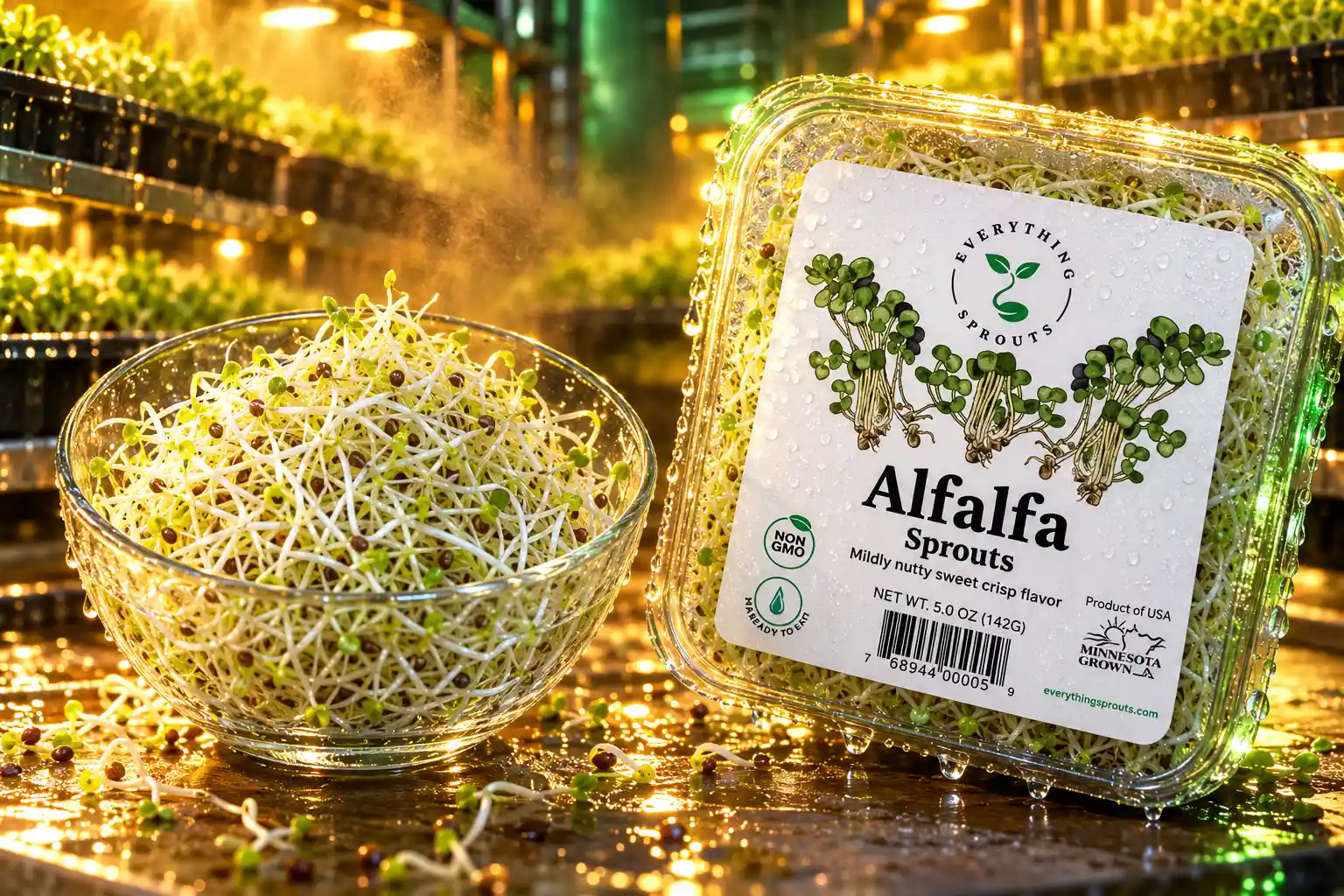
Traceback from those restaurants and from grocery stores pointed to Everything Sprouts, LLC, of Minneapolis, sold under the Everything Sprouts and Calco brands. Confirmed shipments went to wholesale buyers and stores in Minnesota and Wisconsin from May 27 to August 21, and to restaurants in both states. FDA says the packs may have moved farther. Sick people have turned up in 13 other states.
CDC posted the public alert on August 22:
E. coli and Salmonella Outbreak: 55 people sick, 4 hospitalized, in 15 states. Do not eat affected Everything Sprouts alfalfa sprouts. Throw them out or return them.
See the notice for full details: https://t.co/rKjXtejQJ2— CDC (@CDCgov) August 22, 2026
The true count is likely higher, the agency said, because many people recover without a test, and it often takes three to four weeks to tie a new patient to an outbreak. Whole genome sequencing showed the bacteria from patients are closely related, which points to a shared food. Salmonella from nine people’s samples was predicted to resist three or more of fosfomycin, streptomycin, sulfisoxazole, and tetracycline. The E. coli samples showed no predicted drug resistance. Antibiotics are not used to treat Shiga toxin-producing E. coli.
A Leaking Roof, and a 16-Month Wait
FDA inspected the sprouting plant at 2751 Minnehaha Ave. from October 30 through November 14, 2024. On March 28, 2025, the agency sent owner Melissa L. Mann a warning letter. Investigators had judged the firm’s mung bean, soybean, and green sprout products adulterated because they were packed and held under insanitary conditions. The word alfalfa does not appear in that letter. The water problems they wrote down were plant-wide.
On October 31, 2024, our investigator observed the roof leaking through the ceiling tiles in the middle of the production room approximately four feet from the packaging tables. Water from the leak was observed dripping onto the totes of cooled, exposed mung bean sprouts as pallets were transferred through the area for packaging.
FDA warning letter to Everything Sprouts, LLC, March 28, 2025
The same letter recorded a second leak in the warehouse, with water falling near a rack of clean smocks that workers would wear against the crop. Condensate dripped from condenser units inside coolers that held finished sprouts. On an earlier pass, investigators had seen a roof leaking through the ceiling tiles and water on the packing path.
Black organic matter had built up on an overhead irrigation hose that ran directly over exposed soy sprouts. Plastic sheeting on growing cabins was ripped and patched with tape, and sprouts were stuck to the tape. Soiled strip curtains brushed harvested mung bean sprouts as they moved between rooms. Paint was flaking, and soil sat on walls above a conveyor of open product.
The company, in written replies dated December 5 and 6, 2024, said it would write a leak procedure, use drain tarps, squeegee condensate, and later add drip pans or replace the units. Mann’s team told the investigator they rent the building and that the landlord would repair the roof as a long-term project. They gave no date. FDA wrote that it could not judge whether the fixes were enough, and that dripping condensers had already been seen at the same building in 2023 and in 2018, under different owners. “We will evaluate the adequacy of your corrective actions at our next inspection,” the letter said.
FROM THE 2024 INSPECTION TO THE RECALL
- October 30, 2024: FDA opens an inspection at Everything Sprouts in Minneapolis that runs through November 14.
- December 5, 2024: The firm sends written replies describing leak tarps, squeegees, and a roof repair with no date.
- March 28, 2025: FDA issues the warning letter and says it will check the fixes at the next inspection.
- May 27, 2026: Recalled alfalfa lots begin shipping to Minnesota and Wisconsin buyers.
- May 31, 2026: The first known outbreak illness begins.
- August 8, 2026: The last known illness onset is recorded.
- August 19, 2026: FDA returns for an inspection and sample collection, after people are already sick.
- August 22, 2026: Everything Sprouts recalls listed lots of alfalfa sprouts and two mixed cups.
That return visit came more than 16 months after the warning letter. By then CDC already had 55 names on the list. In a statement carried by The Guardian, the company said it had run daily tests since the outbreak began and had “not received any positive lab results.” It also said, “To date, no reports of illnesses involving Everyday Sprouts Alfalfa Sprouts have been reported to the company,” using a name that is not on the packages.
Why Raw Sprouts Keep Making People Sick
Sprouts are grown in warm, wet, nutrient-rich air, the same conditions that help Salmonella and E. coli multiply if they are on the seed or in the room. People eat them raw, or barely cooked, so there is no kill step at the table. FDA’s sprouts guidance for industry records 52 reported outbreaks tied to sprouts in the United States between 1996 and 2020, with at least 2,700 illnesses, 200 hospital stays, and three deaths.
When investigators could name a source in those older outbreaks, they often landed on the seed, not the packing line. A separate FDA sampling assignment found Salmonella on 2.35 percent of seed samples, compared with 0.21 percent of finished sprouts and 0.54 percent of spent irrigation water. Listeria was a different pattern: 1.28 percent of finished sprouts, with no clear drop-off by sample type, which fits a germ that lives in a plant’s environment.
This outbreak carries both stories at once. Four germs showed up in patients who ate product from one grower, which can fit dirty water and dirty equipment. It can also fit a mixed or heavily contaminated seed lot that several growing bins shared. FDA says it is still trying to learn whether a common seed supplier sits behind the illnesses, and whether any other firm is involved.
A 2022 alfalfa outbreak, described in the journal Food Control, sickened 63 people in eight states and put 10 in the hospital. In that case a grower released sprouts after a presumptive Salmonella result without waiting for confirmation. Retail and seed samples later tested negative, and investigators still tied the illnesses to that grower by interviews and traceback. Negative swabs do not close an outbreak file.
Minnesota and Wisconsin Account for Most Cases
Sick people range in age from 12 to 94, with a median of 34. About 73 percent are female. CDC’s race and ethnicity table, built from 52 people with data, is 98 percent White and 98 percent non-Hispanic. Shiga toxin-producing E. coli can cause bloody diarrhea and, in a subset of patients, a kidney failure called hemolytic uremic syndrome. Young children, older adults, and people with weak immune systems face the highest risk of that turn.
Salmonella illness usually starts 12 to 72 hours after a contaminated meal and lasts four to seven days. STEC symptoms can begin a few days after the meal, or as late as nine days. CDC’s state table, updated August 24, puts most of the 55 cases in the two states where the packs were known to be sold.
| State | Sick people |
|---|---|
| Minnesota | 21 |
| Wisconsin | 17 |
| Florida | 2 |
| New York | 2 |
| North Carolina | 2 |
| North Dakota | 2 |
| Indiana | 1 |
| Iowa | 1 |
| Kansas | 1 |
| Michigan | 1 |
| New Hampshire | 1 |
| Pennsylvania | 1 |
| South Carolina | 1 |
| South Dakota | 1 |
| Washington | 1 |
Those figures sum to 55. CDC’s map lists 21 illnesses in Minnesota and 17 in Wisconsin. Minnesota health officials, in an August 20 release, had counted 23 state cases with two hospitalizations between July 8 and August 8; Wisconsin’s health department the same day counted 17 residents and one hospital stay. The later national table is the one CDC is using now.
How people in New Hampshire or Washington got a product whose confirmed shipping map is Minnesota and Wisconsin is still an open line. They may have eaten it in a restaurant while traveling. The packs may have been sold on farther than the first invoices show. FDA says it is still mapping that movement.
Rules for Spent Irrigation Water
Sprout growers already sit under extra rules in the Produce Safety Rule, the 2015 food-safety regulation that covers farms. Subpart M is the sprouts chapter. It tells a grower to treat seeds to cut germs, to watch the growing rooms for Listeria, and to test spent sprout irrigation water from each production batch for Salmonella and E. coli O157:H7, or to test the sprouts themselves. A batch is not supposed to ship if those tests come back positive.
WHAT SUBPART M REQUIRES OF A SPROUT GROWER
- Seed handling: Take steps to keep known hazards off seeds and beans used for sprouting.
- Batch tests: Test spent irrigation water, or the sprouts, from every production batch for Salmonella and E. coli O157:H7.
- Hold rule: Do not release a batch into commerce unless those tests are negative.
- Room tests: Run a written environmental plan to find Listeria in growing, packing, and holding areas.
The warning letter to Everything Sprouts did not cite a failed batch test. It cited water, dirt, and broken surfaces that can hide germs and make sanitizing harder. FDA told Mann that incomplete repairs can create harborage points. Failure to fix the findings, the letter said, could bring seizure or an injunction. The next inspection, the one that was supposed to test those promises, waited until August 19, 2026.
Company testing that comes back clean does not, by itself, wipe out a traceback. CDC’s interview rate and the restaurant clusters are the reason the sprouts were named. FDA was still collecting samples at the plant after the recall went out.
FDA Is Still Tracing the Seed
The investigation is open. FDA has not said the roof caused this outbreak, and it has not named a seed lot. Both remain live questions, and they pull in different directions. A dirty ceiling and dripping coolers would fit a plant that can contaminate more than one sprout type. A bad seed lot would fit the longer American record, in which alfalfa outbreaks have been traced to seed even when the grower later tests clean.
WHAT WE KNOW
- The food: Interviews and traceback from Minnesota and Wisconsin restaurants and stores identified alfalfa sprouts from Everything Sprouts.
- The plant file: FDA documented leaks, condensate, and soiled gear at this address in late 2024 and warned the owner in March 2025.
- The germs: Patients carried three STEC strains and Salmonella Agona, and two people carried both.
WHAT IS UNCONFIRMED
- The seed: FDA is still asking whether a common seed supplier, or another grower, is linked to the illnesses.
- The samples: Results from the August 19 inspection and product testing have not been posted.
- The map: Further shipment beyond Minnesota and Wisconsin is still being checked.
Until those answers land, the practical step is the same. Recalled packs should be thrown out. Surfaces they touched should be washed with hot soapy water or run through a dishwasher. Anyone who ate the sprouts and now has bloody diarrhea, a high fever, or signs of dehydration should call a doctor. Young children with STEC infection need extra watch for kidney trouble.
Lot Numbers 222 Through 230 Are on the Recall
Everything Sprouts, based in Minneapolis, posted the recall on August 22, and FDA carried the notice the same day. The grower said 55 illnesses had been reported to federal and state partners. Recalled alfalfa went out from May 27 to August 21 to wholesale distributors and grocery stores in Minnesota and Wisconsin. Restaurant stock from those lots should already be gone, FDA said. Retailers that repacked the sprouts for the counter were told to pull them.
PACKS IN THE AUGUST 22 RECALL
- Alfalfa cups: Everything Sprouts and Calco 5-oz plastic containers, lots 222, 223, 225, 226, and 230, bar codes 860014523113, 860014523120, and 850079470149.
- Crunchy Protein Sprout Mix: 5-oz cups, lots 222, 223, 226, and 230.
- Zesty Garlic Mix: 5-oz cups, lots 222, 223, 225, 226, and 230.
If a frozen leftover has lost its label, FDA says throw it away. Customers with questions can write the firm at the address listed on the recall notice. The agency’s outbreak page still tells people not to eat, sell, or serve the recalled Calco and Everything Sprouts alfalfa. Sample results from the August 19 visit, and any seed-lot finding, have not been released.
Disclaimer: This article is news reporting on a federal foodborne-illness investigation and a product recall. It is for information only and is not medical advice, a diagnosis, or a guide to treating E. coli, Salmonella, or kidney complications. Readers who think they ate recalled sprouts and now have symptoms should contact a licensed physician or other qualified clinician, and parents of young children should not wait on bloody diarrhea or reduced urination. Case counts, lot lists, and inspection findings reflect CDC and FDA notices as of August 26, 2026, and may change as the investigation continues.

Europe’s Heat Killed 50,391 in Cities Official Counts Still Miss

Caesarean Surge Puts 20 England Maternity Units at Risk

The Protective Ring Around Care Homes Never Existed

Cooper Prioritises Children’s Corridor Care Without an Age Count

Oxford’s Ebola Vaccine Reaches Uganda as Doses Sit Unused

Pennsylvania Measles Deaths Collide With Falling MMR Coverage

FDA Approves XFG COVID Vaccines While the Advice Panel Is Frozen

Muscle-Boosting Drugs Near Approval for Children With SMA

Rasonque’s List Price Shifts the Pancreatic Cancer Bill

Progranulin and JAK2 Split the Macrophages That Heal
-
 NEWS2 months ago
Pennsylvania Measles Deaths Collide With Falling MMR Coverage
-
 NEWS2 months ago
FDA Approves XFG COVID Vaccines While the Advice Panel Is Frozen
-
 FITNESS2 months ago
Muscle-Boosting Drugs Near Approval for Children With SMA
-
 NEWS2 months ago
Rasonque’s List Price Shifts the Pancreatic Cancer Bill
-
 NEWS2 months ago
Progranulin and JAK2 Split the Macrophages That Heal
-

 MENTAL HEALTH2 months ago
After the ADHD Invoice, GPs and Waiters Carry the Cost
-
 NEWS2 months ago
Pennsylvania’s Two Measles Deaths Follow a Long Coverage Slide
-
 NEWS2 months ago
Congo Rolls Out a Mismatched Ebola Vaccine After 3,000 Deaths