
NEWS
QEUH Consultants Warn That Patient Harm Is Now Daily
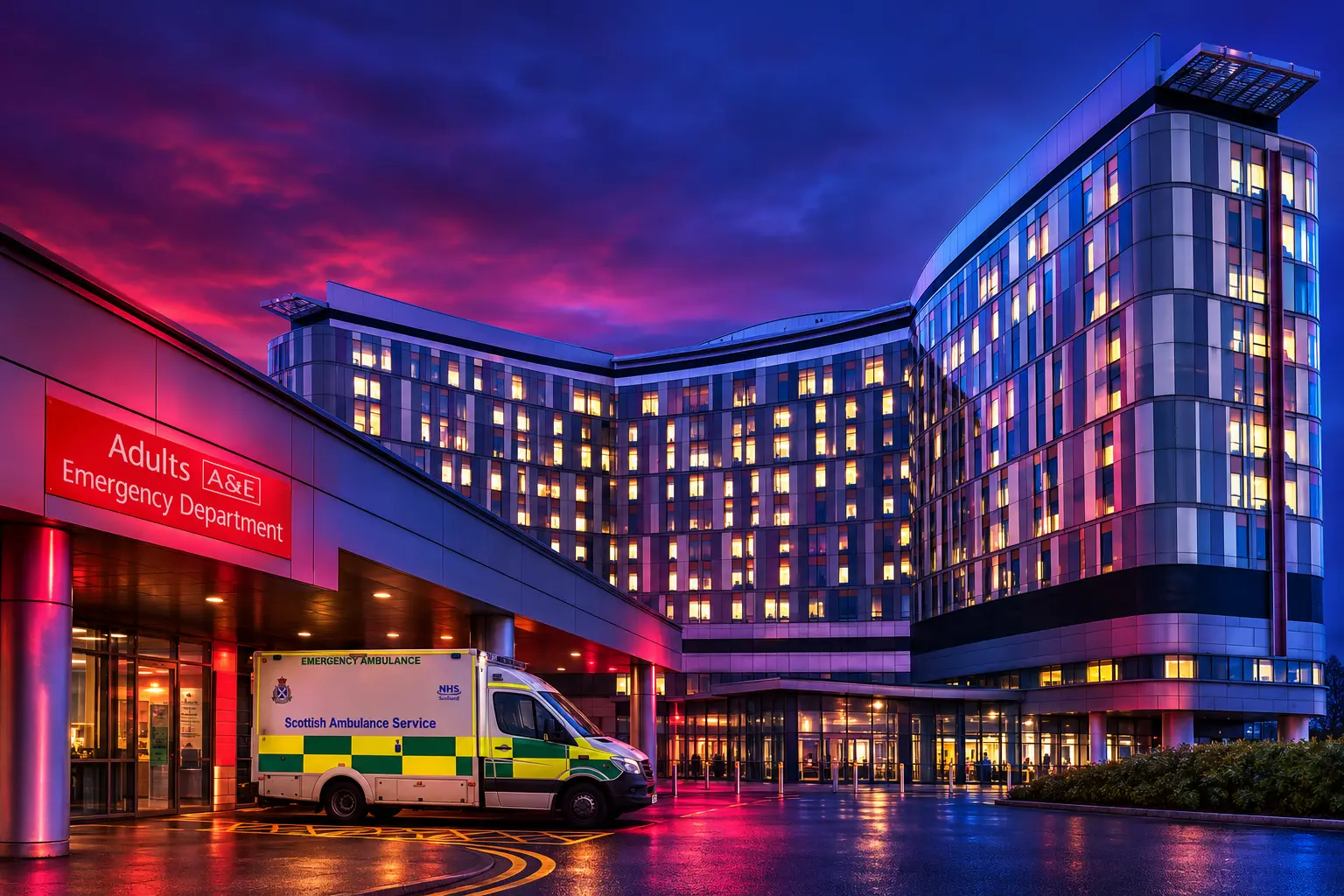
Every A&E consultant at Glasgow’s QEUH has told the watchdog that overcrowding now causes daily harm, months after a 41-recommendation review.

Every emergency consultant at Glasgow’s Queen Elizabeth University Hospital has told Scotland’s health watchdog that patient harm in A&E is now a daily reality. Their letter, sent on 10 July 2026 to Healthcare Improvement Scotland, says overcrowding has worsened since a review published on 27 March 2025, and that staff are moving patients out of resuscitation earlier than they would normally accept.
The board that runs the hospital says improvement work is still under way. First Minister John Swinney, asked about the letter on 10 November, called it an operational matter for NHS Greater Glasgow and Clyde.
Every Consultant Signed the Same Warning
The July letter went to Eddie Docherty, Healthcare Improvement Scotland’s director of quality assurance and regulation. It came from the entire emergency consultant body at the QEUH, Scotland’s biggest hospital, more than a year after the watchdog’s last published review of the department.
The consultants wrote that harm tied to long delays, crowding and exit block is no longer a theoretical risk. Admission waits from A&E can now run past 24 hours before a patient gets a proper inpatient bed. Staff, they said, are working under pressure that carries the risk of system failure beyond their control, and they see no effective plan that matches the scale of the problem.
Patient harm associated with prolonged delays, overcrowding and exit block is not only a theoretical risk but a daily reality for staff.
QEUH emergency consultants, letter to Healthcare Improvement Scotland, 10 July 2026
They said they are forced to step people down from resuscitation bays sooner than would normally be judged safe, then pick other patients for corridor care on wards, because the department is stuck in sustained overcapacity. Daily operational handovers that already go to NHSGGC executives use a short, blunt vocabulary.
WORDS IN THE DAILY HANDOVERS
- Unsafe department: The phrase is used as a routine status, not a one-off alert.
- Gridlock and overcapacity: The department cannot move patients on, so new arrivals stack up.
- Patient harm: Harm is logged in the same notes that go to executives, alongside poor flow and low morale.
- Lack of escalation: Staff say the system above the shop floor is not gripping the surge when it hits.
Those notes matter because they close the usual excuse that nobody at the top had been told. The same executives who receive the handovers are now being told, in a letter to the regulator, that the harm is daily.
The 2025 Review Already Named the Same Failures
None of this arrived from nowhere. A group of QEUH emergency consultants first took safety concerns to Healthcare Improvement Scotland in May 2023. The watchdog later upheld complaints about how those concerns were handled and apologised in March 2024, then opened a review of the three main emergency departments in NHS Greater Glasgow and Clyde: the QEUH, Glasgow Royal Infirmary and the Royal Alexandra Hospital in Paisley.
The review, co-chaired by Dr Pamela Johnston, a former medical director at NHS Tayside, and Professor Hazel Borland, a former nurse director at NHS Ayrshire and Arran, was published on 27 March 2025. It made 41 recommendations, 30 of them for NHSGGC and 11 for government and national bodies. It found crowding and poor patient flow across the three sites, weak visible leadership on the A&E problem, and a culture of disrespectful behaviour, poor teamwork and incivility that was likely to have damaged patient care, above all at the QEUH.
Inspectors also recorded a practice the review said had become normal: patients waiting on trolleys in corridors. At the QEUH, ambulance stacking outside the department had become a standard answer to crowding. Johnston said every member of staff the team met wanted safer care, but that goodwill erodes when people do not feel valued or respected, and that the board needed a whole-system plan that started with staff working together.
A staff survey run for that review in November 2024 drew 114 responses, 64 of them from the QEUH. Some staff called the working environment brutal. One described being haunted by cases in which patients had been harmed. On 30 June 2025, then health secretary Neil Gray wrote that the Scottish Government accepts nine of the recommendations made at national level and partially accepts two. The First Minister had already welcomed the report and said A&E performance data was improving. The July 2026 letter is the consultants’ verdict on what followed.
THE PAPER TRAIL SINCE 2023
- May 2023: QEUH emergency consultants raise safety concerns with Healthcare Improvement Scotland.
- March 2024: The watchdog apologises after complaints about its first handling of those concerns.
- 27 March 2025: The review publishes 41 recommendations and finds corridor care and a serious breakdown in relationships at the QEUH.
- 30 June 2025: Ministers accept nine national recommendations and partially accept two.
- 10 July 2026: The whole consultant body writes that conditions have kept getting worse.
- November 2026: Healthcare Improvement Scotland says it will meet frontline staff and test progress against the 2025 list.
The QEUH has lived through this pattern before. The campus opened in 2015. In 2019 the board was put into stage 4 escalation, the strongest form of special measures, over infections and patient safety. Staff who raised building and water problems said they were not heard. The A&E letter is a different clinical failure, but it is the same sequence: clinicians warn, a review is commissioned, the file thickens, and the department stays unsafe.
How Long Patients Wait at the QEUH
Public Health Scotland figures put 12-hour waits at the QEUH at 5,961 in the first ten months of 2026. That is a 33 percent rise on the total for the whole of 2025. In the week to 25 October 2026, 1,135 patients at the department waited more than four hours to be seen, admitted or sent home, 501 waited more than eight hours, and 223 were still there after 12 hours.
QEUH WAITS IN THE WEEK TO 25 OCTOBER 2026
| Wait in the emergency department | Patients |
|---|---|
| More than 4 hours | 1,135 |
| More than 8 hours | 501 |
| More than 12 hours | 223 |
Those are counts for one hospital in one week, before the winter peak. Across Scotland the picture is already well below the standard ministers still cite. In September 2026 there were 147,945 A&E attendances, and 64.9 percent of A&E attendances ended in admission, transfer or discharge within four hours. The standard is 95 percent. Compliance has sat under 80 percent since summer 2021.
SCOTLAND A&E IN SEPTEMBER 2026
- Four-hour standard: 64.9 percent completed within four hours, against a 95 percent target.
- Waits over 8 hours: 20,138 patients, 13.9 percent of attendances.
- Waits over 12 hours: 8,658 patients, 6 percent of attendances.
- Trend: National four-hour performance has been under 80 percent since summer 2021.
Health Secretary Angela Constance said on 9 November that current waiting times are not acceptable, and that people should use GPs and pharmacies when that is the right door. The consultants’ letter is about the other end of the building: patients who already need a bed, and who are losing hours in A&E because the hospital cannot empty itself.
One Extra Death for Every 72 Long Waits
The letter told Healthcare Improvement Scotland there is now validated evidence that prolonged crowding and exit block raise death rates. The Royal College of Emergency Medicine has put a number on that risk for Scotland as a whole. Using a standard mortality ratio of one extra death for every 72 patients who wait eight to 12 hours before admission, the college estimated 818 associated excess deaths in 2024 among people who spent 12 hours or more in A&E before they were admitted.
That 2024 count sat on 76,510 twelve-hour waits, 58,906 of them people waiting for a ward bed, and was 202 higher than the 2023 estimate. The college called it 16 lives a week. Dr Fiona Hunter, its vice president for Scotland, said the people behind the figure were on trolleys in corridors, cupboards, or any floor space that was left, waiting for a bed that should already have been theirs.
The fact that the deaths of more than 800 patients have been lost due to a system in crisis is a national tragedy. It doesn’t have to be this way, the crisis is fixable and it comes down to patient flow in hospitals.
Dr Fiona Hunter, Vice President for Scotland, Royal College of Emergency Medicine
The 818 figure is a national estimate for 2024, not a body count for the QEUH. It is the method the consultants pointed to when they said crowding is no longer a comfort argument. If the ratio holds, each week of 501 eight-hour waits at one site is not a performance miss. It is a mortality risk sitting in a corridor.
A Culture Report Still Withheld From Staff
The 2025 review said poor relationships at the QEUH were blocking the board’s ability to fix the clinical problems. After it was published, NHSGGC commissioned a further independent look at culture and relationships in the department, led by Professor Tracy Myhill. Consultants say staff took part after being told a summary would follow.
That review, they wrote, included a report from clinical psychologists on the damage done by long exposure to risk and stress. They understand that document reached NHSGGC executives in December 2024. The letter states that, despite repeated requests from the department’s clinical director, the report remains withheld.
A recent survey of the department’s consultants scored their overall experience of working there at 3.5 out of 10. Confidence and trust in the health board’s leadership scored 32 out of 100. Those numbers sit beside Johnston’s 2025 warning that goodwill dies when staff do not feel respected. Eighteen months later the people who run resuscitation at the site still say they do not trust the people who run the board.
Healthcare Improvement Scotland said it takes the concerns seriously, has told Scottish Government colleagues, and will meet frontline staff during November to check progress against the 2025 recommendations. It also said it is for NHSGGC to put the changes in place, and that it would not comment in detail on the correspondence while that follow-up is live. The watchdog that already found a relationship collapse is now being asked, by the same doctors, to look again because the collapse is still in the building.
Patients Ready to Leave Still Occupy the Beds
NHS Greater Glasgow and Clyde said it recognises that some patients still wait too long in the emergency department, especially when the hospital is full and people who are clinically ready to leave cannot go. It said a programme of improvement work is continuing, that further support is required at the QEUH, and that a refreshed whole-system approach is a priority. Patient safety, it said, remains its highest priority.
That diagnosis matches the consultants on one point and ducks them on another. Exit block, patients stuck on wards after they are medically fit, is the plug in the sink. While those beds stay taken, A&E cannot send anyone upstairs, resuscitation cannot be kept for the next crash call, and the corridor becomes a ward. Hunter’s college has said the same thing in plainer words: get people out of A&E into a bed, and get people who are well enough out of hospital.
Constance’s appeal to use GPs and pharmacies is aimed at the front door. The July letter is about the back door. A patient who needed to advocate around the clock for a relative later described the hospital as terrifying. That is what corridor care feels like from a plastic chair, not from a board paper. Treating the warning as a dispute about footfall in A&E misses the people already inside who cannot leave, and the people in resus who are being moved to make space.
Swinney Calls It Operational as Winter Arrives
On 9 November, Constance called the consultants’ account a very distressing picture and said she would raise it with both NHSGGC and Healthcare Improvement Scotland. Pressed on whether the QEUH should go into special measures, she said she always keeps an open mind about what is required, and that winter needs more than one fix. The campus has been in special measures before. She did not rule it out this time.
Swinney told parliament the next day that the letter is an operational matter for Greater Glasgow and Clyde, and that engagement with clinicians has to happen there so the concerns are addressed. Scottish Liberal Democrat health spokesman Adam Harley MSP called the letter chilling and said ministers need to intervene. On 11 November, Scottish Labour health spokesperson Dame Jackie Baillie said Swinney should take some responsibility for what is happening in Scotland’s hospitals.
Calling a resus step-down policy operational is a way of leaving it with the board that the 2025 review already said lacked grip. Healthcare Improvement Scotland’s November visits will test whether any of the 41 recommendations have moved. Until that follow-up is published, the consultants’ own measure still stands: patients are coming to harm every day in the department that was supposed to have been fixed last year, and the culture report they sat for is still on a shelf.
Disclaimer: This article is news reporting on public statements by clinicians, NHS bodies and ministers. It is for information only and is not medical advice, a diagnosis, or a judgement on any individual patient’s care. It is not a substitute for advice from a doctor, nurse, NHS 24 or another qualified clinician, and it is not guidance on whether any person should attend A&E. Anyone with life-threatening symptoms should call 999 or go to emergency care; waiting-time figures, review findings and board statuses are those given by the named bodies on the dates cited and may be revised.

Falling Shot Rates Cost the U.S. Measles Elimination Status

NHS Record Snooping Gives Patients a Reason to Withhold

FDA Rejects Ivonescimab After the HARMONi Survival Miss

The Medicaid Work Delay Leaves January Checks Intact

Pelacarsen Cut Lp(a) 78%, and Heart Attacks Did Not Fall

Pennsylvania Measles Deaths Collide With Falling MMR Coverage

FDA Approves XFG COVID Vaccines While the Advice Panel Is Frozen

Progranulin and JAK2 Split the Macrophages That Heal

Alnylam Defends Amvuttra After Wainua’s ATTR-CM Trial Miss

Muscle-Boosting Drugs Near Approval for Children With SMA
-
 NEWS3 months ago
Pennsylvania Measles Deaths Collide With Falling MMR Coverage
-
 NEWS3 months ago
FDA Approves XFG COVID Vaccines While the Advice Panel Is Frozen
-
 NEWS3 months ago
Progranulin and JAK2 Split the Macrophages That Heal
-
 FITNESS3 months ago
Muscle-Boosting Drugs Near Approval for Children With SMA
-
 NEWS3 months ago
Alnylam Defends Amvuttra After Wainua’s ATTR-CM Trial Miss
-

 MENTAL HEALTH3 months ago
After the ADHD Invoice, GPs and Waiters Carry the Cost
-

 NEWS2 months ago
Rasonque’s List Price Shifts the Pancreatic Cancer Bill
-

 NEWS3 months ago
FDA Flagged This Sprout Plant 16 Months Before the Outbreak