
FOOD
Cargill’s $60 Million Thai Line Targets Cooked Exports
Cargill’s $60 million Thai spend builds cooked-chicken export capacity under Japan’s 70°C heat rule, with a Saraburi line due in 2028.

Cargill is putting Bt2bn ($60m) into cooked chicken in Thailand, with a new automated line at its Saraburi plant due in 2028. The Minnesota company said cooked poultry volume should rise to about 160,000 metric tons, bring in Bt25bn in extra export revenue, and add 300 local jobs. From Thailand it already ships cooked chicken to foodservice and retail buyers in Japan, Europe, and North America.
Cooking is the ticket those markets still accept when raw Thai poultry is blocked by bird-flu rules.
Cargill Puts 2 Billion Baht Into Thai Cooked Chicken
The package is not one machine. Cargill said it covers capacity and efficiency across its Thai poultry network, plus food safety, quality, and new products. Some of the money goes into what the company called “advanced technologies” such as AI, to trim process time and cost.
Cargill Meats Thailand runs a farm-to-fork supply chain in Saraburi and Nakhon Ratchasima, the city locals call Korat. The company has been in the country since 1968 and now employs 15,000 people across protein, feed, grains, and ingredients. Protein is its largest Thai business. Export customers sit in Japan, Hong Kong, Europe, and Canada. At home it sells under the Sun Valley brand.
WHAT THE 2 BILLION BAHT BUYS
- Saraburi cook line: A new automated production line for cooked chicken at the plant less than a two-hour drive from Bangkok, due for completion on an unspecified date in 2028.
- Korat grain silo: A 30,000-metric-ton silo for chicken feed beside an existing mill in Nakhon Ratchasima, due in December 2026.
- Export volume: Cooked poultry output expected to increase to about 160,000 metric tons, with Bt25bn in extra export revenue and 300 local jobs.
- AI over two years: Data processing for faster, more accurate decisions, plus help with food quality and safety management.
Watcharapon Prasopkiatpoka, Cargill’s vice president and poultry managing director for Asia-Pacific, tied the spend to buyers who want a partner that can scale.
Demand for high-quality protein continues to grow across global markets, and customers are looking for reliable innovation partners who can help them scale with confidence. This investment strengthens our ability to deliver poultry products with the quality and consistency our customers need.
Watcharapon Prasopkiatpoka, VP and poultry managing director for APAC, Cargill statement
Hiring on the ground started before the statement. In May 2026 Cargill was already advertising poultry research roles in Saraburi, months before it put a baht figure on the cook line.
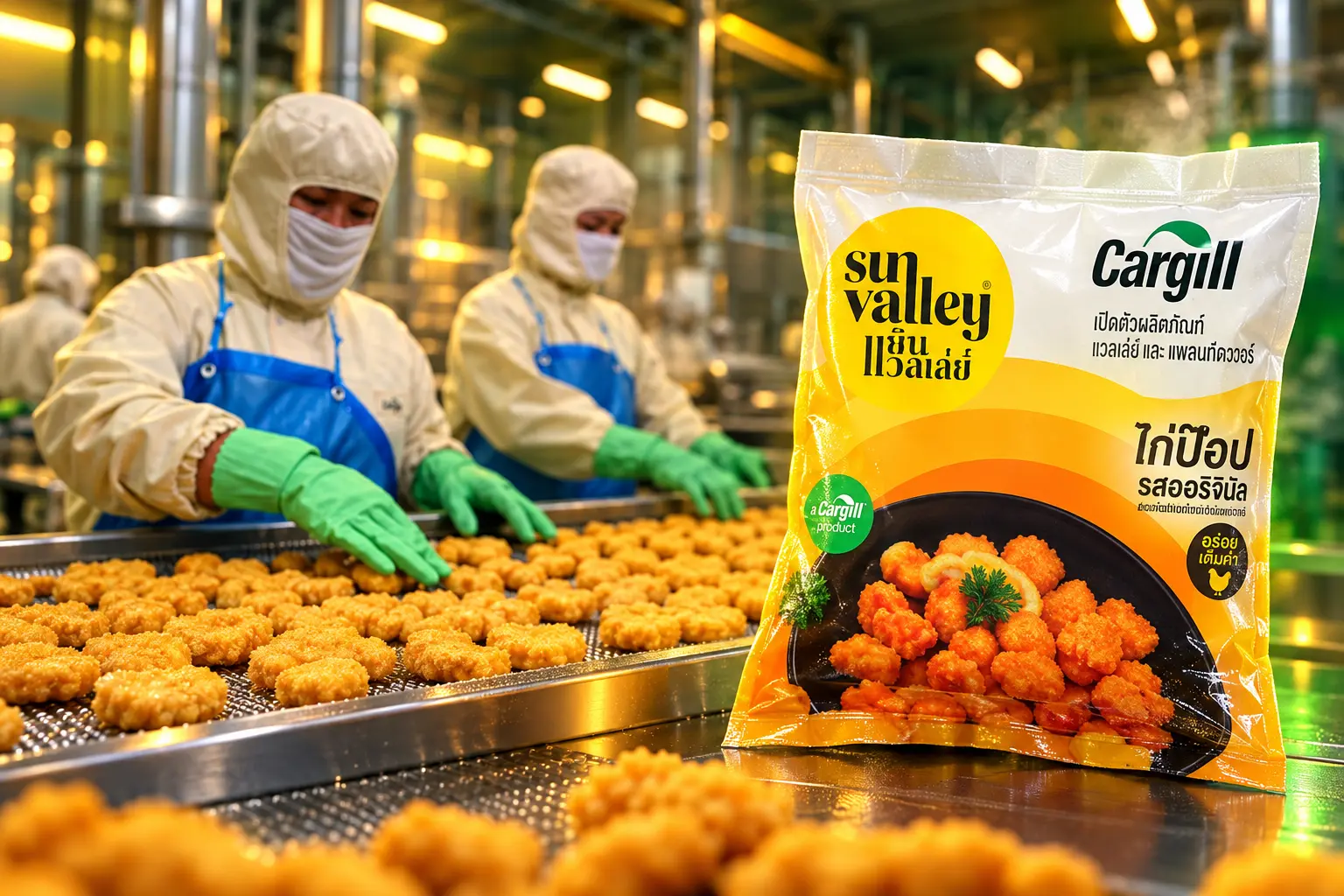
Why Japan Will Take the Chicken Once It Is Cooked
Japan does not treat raw Thai poultry and heat-treated Thai poultry as the same product. Animal health rules from Japan’s Ministry of Agriculture, Forestry and Fisheries set a hard cook for meat that leaves Thailand for Japanese ports. Heat processing means holding the center of the meat at 70°C or higher for one minute or more, inside a plant Japan has inspected and listed.
That rule is older than this spend. Japan wrote it for Thai plants on 23 February 2004 and last amended it on 28 September 2016. The farm that raised the bird must have had no outbreak of notifiable avian influenza, Newcastle disease, fowl cholera, or pullorum/gallinarum salmonella for at least 21 days before slaughter. The cook plant must split raw rooms from cooked rooms, log heat records for two years, and take a visit from Thai animal-health officials at least once every six months. If a listed plant slips, exports from that plant stop.
The same temperature shows up in public-health advice, for a different job. FAO and WHO say cooking poultry through to 70°C kills H5N1 in meat. Japan’s one-minute center hold is a trade gate for designated factories, not a home-kitchen timer, and both sit at the same number because the virus does not survive that heat.
FAS/Tokyo, in its 30 September 2025 poultry annual, said Japan’s chicken market should stay steady in 2026 and that imports of prepared chicken products are expected to rise. Labor shortages and the cost of processing inside Japan are pushing foodservice toward chicken that arrives already cooked. A new Saraburi line that Japan can list is how Cargill stays in that queue.
Thailand Already Leads the World in Processed Chicken
Thailand is a mid-size chicken producer and a large cooked-chicken seller. Krungsri Research, in its November 2025 outlook, put 2024 Thai chicken-meat output at 3.4 million tons, 3.3% of world supply and seventh globally. The same note called Thailand the world’s largest exporter of processed chicken by volume, with a 26.3% world share, ahead of China, Poland, and Germany.
Processed product, not frozen raw cuts, now carries most of the country’s chicken export weight.
THAI CHICKEN EXPORTS, 2024
| Product | Volume | Share of Thai chicken exports | Leading market in that class |
|---|---|---|---|
| Processed (cooked and further) | 0.68 million tons | 59.0% | Japan, 44.5% |
| Frozen | 0.46 million tons | 40.3% | Japan, 38.5% |
| Chilled | 7,500 tons | 0.7% | Myanmar and nearby |
| All chicken products | 1.15 million tons (USD 4.31 billion) | 100% | Japan first in processed and frozen |
Processed volume rose 13.8% in 2024, Krungsri said, and receipts reached USD 2.95 billion even after average prices fell 5.4% to USD 4,354.0 a ton. After Japan, the next processed buyers were the United Kingdom at 29.4%, the Netherlands at 6.6%, and South Korea at 4.3%. Frozen still moves to China and Malaysia as well as Japan. Chilled is a rounding error.
Saraburi is already chicken country. In 2023 it supplied 7.8% of national broiler output, fifth among Thai provinces, according to the same Krungsri note drawing on the Office of Agricultural Economics. Cargill’s cook line sits in a province that already grows the birds. Krungsri expects Thai chicken exports to expand 3.7% to 4.7% a year from 2026 to 2028, helped by buyers who treat Thai plants as a safe source when bird flu hits other exporters. Broiler numbers are projected at 2.05 to 2.15 billion head a year over that stretch.
A 30,000-Ton Silo for Isaan Grain
The other Thai project is feed, not frying. Work is already under way on a 30,000-metric-ton grain silo at Cargill’s Nakhon Ratchasima site in Isaan, the north-east. It sits next to an existing feed mill. Cargill said the silo will “enhance raw material storage capabilities and provide greater flexibility in grain procurement throughout the year, while creating additional income opportunities for local farmers beyond the traditional harvest season.” Completion is due in December 2026.
That matters for cooked export as much as for farm cash. A cook plant that Japan inspects cannot run empty. Extra grain storage lets Cargill buy Thai corn and other feed ingredients after harvest and hold them, instead of living harvest-to-harvest. The company said the wider package will also lift buying of domestic raw materials and services, including feed ingredients, grains, seasonings, and packaging.
Nakhon Ratchasima already sits inside Cargill’s integrated chain: breeder farms, hatcheries, feed, grow-out, and processing. The silo does not add a new geography. It adds a buffer so the 2028 cook line is not hostage to a single harvest window.
AI Goes on the Food-Safety Line
Cargill said some of the Bt2bn will go into AI over the next two years. The jobs it named are paperwork and control, not a robot chef. Data processing is supposed to speed decisions. A second use is food quality and safety management, the files a listed cook plant has to keep if it wants to stay on Japan’s register.
WHERE THE COMPANY SAYS AI WILL SIT
- Plant data: Faster, more accurate decisions on production and cost, according to Cargill’s statement.
- Quality and safety: Help managing food quality and safety, the same records Japanese inspectors can ask to see.
- Network, not one room: Capacity and efficiency upgrades across the whole Thai poultry network, not only the new Saraburi line.
For people who eat the chicken, the health claim is older than the software. WHO says meat can be safely consumed if cooked properly, and that raw or undercooked meat from outbreak areas should be avoided. FAO, in a 2024 rapid assessment of foodborne H5N1, put the risk of people catching the virus from food at negligible and repeated that 70°C cooking renders the virus non-infectious. Cargill’s AI spend is aimed at the factory logs that prove a plant hit that heat, every batch, for buyers in Japan, Europe, and North America.
Milwaukee Closed 221 Ground-Beef Jobs in May
The Thai hire sheet sits next to two U.S. closures Cargill has already finished. In February 2026 the company said it would shut a Milwaukee ground-beef plant, removing 221 jobs. Production stopped on or around 17 April 2026 and the site was fully closed by the end of May. Cargill said the move was “to better align our portfolio with current customer demand and prioritise investments where they are needed most for the future,” and that ground-beef volume would shift to other North American plants, including Butler, Wisconsin.
On 1 August 2025 it closed a turkey plant in Springdale, Arkansas. About 1,000 plant workers lost those jobs, and about 100 local growers lost a buyer. Cargill called it “the right move to make for the future of our turkey business” and shifted volume to plants in Missouri and Virginia.
CARGILL PROTEIN MOVES, 2025 TO 2028
| Site | Action | Jobs | Timing |
|---|---|---|---|
| Saraburi, Thailand | New automated cooked-chicken line | 300 local jobs (company figure) | Due 2028 |
| Nakhon Ratchasima, Thailand | 30,000-metric-ton feed silo | Extra grain income for local farmers (no headcount given) | Due December 2026 |
| Milwaukee, Wisconsin | Ground-beef plant closed | 221 jobs removed | Closed end of May 2026 |
| Springdale, Arkansas | Turkey plant closed | About 1,000 plant workers; about 100 growers | Closed 1 August 2025 |
The 300 Thai jobs do not replace the U.S. cuts, and Cargill did not present them that way. Milwaukee packed ground beef. Springdale packed turkey. Saraburi will pack cooked chicken for export. The common thread is where the company is willing to put capital: a listed cook plant that can still enter Japan after a flu scare, not a U.S. turkey line it has already left.
The silo in Isaan is due first, in December 2026. The Saraburi cook line is due in 2028. Until then the 15,000 people Cargill already employs in Thailand keep shipping cooked chicken through plants Japan, Europe, and North America already know how to inspect.

Europe’s Heat Killed 50,391 in Cities Official Counts Still Miss

Caesarean Surge Puts 20 England Maternity Units at Risk

The Protective Ring Around Care Homes Never Existed

Cooper Prioritises Children’s Corridor Care Without an Age Count

Oxford’s Ebola Vaccine Reaches Uganda as Doses Sit Unused

Pennsylvania Measles Deaths Collide With Falling MMR Coverage

FDA Approves XFG COVID Vaccines While the Advice Panel Is Frozen

Muscle-Boosting Drugs Near Approval for Children With SMA

Progranulin and JAK2 Split the Macrophages That Heal

After the ADHD Invoice, GPs and Waiters Carry the Cost
-
 NEWS2 months ago
Pennsylvania Measles Deaths Collide With Falling MMR Coverage
-
 NEWS2 months ago
FDA Approves XFG COVID Vaccines While the Advice Panel Is Frozen
-
 FITNESS2 months ago
Muscle-Boosting Drugs Near Approval for Children With SMA
-
 NEWS2 months ago
Progranulin and JAK2 Split the Macrophages That Heal
-
 MENTAL HEALTH2 months ago
After the ADHD Invoice, GPs and Waiters Carry the Cost
-
 NEWS2 months ago
Rasonque’s List Price Shifts the Pancreatic Cancer Bill
-
 NEWS2 months ago
Pennsylvania’s Two Measles Deaths Follow a Long Coverage Slide
-
 NEWS2 months ago
FDA Flagged This Sprout Plant 16 Months Before the Outbreak