
NEWS
Falling Shot Rates Cost the U.S. Measles Elimination Status
PAHO withdrew U.S. measles elimination after 12 months of the same virus lineage, a verdict that tracks kindergarten MMR coverage now stuck at 92.4%.

The Pan American Health Organization withdrew the United States’ measles elimination status on Nov. 17, 2026, after the same virus lineage spread without a break for at least 12 months. CDC figures show 5,412 confirmed measles cases as of Nov. 12, the highest annual total since 1991.
The finding ends a designation first granted in 2000. It also timestamps a slower failure: kindergarten MMR coverage that has sat under the 95% line that stops community spread.
PAHO Pulls a Designation the U.S. Held Since 2000
PAHO Director Jarbas Barbosa accepted the recommendation of the Measles, Rubella and Congenital Rubella Syndrome Elimination Regional Monitoring and Re-Verification Commission, which met Nov. 10 through Nov. 13. Under the commission’s rule, endemic spread is back when the same measles virus genotype and lineage circulate without interruption for 12 months or more in a country. Bolivia and Mexico lost the status on the same review.
Elimination never meant zero imported infections. Travelers can still bring measles in, and short outbreaks can be stopped without costing the designation. The lost status means one lineage kept moving long enough to be treated as domestic, not a string of separate imports.
Losing measles elimination status is much more than losing a public health designation. It means the virus has circulated for a prolonged period, putting families and communities at risk of preventable illness, hospitalization and death.
Jarbas Barbosa, Director, Pan American Health Organization
PAHO’s own account of the decision is on the record here:
🔴 PAHO called on countries across the Americas to intensify efforts to stop measles transmission. 🇧🇴 Bolivia, 🇲🇽 Mexico, and the 🇺🇸 United States have lost their #measles elimination status.
🔗 https://t.co/6JOfvJf5po pic.twitter.com/W7CmV5DB9L
— PAHO/WHO (@pahowho) November 17, 2026
As of Nov. 13, the Region of the Americas had 58,213 confirmed cases and 82 deaths, against 12,806 cases in the same stretch of 2025. One infected person can pass measles to as many as 18 people who are not immune. The illness can bring pneumonia, brain inflammation, and blindness, and it can weaken the immune system for months afterward.
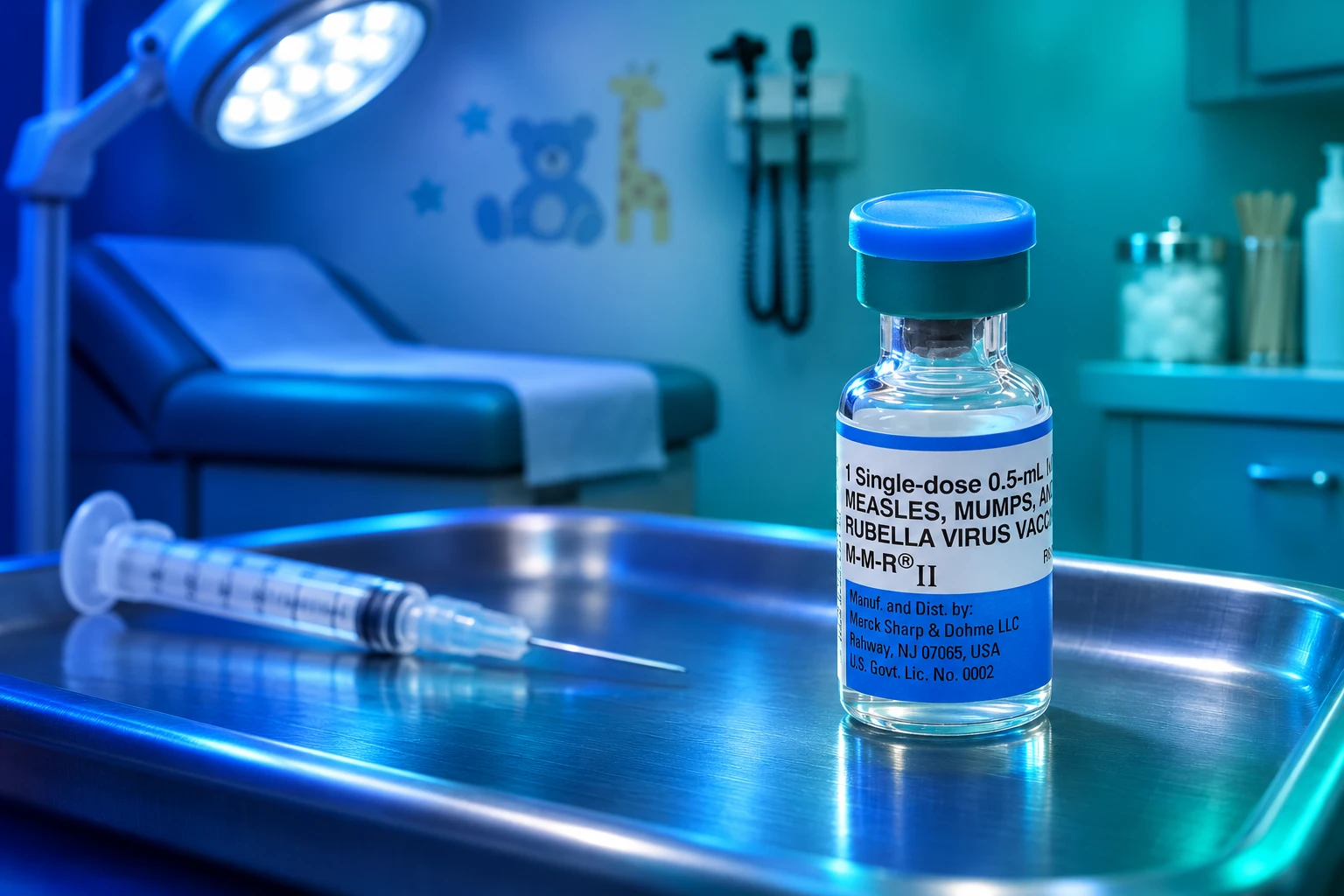
Kindergarten MMR Coverage Sat at 92.4% Last School Year
CDC SchoolVaxView data for 2025-26 put national MMR coverage among kindergartners at 92.4%, matching polio coverage and sitting above DTaP at 92.0%. That is down from 95.2% in 2019-20, the last school year at the herd-immunity line, and from 92.7% in 2023-24. About 280,000 kindergartners were in class without proof they had finished the MMR series.
Exemptions from one or more shots rose to 4.2% from 3.6% the year before, about 155,000 children. Those two figures are not the same group. An exemption is a formal opt-out. The larger 280,000 count also includes missing records and unfinished series. Exemptions rose in 41 states and Washington, D.C., and 24 states now report rates above 5%.
KINDERGARTEN PROTECTION, 2025-26
| Measure | Figure | Why it matters |
|---|---|---|
| National MMR coverage | 92.4% | Below the 95% two-dose line used to stop community spread |
| Coverage in 2019-20 | 95.2% | Last school year at the herd-immunity threshold |
| Kindergartners without MMR documentation | About 280,000 | Includes missing records and unfinished series |
| Exempt from one or more vaccines | 4.2% (about 155,000) | Up from 3.6% the prior school year |
| Idaho MMR coverage | 75.2% | Lowest state figure in the CDC table |
| West Virginia MMR coverage | 98.9% | Highest state figure in the same table |
KFF’s read of the same CDC table found 39 states had MMR vaccination rates below 95%. National averages hide the pockets that actually catch fire. PAHO’s notice said those gaps, missed shots, and hesitancy leave children, teens, and adults open to infection even when a state looks fine on paper.
Two MMR doses are 97% effective against measles; one dose is 93%. CDC still recommends the first dose at 12 through 15 months and the second at 4 through 6 years. The coverage slide CDC now cites began with COVID-era disruptions to routine childhood shots, years before the current HHS leadership took office. That timing does not change the arithmetic. A 2.8-point drop from 95.2% is enough, in clustered communities, to let a lineage run a full year.
Pennsylvania Logged 1,529 Cases, the Largest State Total
Of the 5,412 confirmed 2026 cases, 5,394 came from 47 jurisdictions and 18 from international visitors. CDC counted 43 outbreaks, defined as three or more related cases, and 96% of infections (5,216 of 5,412) were outbreak-linked: 3,831 from outbreaks that started this year and 1,385 from outbreaks that started in 2025. The full-year 2025 total was 2,289 cases across 48 outbreaks.
Pennsylvania reported 1,529 cases, the largest state number on CDC’s table, ahead of Kentucky (212), Ohio (211), and New York State (210). That load grew out of low vaccination pockets in Pennsylvania that had already produced hundreds of infections earlier in the surge. The national measles count hit 4,080 while those school-year gaps were still widening.
THE 2026 CASE FILE, AS OF NOV. 12
| Measure | 2026 to date | 2025 full year |
|---|---|---|
| Confirmed cases | 5,412 | 2,289 |
| Share unvaccinated or unknown | 96% | 93% |
| Two documented MMR doses | 2% | 4% |
| Hospitalized | 11% (591) | 11% (244) |
| Under 5 years | 951 (18%) | 584 (26%) |
| Ages 5-19 | 2,183 (40%) | 1,018 (44%) |
| Ages 20 and older | 2,240 (41%) | 674 (29%) |
| CDC-counted deaths | 6 | 3 |
Adults now make up a larger share than they did in 2025, which is what a long, uncontained run looks like once the virus leaves child-heavy clusters. Among children under 5, 17% of cases were hospitalized (160 of 951). CDC lists 6 measles-associated deaths in 2026. State health departments have confirmed 10 in the same year: 7 in Pennsylvania, 1 in New York, and 2 in Wisconsin. Those are separate tallies. CDC says it is working with the Council of State and Territorial Epidemiologists on a shared death definition, a gap that already showed up in Pennsylvania deaths missing from the CDC count.
How a Country Wins Measles Elimination Back
A country gets the designation back by showing interruption of endemic transmission for 12 months, backed by vaccination, lab work, and outbreak response, not by a press conference. PAHO officials have said the United States is expected to file a corrective action plan in the coming weeks that spells out how it will stop the current lineage. The 12-month clock does not start on the announcement. It starts when that lineage actually goes quiet.
THE PATH BACK TO ELIMINATION
- 2000: The United States is verified as having interrupted endemic measles spread.
- 2019: Almost 1,300 U.S. cases, many tied to a large New York outbreak, come close to costing the status.
- 2018-2019: Endemic spread is re-established in Venezuela, then Brazil; the Americas later lose and then rebuild regional verification.
- 2024: The region is again verified measles-free after Brazil and Venezuela interrupt transmission.
- November 2025: Canada’s 12-month chain costs the country, and the region, measles-free verification.
- Nov. 10-13, 2026: The regional commission reviews U.S., Mexican, and Bolivian evidence.
- Nov. 17, 2026: Barbosa accepts the finding that endemic spread has been re-established in all three countries.
PAHO notes that Canada has since interrupted the chain that cost it the status and is working through the regain process. That is the same sequence now in front of Washington: stop this lineage, keep surveillance tight enough to prove the stop, and hold two-dose coverage at 95% in every community, not as a national average.
Canada Already Lost, and Mexico and Bolivia Followed
The Americas were the first region in the world to eliminate measles, then did it a second time. Regional status came back in 2024 after Venezuela and Brazil closed long outbreaks. It fell again in November 2025 when Canada crossed the 12-month line. The U.S. loss does not reset that regional clock by itself. It makes the climb back steeper because three large countries are now in the regain queue at once.
Barbosa called the latest withdrawals a serious warning and said they are reversible. The commission’s own punch line was blunter. Elimination is not a trophy that sits on a shelf. It has to be protected every day by closing immunity gaps and reaching every community. Other WHO regions have been through the same paper cut. Armenia, Austria, Azerbaijan, Spain, the United Kingdom, and Uzbekistan are among the countries Kennedy listed as having lost elimination after COVID-era drops in routine shots.
Joseph Kanter, chief executive of the Association of State and Territorial Health Officials, put the domestic job in one sentence inside the CDC’s joint notice: the country cannot accept measles as an endemic disease again, and families deserve a sustained campaign to re-eliminate it. Local health departments are already on that campaign, case by case, in counties where the kindergarten rate never made the national average look dangerous.
CDC Sent $100 Million Before the Badge Came Off
CDC Director Erica Schwartz, confirmed in August, said the agency’s field work does not change because a designation moved. Health and Human Services Secretary Robert F. Kennedy Jr. said the United States will stop outbreaks, protect families, and work to regain the status, and that he continues to recommend MMR as the most effective prevention. Both names sit on the same Nov. 17 joint statement that still points families toward the shot.
The measles elimination designation is not what protects Americans. Vaccination does. We know where transmission is occurring and we’ve invested $100 million in state and local health departments to reach those communities. Losing a designation doesn’t mean we abandon an evidence-based approach. It means we remain focused on stopping outbreaks.
Erica Schwartz, CDC Director, joint statement, Nov. 17, 2026
Since August, CDC has sent about $100 million in state and local health departments to strengthen prevention and response through most of 2027.
WHERE THAT FUNDING AND HELP WENT
- Vaccine-preventable disease agreement: $50.2 million to find emerging risks, close vaccination gaps, build community partnerships, and support rapid outbreak response.
- Epidemiology and laboratory capacity: $49.8 million to strengthen prevention, preparedness, detection, and response.
- Epi-Aid teams already in: Texas, South Carolina, Virginia, Kansas, New Mexico, and Wisconsin asked CDC for field help and worked with federal teams on those outbreaks.
- Later requests: Pennsylvania and New York have since asked for the same Epi-Aid support.
The money and the teams are the practical answer to a paper loss. They do not restart the 12-month clock. Only a quiet lineage does that, and only 95% two-dose coverage in the pockets that have been feeding this outbreak will keep a new clock from starting the day after the old one ends. The corrective plan is due in the coming weeks. After that, the United States has to prove, with lab sequences and case investigations, that this lineage has actually stopped.
Frequently Asked Questions
What Does Measles Elimination Status Mean?
It means a country has stopped continuous local spread of a given measles strain for at least a year, with strong enough vaccination and surveillance to catch imports before they take root. It is not the same as eradication, which would mean zero measles worldwide. Limited outbreaks sparked by travel do not, on their own, cost the status.
How Does a Country Lose Measles Elimination Status?
PAHO’s commission treats endemic spread as re-established when epidemiological and laboratory evidence shows a chain of one viral strain, identical genotype and lineage, running for 12 months or more in a country or defined area. The date used to judge that 12-month run is not moved or extended; what can shift is when the commission meets to review a country’s file.
How Effective Is the MMR Vaccine Against Measles?
Two doses are 97% effective (range 67% to 100%) and one dose is 93% effective (range 39% to 100%). CDC considers people who got both childhood doses protected for life against measles, with no booster recommended for measles. About 3 in 100 people with two prior doses can still get infected after intense or prolonged exposure, usually with milder illness and less spread to others. The second dose may be given as soon as 28 days after the first.
Which Other Countries in the Americas Lost This Status Recently?
Canada lost measles elimination in November 2025, which also cost the Region of the Americas its regional verification. Bolivia, Mexico, and the United States lost national status on Nov. 17, 2026. Brazil’s last endemic case was recorded on June 5, 2022, and Venezuela’s on Aug. 11, 2019; both were later re-verified, which is why the region recovered its measles-free label in 2024 before Canada’s chain knocked it down again.
What Kindergarten MMR Rate Stops Measles From Spreading?
Health agencies use 95% two-dose coverage in every community, which is also Healthy People 2030 objective IID-04 for kindergartners. A national figure near 92% can still hide counties and school networks far below that line, which is why outbreaks keep starting in the same kinds of pockets even when most children in a state are vaccinated.
Disclaimer: This article is news reporting and analysis of public-health data and official statements. It is for information only and is not medical advice, a vaccination recommendation tailored to any reader, or a diagnosis of measles or any other illness. Talk with a licensed physician, pediatrician, or other qualified clinician before making decisions about MMR vaccination, outbreak exposure, or treatment. Case counts, death tallies, coverage rates, and elimination status are those published by the cited agencies as of the dates named in this story and can change as reviews are completed.

Falling Shot Rates Cost the U.S. Measles Elimination Status

NHS Record Snooping Gives Patients a Reason to Withhold

FDA Rejects Ivonescimab After the HARMONi Survival Miss

The Medicaid Work Delay Leaves January Checks Intact

Pelacarsen Cut Lp(a) 78%, and Heart Attacks Did Not Fall

Pennsylvania Measles Deaths Collide With Falling MMR Coverage

FDA Approves XFG COVID Vaccines While the Advice Panel Is Frozen

Progranulin and JAK2 Split the Macrophages That Heal

Alnylam Defends Amvuttra After Wainua’s ATTR-CM Trial Miss

Muscle-Boosting Drugs Near Approval for Children With SMA
-
 NEWS3 months ago
Pennsylvania Measles Deaths Collide With Falling MMR Coverage
-
 NEWS3 months ago
FDA Approves XFG COVID Vaccines While the Advice Panel Is Frozen
-
 NEWS3 months ago
Progranulin and JAK2 Split the Macrophages That Heal
-
 FITNESS3 months ago
Muscle-Boosting Drugs Near Approval for Children With SMA
-
 NEWS3 months ago
Alnylam Defends Amvuttra After Wainua’s ATTR-CM Trial Miss
-

 MENTAL HEALTH3 months ago
After the ADHD Invoice, GPs and Waiters Carry the Cost
-

 NEWS2 months ago
Rasonque’s List Price Shifts the Pancreatic Cancer Bill
-

 NEWS3 months ago
FDA Flagged This Sprout Plant 16 Months Before the Outbreak