
NEWS
U.S. Measles Count Hits 4,080 as School Shot Rates Fall
The United States has confirmed 4,080 measles cases in 2026, only 18 of them in visitors, after kindergarten MMR coverage fell to 92.4%.

The United States has confirmed 4,080 measles cases in 2026, the most since 1991, with only 18 of them in international visitors. The Centers for Disease Control and Prevention posted the tally on Oct. 9 from reports received through Oct. 8.
Ninety-five percent of patients were unvaccinated or had unknown shot status. Kindergarten MMR coverage in the 2025-26 school year sat at 92.4%, under the 95% line used to keep measles from spreading in a classroom.
Almost None of This Year’s Measles Was Imported
Of the 4,080 confirmed measles cases, 4,062 were reported by 47 jurisdictions: 45 states plus Washington, D.C., and New York City. The other 18 were in visitors from abroad. That is 0.44% of the national count.
CDC logged 42 outbreaks in 2026, defined as three or more related cases. Ninety-six percent of confirmed infections, 3,897 of 4,080, were tied to those clusters. Some 2,513 came from outbreaks that started this calendar year. Another 1,384 came from outbreaks that started in 2025 and never fully died out.
Last year finished at 2,289 cases, with 26 among visitors and 48 outbreaks. The 2026 total is already 78% above that full-year figure, and the calendar still has more than two months left. From 2024’s 285 cases and 16 outbreaks, the country has moved in two seasons from scattered import chains to a map that is mostly homegrown.
CDC added 193 cases from the prior week’s 3,887, a 5.0% rise. Children and teens 19 and younger make up 59% of patients: 710 under age 5 and 1,716 ages 5 to 19. Adults 20 and older account for 1,635 cases. Nineteen patients have no age on the report.
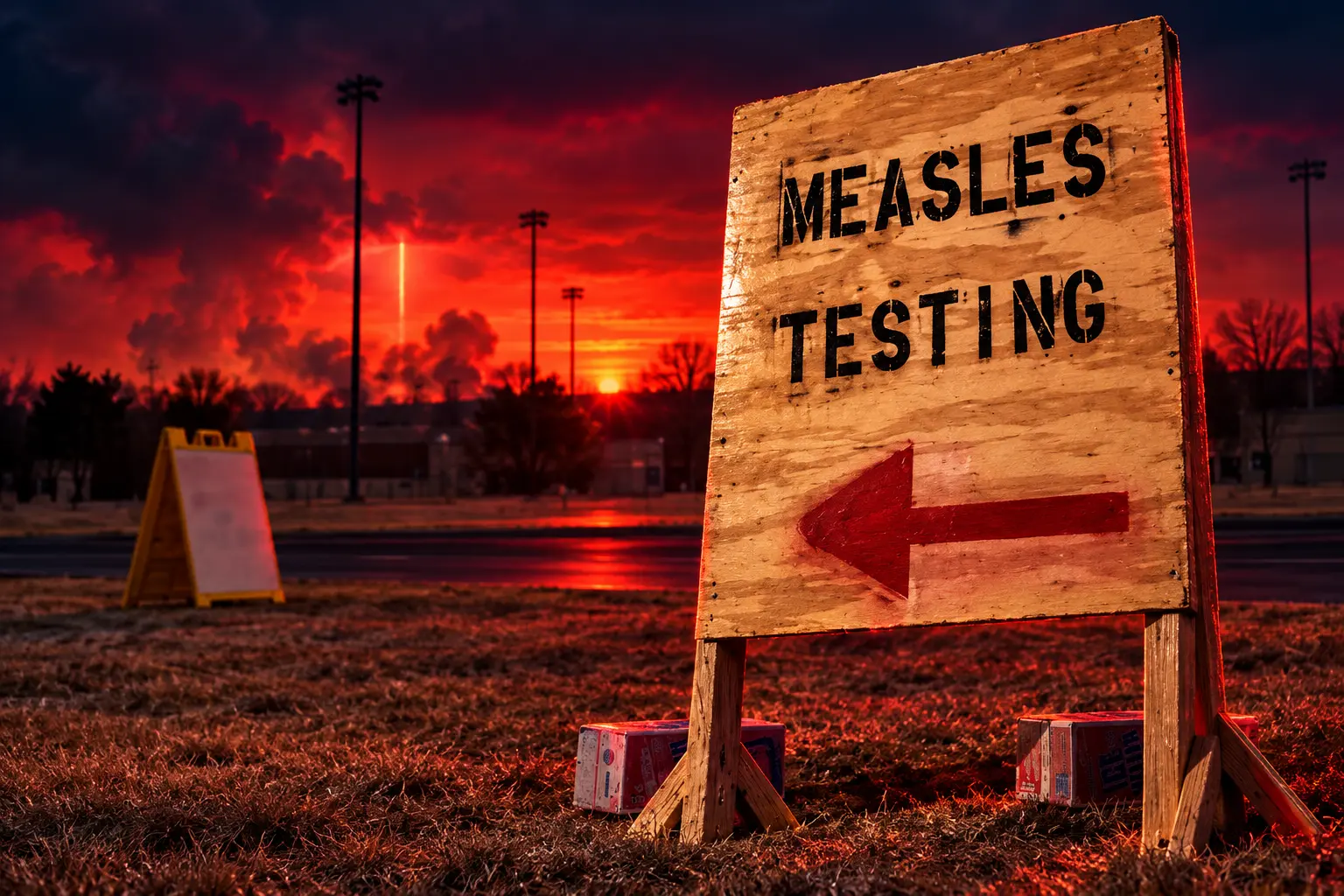
Kindergarten MMR Coverage Fell Below 95%
CDC tells communities they need more than 95% coverage to keep measles from finding the next susceptible child. School reports for 2025-26 show the national kindergarten MMR rate at 92.4%, the same as polio coverage, with DTaP at 92.0%. In 2019-20, before the COVID-19 school years, MMR coverage was 95.2%.
KINDERGARTEN SHOTS, 2025-26
- MMR coverage: 92.4% of kindergartners, 2.8 points under the 95% community-immunity line and under the 95.2% recorded in 2019-20.
- Missing paperwork: CDC counts about 280,000 kindergartners without documented MMR completion for the school year.
- Exemptions: 4.2% of kindergartners, about 155,000 children, were exempt from one or more shots, up from 3.6% the year before.
- How wide it spread: Exemptions rose in 41 states and D.C., and 24 states now report exemption rates above 5%.
Those gaps are not evenly spread. A state can post a decent average and still have a county where half the kindergarten class is unprotected, which is how a virus that needs 95% coverage explodes once it lands. Dr. Peter Chin-Hong, an infectious diseases specialist and associate dean for regional campuses at the University of California, San Francisco, said the vaccination split in this year’s cases is “very telling.”
It’s not a surprise, but it’s chilling in many ways.
Dr. Peter Chin-Hong, infectious diseases specialist, University of California, San Francisco
He also said confirmed totals likely miss families who never got tested, because deaths and hospital stays already hint at a larger infected pool than the dashboard shows.
Pennsylvania Now Accounts for 27% of U.S. Cases
On the CDC map as of Oct. 8, Pennsylvania had 1,105 cases, 27% of the U.S. total. South Carolina had 670 and Utah 535. The state’s own health department, one day later, counted 1,136 cases across 41 counties, with 219 hospital stays and five measles-associated deaths.
WHERE 2026 CASES ARE CONCENTRATED
| Jurisdiction | 2026 cases (CDC, Oct. 8) | 2025 full year |
|---|---|---|
| Pennsylvania | 1,105 | 16 |
| South Carolina | 670 | 333 |
| Utah | 535 | 189 |
| Texas | 192 | 803 |
| Virginia | 178 | not listed here |
| Florida | 148 | 8 |
| Ohio | 147 | 40 |
| Arizona | 110 | 222 |
The map shifted. Texas, which logged 803 cases in 2025 during the West Texas surge, is at 192 so far in 2026. Florida went from 8 to 148. Ohio went from 40 to 147. Pennsylvania went from 16 to 1,105. This is no longer one state’s leftover outbreak.
On Oct. 9 the Pennsylvania Department of Health said four of 1,136 patients had been vaccinated, less than 1%. State nurses had already given more than 5,500 MMR doses at 180 pop-up clinics since the outbreak began in late April, and more than 8,500 when state health centers are included. In a typical month, Pennsylvania providers give about 25,000 MMR doses. In August they gave more than 49,000. In September they gave more than 53,000.
Why the Death Toll Does Not Match
CDC lists two measles deaths in 2026 and three in 2025, and it flags the 2026 figure as subject to change while it works with the Council of State and Territorial Epidemiologists on a standard death definition. Pennsylvania has confirmed five measles-associated deaths, the first in the state since 1992.
On Sept. 30, the department reported a fifth measles-associated death to CDC: an unvaccinated Lancaster County resident who had tested positive. The state will not release identifying details. Lancaster County Coroner Dr. Stephen Diamantoni earlier said one of the first deaths was a newborn whose autopsy found a torn spleen, and that the pathologist did not treat measles as the cause.
That gap is now a method fight. Health and Human Services Secretary Robert F. Kennedy Jr. called the state’s first death announcement “premature” and said the deaths “may even have been altogether fabricated.” CDC staff at first accepted the state reports, then the agency said it would count measles deaths when the National Center for Health Statistics lists measles as the underlying cause. Analysts at KFF noted the shift to death certificates instead of state reports breaks from the usual near-real-time case system, and that vital-statistics files can lag by three months to a year.
WHAT WE KNOW
- State count: Pennsylvania has confirmed five measles-associated deaths in 2026, using a definition that looks at lab or epidemiologic evidence around the time of death.
- Federal count: CDC’s measles page lists two U.S. deaths in 2026 and does not name the states.
- The new rule: CDC says it will update the death line when NCHS records show measles as the underlying cause, and it is writing a shared case definition with state epidemiologists.
WHAT IS UNCONFIRMED
- Remaining PA deaths: Whether NCHS will code measles as the underlying cause for every death the state has already logged.
- Untested infections: How many household cases never reached a lab, the undercount Chin-Hong described when he said the official numbers are only part of the picture.
Public argument has followed that paperwork. A large share of high-engagement posts treat the first Pennsylvania deaths as proof the outbreak is being oversold, because at least one involved an infant who was not old enough for MMR. That dispute does not move the 414 hospital stays, and it does not move the 95% of cases in people with no documented shots.
15% of Children Under 5 Needed Hospital Care
CDC counted 414 measles hospital stays in 2026, 10% of confirmed cases, compared with 244 stays (11%) across all of 2025. The risk is not even.
HOSPITAL STAYS BY AGE, 2026
- Under 5 years: 15% hospitalized, 107 of 710 children.
- Ages 5 to 19: 5% hospitalized, 78 of 1,716 patients.
- Ages 20 and older: 14% hospitalized, 229 of 1,635 adults.
- Unknown age: none of 19 patients.
Infants too young for the first MMR dose, due at 12 to 15 months, sit inside that under-5 group. They depend on everyone around them already being immune. Pennsylvania’s own notice puts typical measles mortality at one to three deaths per 1,000 cases and says the virus can hang in the air or on surfaces for up to two hours after a patient leaves. People can spread it four days before the rash and four days after. Symptoms start 7 to 21 days after exposure.
John Brownstein, an epidemiologist and chief innovation officer at Boston Children’s Hospital, put the problem in one line: the country already has the tool.
It’s a vaccine that is incredibly effective and the goal is to close vaccination gaps.
John Brownstein, epidemiologist, Boston Children’s Hospital
Elimination Still Depends on 12 Quiet Months
The United States declared measles eliminated in 2000, meaning no continuous spread for at least 12 months with surveillance strong enough to tell an imported case from a local chain. A Congressional Research Service brief on the 2025-26 outbreaks calls this year’s load the highest annual count since 1991, when 9,643 cases were reported.
HOW THE QUIET YEARS ENDED
- 2000: The United States declares measles eliminated after a high-coverage two-dose program.
- 2019-20 school year: Kindergarten MMR coverage sits at 95.2%.
- 2025: CDC records 2,289 cases, 48 outbreaks, 244 hospital stays, and three deaths, the worst year since the early 1990s.
- August 17, 2026: School reports put kindergarten MMR at 92.4%, with about 280,000 children lacking documented completion.
- September 30, 2026: Pennsylvania confirms its fifth measles-associated death.
- October 8, 2026: The national confirmed total reaches 4,080, including 1,384 cases still tied to outbreaks that began in 2025.
Those 1,384 leftover-chain cases are the practical test of elimination. A status that requires 12 silent months cannot survive a second calendar year that is still eating last year’s clusters. Brownstein said there is “a very strong chance that we would lose our elimination status because we’re seeing the signs that measles is becoming continuously established here in the U.S.”
Two MMR Doses Still Stop 97% of Measles
CDC recommends the first MMR dose at 12 to 15 months and the second at 4 to 6 years. One dose is 93% effective against measles. Two doses are 97% effective. In 2026, 2% of confirmed cases had one documented dose and 2% had two. In Pennsylvania, the department repeats that two doses provide 97% lifetime protection and that people with two documented doses do not need another.
The shots still do what they were built to do in the people who get them. The 4,080-case year is what happens when kindergarten coverage sits at 92.4%, exemptions hit 4.2%, and 1,384 infections in October still belong to outbreaks that started last year. CDC’s death line may stay at two until death certificates catch up. The hospital wards and the school rolls are not waiting on that form.
Disclaimer: This article is news reporting on CDC, state health department, and research-institute figures. It is for information only and is not medical advice, a diagnosis, or a recommendation about whether any person should receive or decline the MMR vaccine. Readers should talk with a licensed physician, pediatrician, or other qualified clinician about personal vaccination status, exposure, pregnancy, and immune conditions before making a health decision. Case counts, death totals, outbreak maps, and school coverage rates reflect the cited sources as of the dates given and can change as labs confirm more cases and as death records are reviewed.

Europe’s Heat Killed 50,391 in Cities Official Counts Still Miss

Caesarean Surge Puts 20 England Maternity Units at Risk

The Protective Ring Around Care Homes Never Existed

Cooper Prioritises Children’s Corridor Care Without an Age Count

Oxford’s Ebola Vaccine Reaches Uganda as Doses Sit Unused

Pennsylvania Measles Deaths Collide With Falling MMR Coverage

Muscle-Boosting Drugs Near Approval for Children With SMA

FDA Approves XFG COVID Vaccines While the Advice Panel Is Frozen

Progranulin and JAK2 Split the Macrophages That Heal

After the ADHD Invoice, GPs and Waiters Carry the Cost
-
 NEWS2 months ago
Pennsylvania Measles Deaths Collide With Falling MMR Coverage
-
 FITNESS2 months ago
Muscle-Boosting Drugs Near Approval for Children With SMA
-
 NEWS2 months ago
FDA Approves XFG COVID Vaccines While the Advice Panel Is Frozen
-
 NEWS2 months ago
Progranulin and JAK2 Split the Macrophages That Heal
-
 MENTAL HEALTH2 months ago
After the ADHD Invoice, GPs and Waiters Carry the Cost
-

 NEWS2 months ago
Rasonque’s List Price Shifts the Pancreatic Cancer Bill
-
 NEWS2 months ago
Pennsylvania’s Two Measles Deaths Follow a Long Coverage Slide
-

 NEWS2 months ago
FDA Flagged This Sprout Plant 16 Months Before the Outbreak