
NEWS
Kenya’s First Bundibugyo Death Meets a Vaccine Gap
Kenya’s first Bundibugyo Ebola death is an imported DRC case. Licensed vaccines miss this species, and 122 contacts are now under watch.

Kenya recorded its first Bundibugyo Ebola death on 5 October after a traveller reached Nairobi from the DRC via Uganda. The man, a Kenyan who had lived in the Democratic Republic of the Congo for seven years, was isolated at Nairobi Hospital and died the same night tests confirmed Bundibugyo virus disease.
Licensed Ebola shots target a different species. Kenya is now running a contact-tracing response without a vaccine that is approved for this strain, while the DRC outbreak that produced the case is still growing.
The Patient Reached Nairobi After a Month of Illness
Kenya’s Ministry of Health said the patient fell ill about a month ago and was treated at several hospitals in the DRC. He travelled by road through Beni to Kampala on 2 October, then boarded Jambojet flight 8523 and landed at Jomo Kenyatta International Airport at 1:10 p.m. on 3 October.
He passed routine port-health screening. A relative drove him straight to Nairobi Hospital, where staff isolated him in the accident and emergency unit and later moved him to the East Wing isolation facility. His symptoms included fever, chills, fatigue, muscle pain, painful swallowing, a sore throat, and bleeding under the skin at injection sites.
Samples taken on 5 October tested positive for Bundibugyo virus at both the National Virology Reference Laboratory and the Kenya Medical Research Institute. He received supportive care and died that night. He was buried on 6 October under Kenya’s Ebola safe and dignified burial protocol. The ministry notified the World Health Organization the same day under the International Health Regulations (2005).
WHO epidemiologists noted that a month from first illness to death is longer than Bundibugyo virus disease usually runs. They presume he was not first sick with BVD and was infected in a health facility or in the community while seeking care for another problem. It is still unclear whether he had symptoms on the road or on the flight.
THE PATIENT’S PATH
- May 2026: Kenya goes on high alert after Bundibugyo outbreaks are declared in the DRC and Uganda.
- 2 October 2026: The patient travels by road from the DRC through Beni to Kampala.
- 3 October 2026: Jambojet flight 8523 lands in Nairobi at 1:10 p.m.; a relative takes him to Nairobi Hospital, where he is isolated.
- 5 October 2026: Both Kenyan reference labs confirm Bundibugyo virus; the patient dies that night.
- 6 October 2026: Safe burial is completed and Kenya notifies WHO, becoming the fourth country to confirm BVD.
- 11 October 2026: Health Cabinet Secretary Aden Duale says 122 contacts are listed, 108 are in quarantine, and no second case has been found.
France reported a travel-related Bundibugyo case in June. Uganda, where the virus was first identified in 2007, ended its latest outbreak in August. Most Ugandan cases were imported from the DRC; a few were local infections among contacts and health workers tied to those arrivals. A health worker who tested positive in the DRC was medically evacuated to the Netherlands on 1 October and is not counted as a Dutch local case.
Bundibugyo Is a Different Ebola Species
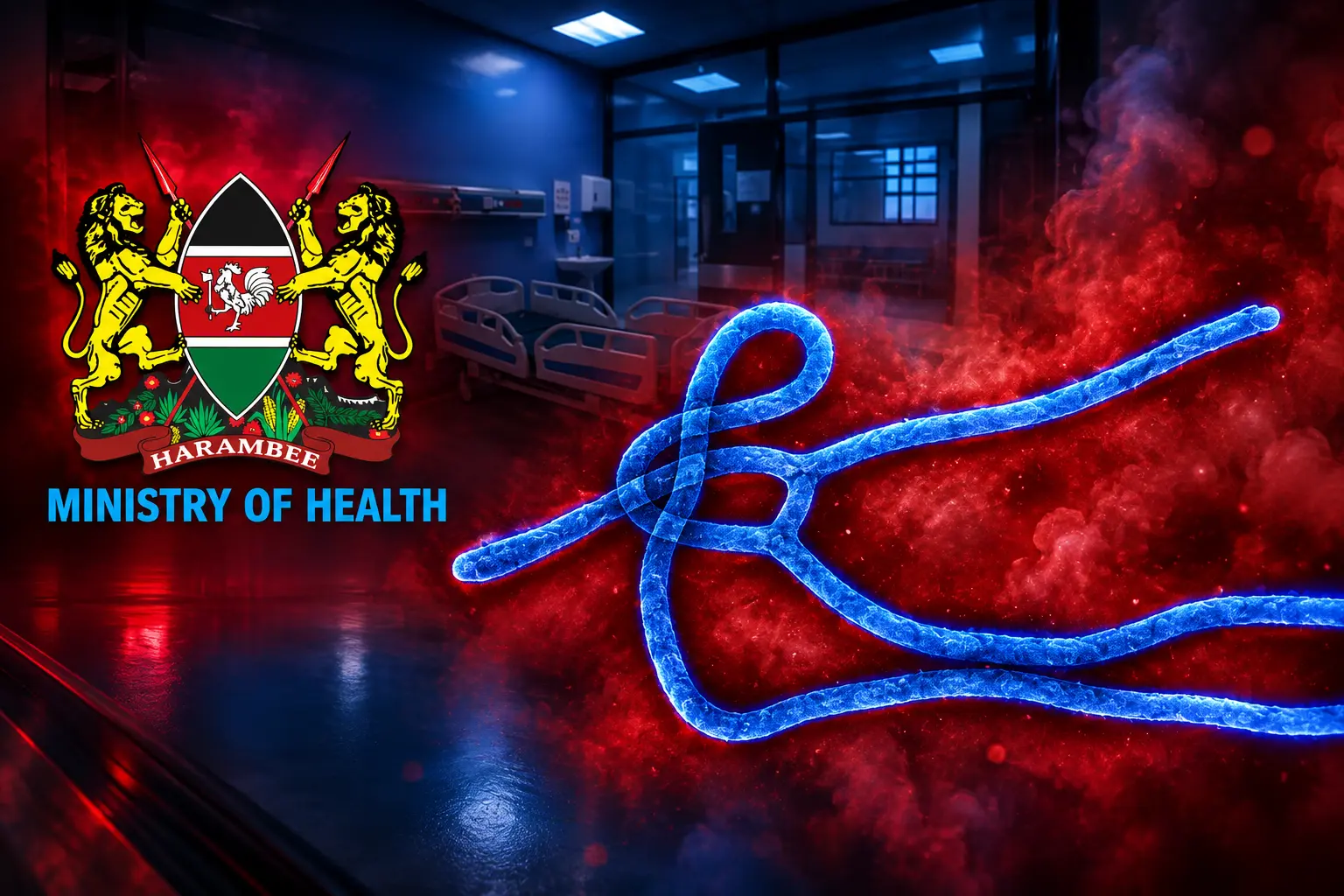
Bundibugyo virus disease is Ebola disease caused by Bundibugyo virus, one of the orthoebolavirus species. Fruit bats are the suspected animal host. People then spread it through direct contact with blood, secretions, organs, or other body fluids, or with surfaces and materials those fluids have touched. Health facilities and unsafe burials amplify spread when protection is weak.
The incubation period is 2 to 21 days. Infected people are not infectious until symptoms start. Early signs are ordinary: fever, fatigue, muscle pain, headache, and sore throat. Later come gut symptoms, organ failure, and, in some patients, bleeding. That early overlap with malaria and other fevers is why labs, not first impressions, decide the case.
WHO puts the case fatality ratios from the two previous Bundibugyo outbreaks, in Uganda in 2007 and in the DRC in 2012, at 30% and 50%. The current DRC epidemic is running at 48.2%. Control still depends on finding patients, isolating them, tracing contacts, burying the dead safely, and keeping communities in the response, because no approved vaccine or specific treatment exists for BVD.
That gap is the part the 2014 to 2016 West Africa playbook does not carry over. ERVEBO, the live Ebola Zaire vaccine, is indicated for prevention of disease caused by Zaire ebolavirus in people 12 months and older. The U.S. label states that it does not protect against other Ebolavirus species. Inmazeb and Ebanga, the two FDA-approved antibody drugs, were also cleared for Zaire infection.
THE SHOTS AND DRUGS THAT DO NOT COVER THIS STRAIN
| Product | Licensed use | Bundibugyo virus |
|---|---|---|
| ERVEBO | Prevents Zaire ebolavirus disease | Not licensed |
| Inmazeb and Ebanga | Treat Zaire ebolavirus infection | Not licensed |
| Supportive hospital care | Used in all Ebola disease | The only approved path now |
The U.S. Administration for Strategic Preparedness and Response says there are currently no FDA-approved treatments or vaccines specifically for Bundibugyo ebolavirus. BARDA is evaluating Bundibugyo candidates. An investigational antibody, MappBio’s MBP134, has laboratory data that suggest it may work against Bundibugyo and has completed a phase I safety study. WHO’s Africa office says other candidate products are in clinical trials. That is not a licensed shot a Kenyan contact can be offered today.
Why Airport Screening Did Not Stop Him
Kenya had already screened 652,584 travellers by 6 October and tested 267 samples at five labs, including mobile units at Busia and Lwakhakha. One sample was positive: this patient. He still walked through normal public-health screening at the airport and reached a city hospital in a private car.
Port screening looks for fever and obvious illness. Early Ebola looks like a dozen other infections, and WHO says it is not clear when this man became symptomatic on the journey. A long, partially treated illness in DRC hospitals also left a wide window in which he could have been infected and then travelled while the picture was still messy.
Naming Kampala as the transit stop is required for tracing the flight. It is also being read, in Uganda, as if the outbreak had restarted there. Uganda closed its outbreak in August. The practical unit of risk is the overland-plus-air corridor from eastern DRC through Entebbe to Nairobi, which a sick adult can cover in two days.
Health emergency preparedness gives us a head start. Kenya has put important outbreak control measures in place. The priority now is to move swiftly to detect any further cases before the virus has an opportunity to spread.
Dr Mohamed Janabi, WHO Regional Director for Africa, WHO statement
WHO advises against travel or trade bans on the DRC, Uganda, or Kenya on the information now in hand. Duale made the same point in Nairobi: Kenya remains open, with stronger screening rather than closed borders.
Ituri Still Carries Most of the Dead
The Kenyan death is one export from a much larger epidemic. WHO’s Disease Outbreak News, with data as of 6 October, records 8,728 confirmed cases and 4,205 deaths in the DRC, plus 2,269 recoveries, a crude case fatality ratio of 48.2%. Cases have been found in 64 health zones across seven of the country’s 26 provinces. WHO calls this the largest Ebola disease outbreak ever recorded in the DRC, whatever the species.
Since a 25 September update, the DRC added 775 confirmed cases and 379 confirmed deaths. Sixty-two new confirmed cases were reported in the 24 hours to 6 October. The seven-day average rose to 72 new cases a day. Over three completed epidemiological weeks, new weekly cases rose 2.5%, from 475 to 487, while weekly deaths stayed almost flat at 224 against 222.
WHERE CONFIRMED DRC CASES STOOD ON 6 OCTOBER
| Province | Confirmed cases | Confirmed deaths | Note |
|---|---|---|---|
| Ituri | 6,480 | 2,989 | Epicentre; 28 of 36 health zones |
| North Kivu | 1,755 | 1,013 | Highest provincial CFR, 57.7% |
| Haut-Uélé | 364 | 153 | Seven of 13 health zones |
| Tshopo | 51 | 17 | Seven of 23 health zones |
| DRC total | 8,728 | 4,205 | Seven provinces, 64 health zones |
Beni and Katwa in North Kivu, and Rwampara, Bunia, and Mandima in Ituri, were the hardest-hit health zones. Alimbongo in North Kivu is the newest, with four confirmed cases and two deaths. Forty-eight of the 64 affected zones still had at least one new case in the preceding 21 days.
Of 372 deaths reported since the late-September update, 264 occurred in communities and 108 in treatment centres. WHO reads that split as delayed detection and delayed care. Contact follow-up in the DRC stood at 80.4% as of 4 October (23,741 of 29,535 contacts), below the 85% target. That is how an infected adult can leave Beni, cross Uganda, and board a Nairobi flight before anyone has a lab result.
WHO, in an 14 August reassessment, rated risk very high inside the DRC, high for countries that share a land border, and low for the rest of Africa and the world. A separate rapid risk assessment for Kenya was still being prepared. The outbreak has been a Public Health Emergency of International Concern since 17 May.
122 Contacts, and Still No Second Kenyan Case
On 6 October the ministry had listed 28 contacts among family members and health workers who cared for the patient, and was still tracing 23 passengers and four crew from the same flight. Quarantine plans were already under way for people judged at risk.
Five days later the list was much longer, and still had only one confirmed infection.
KENYA’S 11 OCTOBER COUNT
- Contacts listed: All 122 contacts of the case have been listed and verified, Duale said in an 11 October statement.
- In quarantine: 108 people (88.5%) are in quarantine and being monitored daily; none had developed symptoms by that statement.
- Lab work: 293 samples from 289 alerts had been tested, with only the imported case positive.
- Entry screening: 667,675 travellers had been screened at 26 points of entry, including 2,345 in the previous 24 hours.
Duale said tracing of the remaining contacts was continuing, including with international partners where needed. Surveillance was running around the clock. The National Taskforce, the National Public Health Emergency Operations Centre, and the National Incident Management System were active, with rapid response teams on 24-hour standby.
All 122 contacts of the case have been listed and verified. 108 (88.5%) are in quarantine and being monitored daily and none have developed any symptoms thus far.
Aden Duale, Health Cabinet Secretary, 11 October statement
A 21-day watch after last exposure is the standard window, because that is the outer incubation period. The last hospital contact was 5 October. Family, flight, and clinic contacts therefore remain the live question, not a second confirmed Kenyan death. No new case had been recorded by 11 October. That is a good interval. It is not the end of the clock.
Isolation Units Cover 27 High-Risk Counties
Kenya had months to prepare after the DRC and Uganda declarations in May. WHO says the country’s Ebola preparedness score, which tracks surveillance, labs, isolation, treatment, and trained teams, rose from 66% in May to 82% in July. The ministry said 4,971 health workers at national and sub-national level had been trained in Ebola prevention and management by 6 October. Duale later said the surge roster includes 102 responders who worked the 2014 to 2016 West Africa outbreak.
WHO and partners ran simulation exercises and trained a national pool of rapid-response trainers. Isolation units across 27 high-risk counties have been identified and assessed. Case managers have been trained, and surveillance tools updated so a suspected case can be reported and investigated quickly. WHO delivered about 1,000 Ebola tests and 1,000 personal protective equipment kits to those counties.
HOW THIS VIRUS MOVES, AND WHAT STOPS IT
- Body fluids: Spread is through blood, vomit, faeces, urine, saliva, sweat, breast milk, or semen of a person who is sick or who has died, when the virus meets broken skin or the eyes, nose, or mouth.
- Objects: Bedding, clothes, and medical gear contaminated with those fluids can carry infection.
- Care and burial: Most chains run through family care, clinics with weak infection control, and funerals that involve touching the body.
- Not the air, not the incubation: People do not spread Bundibugyo virus before symptoms start, and WHO is not treating this as an airborne threat.
Duale asked the public not to panic, to wash hands or use alcohol rub, to keep distance from sick arrivals from countries with active transmission, and to go to a recognised facility if unwell. Health workers were told to keep infection-prevention rules in place. The ministry’s toll-free line is 719. Airports, seaports, and land borders stay open with extra screening. There is no lockdown and no ban on gatherings.
That is the whole Kenyan toolkit for a species that still has no licensed shot: find the contacts, hold the 21-day watch, bury the dead without touching the body, and keep clinics from becoming the next link. In the DRC, tens of new confirmed cases are still being counted on a typical day. Nairobi’s imported death is how that unfinished epidemic looks when it meets an East African flight.
Disclaimer: This article is news reporting on a public-health event and is for information only. It is not medical advice, a diagnosis, or a personal guide to infection control, travel, vaccination, or quarantine. Anyone who has fever after travel, or who thinks they may have been exposed to a patient with viral haemorrhagic fever, should contact a qualified physician or local public-health authority and follow official Ministry of Health instructions. Case counts, contact numbers, and outbreak status change as health authorities update their investigations and may already have moved on from the figures cited here.

Europe’s Heat Killed 50,391 in Cities Official Counts Still Miss

Caesarean Surge Puts 20 England Maternity Units at Risk

The Protective Ring Around Care Homes Never Existed

Cooper Prioritises Children’s Corridor Care Without an Age Count

Oxford’s Ebola Vaccine Reaches Uganda as Doses Sit Unused

Pennsylvania Measles Deaths Collide With Falling MMR Coverage

FDA Approves XFG COVID Vaccines While the Advice Panel Is Frozen

Muscle-Boosting Drugs Near Approval for Children With SMA

Progranulin and JAK2 Split the Macrophages That Heal

After the ADHD Invoice, GPs and Waiters Carry the Cost
-
 NEWS2 months ago
Pennsylvania Measles Deaths Collide With Falling MMR Coverage
-
 NEWS2 months ago
FDA Approves XFG COVID Vaccines While the Advice Panel Is Frozen
-
 FITNESS2 months ago
Muscle-Boosting Drugs Near Approval for Children With SMA
-
 NEWS2 months ago
Progranulin and JAK2 Split the Macrophages That Heal
-
 MENTAL HEALTH2 months ago
After the ADHD Invoice, GPs and Waiters Carry the Cost
-

 NEWS2 months ago
Rasonque’s List Price Shifts the Pancreatic Cancer Bill
-
 NEWS2 months ago
Pennsylvania’s Two Measles Deaths Follow a Long Coverage Slide
-

 NEWS2 months ago
FDA Flagged This Sprout Plant 16 Months Before the Outbreak