
NEWS
Imported Catering Eggs Keep the UK Salmonella Outbreak Alive
474 Salmonella cases and two deaths are running through imported eggs in cafes, not Lion-marked shop eggs, and tracing that catering channel is taking weeks.

The UK Health Security Agency has counted 474 Salmonella Enteritidis cases and two deaths across three related clusters, most of them after meals eaten out. Investigators say imported eggs used in cafes, restaurants and takeaways are the leading lead, and shop-bought British Lion eggs are not implicated.
That split is the hole this outbreak is running through. The Lion scheme already made the supermarket box a very low-risk food. Catering still buys cheaper imported eggs in mixed bulk, and that channel is what tracing has yet to name.
474 Cases Across Three Related Outbreaks
On 27 August 2026, UKHSA said it was investigating three related Salmonella Enteritidis clusters in parallel, with figures as of 10:00 on 25 August. The strains, labelled t5.9411, t0.24068 and t5.9765, are genetically distinct but sit in the same family, and case counts in all three have risen since June 2026.
THE THREE CLUSTERS AS OF 25 AUGUST 2026
| Cluster | Confirmed cases | Deaths | Admitted to hospital | Sample dates |
|---|---|---|---|---|
| t5.9411 | 259 | 1 | 41 of 149 with records | 11 August 2025 to 8 August 2026 |
| t0.24068 | 177 | 0 | 12 of 27 with records | 27 May 2025 to 5 August 2026 |
| t5.9765 | 38 | 1 | 5 of 14 with records | 27 January 2026 to 29 July 2026 |
| Combined | 474 | 2 | 58 of 190 with records |
The newest wave is tightly packed. UKHSA logged 189 cases in a four-week span for t5.9411 alone, with sample dates from 27 July to 24 August 2026, plus 18 and 6 in the other two clusters over the same window, a combined 213. Of 190 people with hospital records, 58 of 190 were admitted. Ages run from infants to 92, with median ages of 30, 29 and 32.
England reported 10,406 laboratory Salmonella infections in 2025, and 3,104 of them (29.8%) were Enteritidis, the most common serovar. Whole-genome sequencing of every cultured sample is what tied these 474 together. The European Centre for Disease Prevention and Control counted 341 confirmed t5.9411 cases from May 2025 to August 2026 across several countries, with the UK at 61% and the Netherlands at 31%.
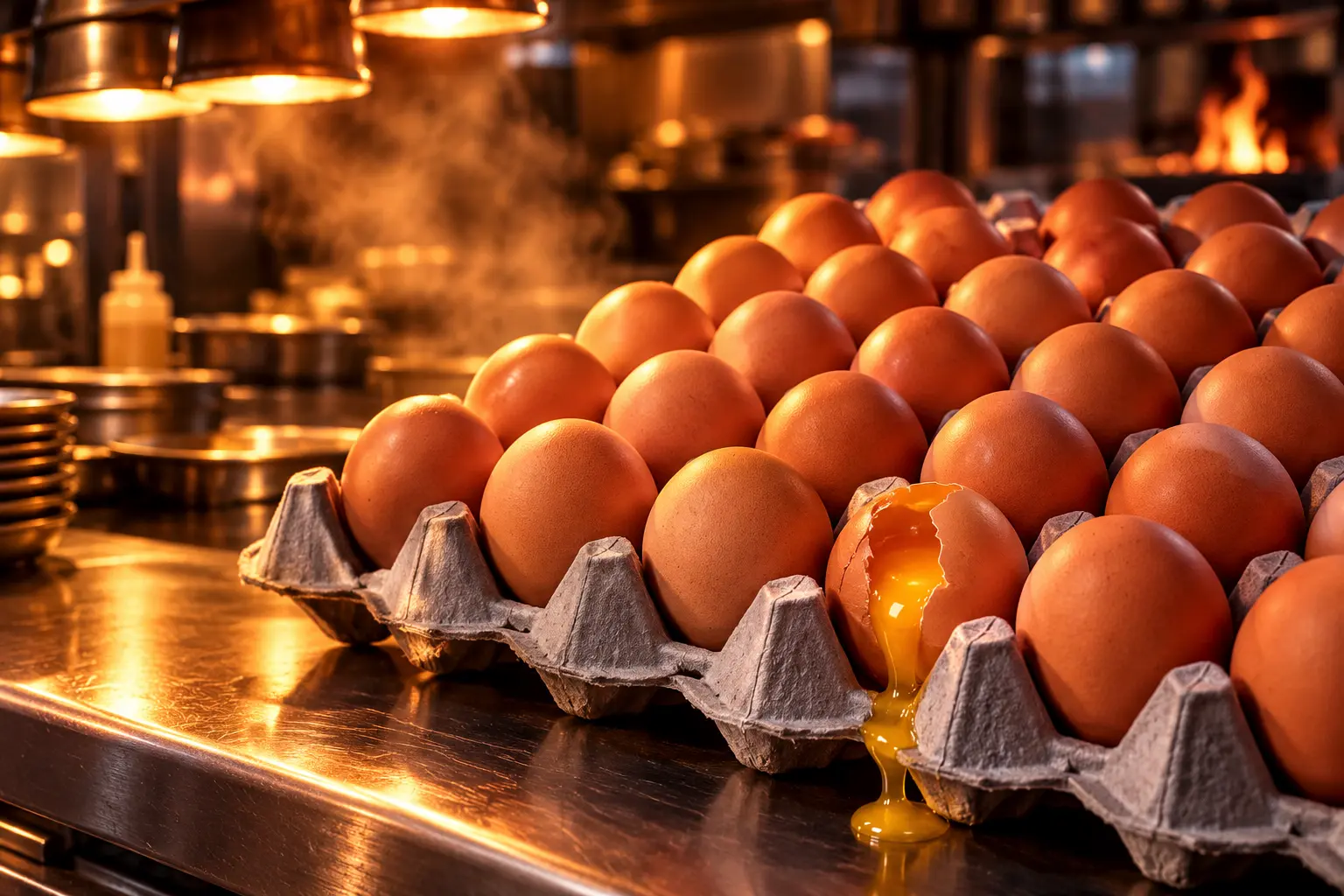
Most Patients Ate Out, Not Eggs From Home
UKHSA opened the t5.9411 inquiry on 26 May 2026 after sequencing showed a single 5-SNP cluster. By 13 August it had 207 confirmed cases, 206 of them in 2026, including 199 in England, 6 in Scotland, 1 in Wales and 1 in Northern Ireland. London had 47 of those English cases and Yorkshire and the Humber 38. Only 6 of 207 people (3%) had travelled outside the UK. Two people had bloodstream infections.
Hannah Charles, lead epidemiologist at UKHSA, said the overall risk to the public remains low, and that the inquiry so far “indicates a link to imported eggs, however this investigation remains ongoing.”
WHAT THE QUESTIONNAIRES SHOWED
- Eating out: Of 114 people who completed a questionnaire as of 13 August, 95 (83%) had eaten food prepared outside the home in the week before symptoms.
- Named premises: Five unnamed food businesses were each visited by two or more unrelated cases, linking 24 people in total.
- Egg dishes: Eleven of those 24 people said they ate dishes made with eggs, and UKHSA called egg consumption the strongest signal to date.
- Supply mix: Those kitchens were taking eggs from multiple sources, including importers, and local checks found possible cross-contamination in two of the settings.
- UK flocks: There is no identified link to UK-produced eggs or poultry.
The five businesses have not been named, so a diner still has no venue list to avoid. That is why the practical warning has settled on how the egg is cooked, not on where the plate came from.
Why British Lion Eggs Stay on the Safe List
The British Lion Code of Practice, launched in 1998, requires a unique passport for hens, eggs and feed, on-farm stamping, extra testing beyond the National Control Programme, and hens vaccinated against Salmonella Enteritidis and Salmonella Typhimurium. More than 90% of UK eggs are produced under it. On 11 October 2017 the Food Standards Agency told infants, children, pregnant women and older people they could eat those eggs raw or lightly cooked.
Heather Hancock, then FSA chair, said vulnerable groups could “safely eat UK eggs without needing to hardboil them, so long as they bear the British Lion mark.” Laid in Britain eggs later passed the same very-low-risk test. Professor Ian Young, the FSA’s chief scientific adviser, has repeated that there is no evidence UK-produced eggs are involved in the current clusters, and that thoroughly cooked eggs handled hygienically should not present a food safety risk.
If you’re eating out or buying food that contains eggs, you may not know if these carry the British Lion mark or are Laid in Britain assured. If this is the case, when eating out the safest approach for vulnerable people is to ensure they’re thoroughly cooked and to avoid dishes containing raw or lightly cooked egg, such as mousses, fresh mayonnaise or hollandaise sauce.
Professor Ian Young, Chief Scientific Adviser, Food Standards Agency
That last sentence is the live rule, because a cafe breakfast does not come with a stamp on the shell. UK farmers already pay for vaccination and audits that make the shop box safe; the diner eating out cannot see whether those controls were in the pan.
The 1.6 Billion Eggs That Never Reach the Shop
The British Egg Industry Council’s Shell Shocked report, published in March 2026, put a 60 percent rise in imported eggs since 2021, from about 1 billion a year to 1.6 billion, a gain of more than 600 million. The UK eats 14 billion-plus eggs a year. Industry figures for 2025 split that market as 64% retail shell eggs, 20% foodservice shell eggs and 16% processed egg products, with the country 89% self-sufficient. The extra imports, the report said, mainly enter wholesale, catering, manufacturing and the public sector, not the supermarket aisle.
Paul Wigley, professor of animal microbial ecosystems at the University of Bristol, said bulk imported eggs are cheaper than Lion eggs “and so can end up being used in schools and nursing homes along with cafes, restaurants and takeaways.” He also noted that mixed batches from different lots are common, even if the clustering of cases still points to a single source. A Chartered Institute of Environmental Health survey cited in the same report found that 82% of respondents thought imported eggs pose a greater food safety risk in professional kitchens.
Ukraine gained tariff-free access for eggs in May 2022, later extended to March 2028. The Animal and Plant Health Agency recorded about 8 million kilograms of Ukrainian eggs in the early part of 2025, more than from Poland or Spain, and individual consignments into the UK rose from roughly 3,500 in 2023 to over 10,000 in 2024. Conventional battery cages, banned in the UK since 2012, remain in use in some supplying countries. British producers put the cost of moving to higher-welfare systems at around £400 million. Nick Allen, BEIC chief executive, wrote that inferior imports pose “real and urgent risks” for consumers and the wider food industry. Per-person consumption has climbed from about 160 eggs a year in 2004 to more than 200 in 2025, which is why a catering-channel failure now reaches so many plates.
UKHSA has not named a country of origin for the current clusters, and Young has not either. Cheaper import volume explains how a contaminated lot can keep seeding cafes after the shop box has been cleaned up; it does not, on its own, identify the farm.
Food Service Mixes Batches Faster Than Tracing Can Follow
Prof Chris Elliott of Queen’s University Belfast said the number of cases would keep rising until the source was identified, which could take “not days, but weeks,” and that food service is much harder to map than retail. “Within the UK’s retail industry, they really know their supply chains extremely well. But with food service, less so.” He also warned against pressing agencies to name Poland or Romania before they are sure.
Prof Brad Spiller, head of medical microbiology at Cardiff University, called the common source “probably the most concerning aspect,” and said the contamination “won’t naturally stop” until that source is identified. Prof Mark Stevens, chair of microbial pathogenesis at the University of Edinburgh, said hundreds of people being infected by a common strain is rare even in a country that sees thousands of Salmonella cases a year, and that cases here are arriving together rather than spread out.
WHAT WE KNOW
- The setting: Illness is linked to eating out in small cafes, restaurants and takeaways, not to eggs cooked at home from British Lion boxes.
- The pathogen: Three related Salmonella Enteritidis clusters, with t5.9411 genetically linked within 25 SNPs to a 2025 outbreak that was also tied to imported eggs.
- The advice: Vulnerable people should only eat raw or runny eggs that carry the British Lion mark or Laid in Britain assurance, and should order them well cooked when eating out.
WHAT IS UNCONFIRMED
- The farm: No producer, packing plant or country of origin has been named.
- The menu: Eggs are the strongest signal, not a closed proof, and kitchen hygiene is still under review at two linked sites.
- The venues: The five businesses tied to 24 cases have not been identified in public.
Wigley put the diner’s only personal step in one line: avoid runny eggs outside the home unless they are Lion-marked. That is a thin control in a takeaway, where the cook is not going to pass the box across the counter.
Poland, Ukraine Trade and Earlier Waves
This is not the first time imported eggs have arrived with Salmonella Enteritidis. The BEIC chronology and FSA warnings from recent years show the same pattern: a lot enters catering or wholesale, cases cluster, and a country is named only after the traceback lands.
THE RECENT IMPORTED-EGG WAVES
- 2024: More than 200 Salmonella cases in the UK are linked to eggs imported from Poland, and the FSA warns food businesses about sourcing.
- May to October 2025: 123 confirmed illnesses in the UK are traced to a single imported egg distributor.
- 2025: The t0.24068 cluster is first investigated, then rises again from June 2026.
- 26 May 2026: UKHSA opens the t5.9411 outbreak inquiry after sequencing shows a single 5-SNP cluster.
- 13 August 2026: 207 cases are counted in that first cluster, 83% of interviewees having eaten out, with one death and two bloodstream infections.
- 27 August 2026: UKHSA publishes 474 cases across three clusters and two deaths, and says Thursday tallies will continue until the incident is closed.
Mark Williams, chair of the BEIC, has said the current inquiry is pointing towards imported eggs and that British Lion production remains the control diners can trust in the shop. The National Farmers Union has called the outbreak a wake-up call for tougher import rules. Those are industry asks, not FSA decisions. Young’s line still stands: cooked eggs handled cleanly should not present a food safety risk, and UK flocks are not in the dock.
What Vulnerable Diners Should Order Instead
Most infections cause a short run of diarrhoea, cramps, vomiting and fever, and people get better without treatment. Young children, older adults, pregnant people and anyone with a weak immune system can become much more ill, including sepsis that needs hospital care. Anyone worried should contact a GP or out-of-hours service.
HOW TO EAT EGGS WHILE THE SOURCE IS UNKNOWN
- At home: British Lion or Laid in Britain eggs remain the FSA’s very-low-risk choice, including runny yolks, except for people on medically supervised diets.
- When eating out: Vulnerable diners should ask for eggs thoroughly cooked and skip fresh mayonnaise, hollandaise, mousses and other dishes that use raw or lightly cooked egg.
- In the kitchen: Store and cook to packet instructions, and wash hands before handling food and after touching raw eggs, meat or poultry.
UKHSA said it will keep publishing case counts at 9:30am on Thursdays, using data from 10:00 the previous Tuesday, until the incident is closed. As of 25 August 2026 the farm, the country and the five linked kitchens were still unnamed, which is why a runny yolk in a cafe remains a guess and a Lion box at home does not.
Disclaimer: This article is news reporting and analysis of an ongoing UK Health Security Agency and Food Standards Agency inquiry, and it is for information only. It is not medical advice, a diagnosis, or a substitute for clinical care, and it is not advice on what any cafe, school, care home or household should buy or serve. Readers who are ill, pregnant, immunocompromised, or caring for young children or older adults should speak to a GP, pharmacist, or other qualified clinician before changing their diet or treatment. Case counts, hospital figures, and the suspected source reflect official releases as of 25 to 27 August 2026 and may change as Thursday updates continue.

Europe’s Heat Killed 50,391 in Cities Official Counts Still Miss

Caesarean Surge Puts 20 England Maternity Units at Risk

The Protective Ring Around Care Homes Never Existed

Cooper Prioritises Children’s Corridor Care Without an Age Count

Oxford’s Ebola Vaccine Reaches Uganda as Doses Sit Unused

Pennsylvania Measles Deaths Collide With Falling MMR Coverage

Muscle-Boosting Drugs Near Approval for Children With SMA

FDA Approves XFG COVID Vaccines While the Advice Panel Is Frozen

Progranulin and JAK2 Split the Macrophages That Heal

After the ADHD Invoice, GPs and Waiters Carry the Cost
-
 NEWS2 months ago
Pennsylvania Measles Deaths Collide With Falling MMR Coverage
-
 FITNESS2 months ago
Muscle-Boosting Drugs Near Approval for Children With SMA
-
 NEWS2 months ago
FDA Approves XFG COVID Vaccines While the Advice Panel Is Frozen
-
 NEWS2 months ago
Progranulin and JAK2 Split the Macrophages That Heal
-
 MENTAL HEALTH2 months ago
After the ADHD Invoice, GPs and Waiters Carry the Cost
-

 NEWS2 months ago
Rasonque’s List Price Shifts the Pancreatic Cancer Bill
-
 NEWS2 months ago
Pennsylvania’s Two Measles Deaths Follow a Long Coverage Slide
-
 NEWS2 months ago
FDA Flagged This Sprout Plant 16 Months Before the Outbreak