
NEWS
Clear Eyes Repeats a Sterility Recall America Already Lived
Prestige is pulling 39,060 Clear Eyes Maximum Itchy Eye Relief bottles, the same sterility-assurance gap that hit the brand in 2019.

Prestige Consumer Healthcare is recalling 39,060 bottles of Clear Eyes Maximum Itchy Eye Relief after a sterility check failed on one lot. The Tarrytown, N.Y., firm started the pull on July 29, 2026, through its Medtech Products unit, and the Food and Drug Administration classed it Class II on August 14.
The bottles are 15 mL droppers from lot 2552A, dated to expire September 30, 2027. Phil Terpolilli, vice president of investor relations at Prestige, said a possible contaminant turned up in manufacturing, that tests did not confirm the lot was dirty, and that no serious injuries had been reported.
Prestige Pulls One Lot of Clear Eyes Nationwide
The FDA enforcement record lists the reason as “lack of assurance of sterility” and “potential contamination.” That phrase means the batch did not clear the sterility testing needed to ship with confidence. It is not a lab report naming a germ in a sealed bottle.
Terpolilli said only this lot is involved and that other Clear Eyes products stay on sale. He did not name the plant or the suspected contaminant, and the agency did not either.
Although the affected product was not confirmed to be contaminated, we initiated this voluntary recall out of an abundance of caution and our commitment to providing consumers with safe, high-quality products.
Phil Terpolilli, vice president of investor relations, Prestige Consumer Healthcare
Poison-control desks spent late August telling people to turn the bottle over rather than toss every Clear Eyes SKU. The louder public reflex still treats any sterility recall as a rerun of the 2023 outbreak that blinded patients. This pull is narrower than that memory, and the brand has been down this road before.
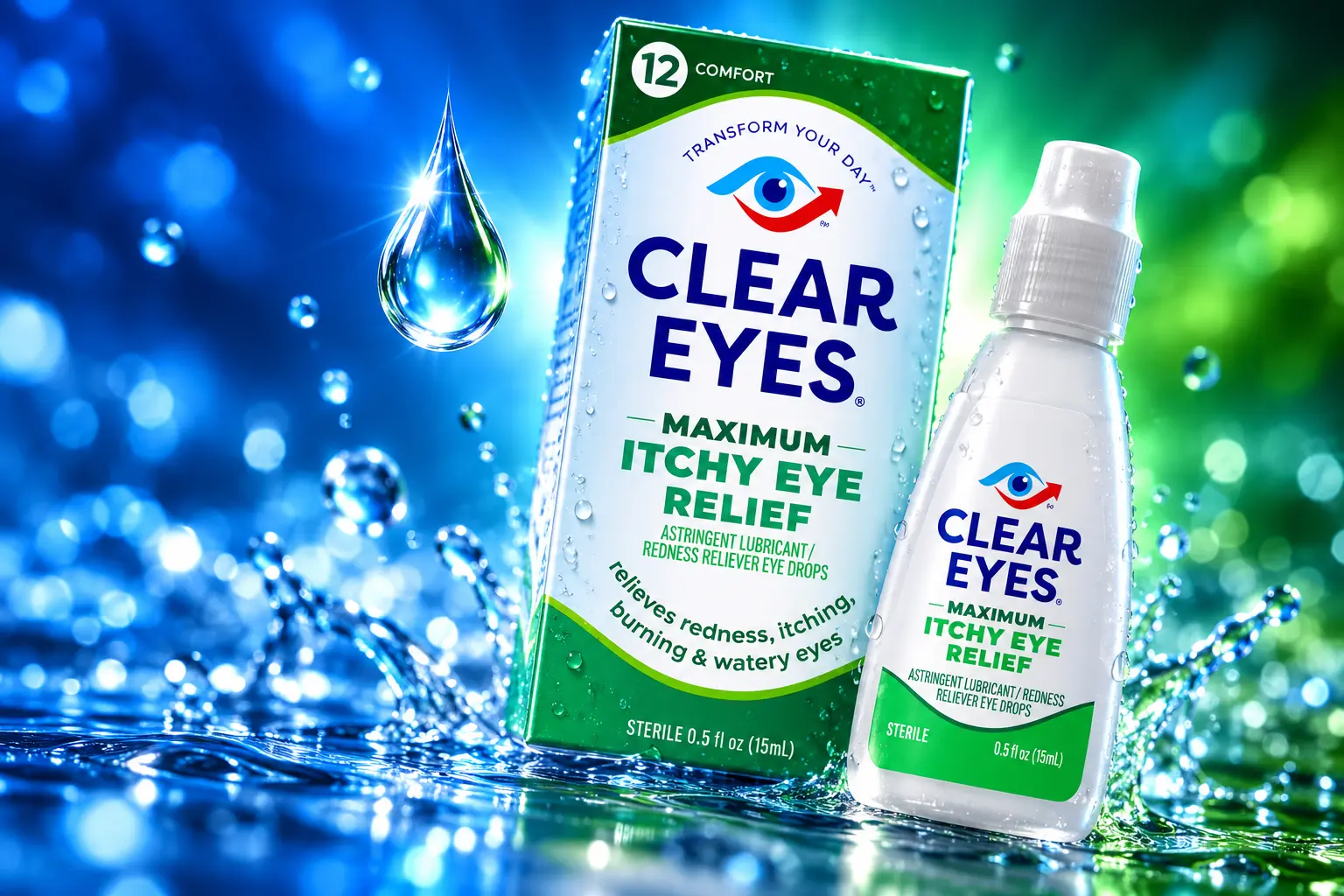
Lot 2552A and the 2027 Expiration Date
The front label will not tell you if you are holding the recalled stock. The lot code sits on the bottle and carton, so you have to pick the pack up. Because the date is more than a year out, many of these droppers are still in bathrooms, glove boxes, and desk drawers.
HOW TO MATCH THE RECALLED BOTTLE
| Marker | Recalled value |
|---|---|
| Product | Clear Eyes Maximum Itchy Eye Relief |
| Size | 15 mL (0.5 fl oz) dropper |
| Lot code | 2552A |
| Expiration | September 30, 2027 |
| NDC | 67172-999-01 |
| UPC | 6 78112 65920 3 |
| Recall number | D-0766-2026 |
A 6 mL carton of the same name uses a different NDC and is not on the recall list. Terpolilli told customers with questions to use the Clear Eyes site or call 800-443-4908 on weekdays. The printed label also lists 1-877-274-1787.
The drops are an astringent, lubricant, and redness reliever sold for itching, burning, redness, and watering. Retail lists in company materials and store locators include Walmart, Target, Kroger, Meijer, Giant Eagle, Dollar General, and Family Dollar. A later correction said this lot was not sold at CVS.
Clear Eyes Already Faced This in 2019
Seven years ago the same brand was swept into another sterility-assurance recall, that time by a contract maker. On July 16, 2019, Altaire Pharmaceuticals told FDA it was pulling OTC eye products labeled for several firms, including Prestige, because managers doubted quality controls on critical systems. FDA said those gaps meant a 2019 Clear Eyes redness-relief lots could not be treated as sterile.
Altaire said it had no adverse-event reports and no out-of-spec sterility results, in house or at third-party labs. The notice still warned that putting a non-sterile product into an eye “may result in serious and potentially life threatening infections or death.” The 2026 action uses the same core reason, this time on Maximum Itchy Eye Relief, and again without a named pathogen.
STERILITY PULLS THAT SHAPE THIS WEEK
- July 16, 2019: Altaire recalls Prestige-labeled Clear Eyes Redness Relief lots for lack of sterility assurance, with no injuries reported.
- February 2, 2023: Global Pharma Healthcare recalls EzriCare and Delsam Pharma artificial tears over possible microbial contamination after a CDC cluster alert.
- May 15, 2023: CDC’s outbreak tally reaches 81 patients, 14 with vision loss, 4 who had an eye removed, and 4 deaths within 30 days of culture.
- July 29, 2026: Prestige starts the Clear Eyes Maximum Itchy Eye Relief recall of 39,060 bottles from lot 2552A.
- August 14, 2026: FDA assigns the action Class II, the middle of its three recall grades.
The 2019 Altaire notice also covered other labelers’ washes, lubricants, and ointments. Prestige later fought with that maker in court over costs. The 2026 record does not say who filled lot 2552A.
What a Class II Recall Allows and Forbids
FDA’s middle grade is a situation in which use may cause temporary or medically reversible health harm, or in which the chance of serious harm is remote. Class I is the death-or-disability tier. Class III is for problems unlikely to hurt anyone.
On the agency’s consumer page for drug recalls, Class II and Class III products can often stay in use unless the firm or FDA says otherwise. Prestige is telling people to stop and return lot 2552A, which is the instruction that governs this bottle. The drops go on the eye’s surface, where even a short-lived infection can scar a cornea, so the firm is not waiting for a positive culture.
Class II is also the grade that usually attaches to “lack of assurance of sterility” when no organism has been recovered. That is a process failure, not a patient count. It still ends the lot, because eye drops are supposed to be sterile when they leave the filler.
Four Deaths in 18 States Changed the Stakes
The reason a Class II eye-drop recall still empties cabinets is February 2023. Global Pharma Healthcare, making artificial tears later sold as EzriCare and Delsam Pharma, recalled every in-date lot after CDC flagged a cluster of Verona Integron-mediated, Guiana-extended-spectrum, carbapenem-resistant Pseudomonas aeruginosa. The company notice, posted by FDA, cited 55 adverse events at that moment, including eye infections, permanent vision loss, and a death from a bloodstream infection.
CDC’s later update, dated May 15, 2023, counted 81 patients in 18 states. Fourteen lost vision. Four more had an eye surgically removed. Four died within 30 days of a clinical culture. Most patients had used artificial tears; EzriCare, a preservative-free drop in a multi-use bottle, was the brand named most often. Opened bottles in two states grew the outbreak strain.
Lot 2552A is a different product. DailyMed and the brand site list glycerin, naphazoline, and zinc sulfate as the actives, with benzalkonium chloride among the inactive ingredients, so this formula is preserved. Directions are 1 to 2 drops in the affected eye up to four times a day, after taking out contact lenses. The label also warns that overuse can increase redness and that the solution should not be used if it changes color or turns cloudy.
2023 OUTBREAK VERSUS THE 2026 LOT
| Point | 2023 EzriCare / Delsam tears | 2026 Clear Eyes lot 2552A |
|---|---|---|
| What was found | Drug-resistant Pseudomonas matched to patients | No confirmed contaminant |
| Scope | All in-date lots, consumer level | 39,060 bottles, one lot |
| Preservative | Preservative-free multi-use bottle | Benzalkonium chloride on the label |
| Harm counted | 81 patients, 14 vision losses, 4 eye removals, 4 deaths | No serious events reported |
| FDA grade | Tied to a deadly outbreak investigation | Class II |
Replies under local-TV recall posts still jumped to overseas plants, which is the 2023 story people remember. Prestige has not named a factory for lot 2552A. Treating this bottle as EzriCare 2.0 overstates the evidence; ignoring it because the class is II understates how the eye handles a dirty drop.
A Yale Review Counts 110 Recalled Tear Formulas
Aishwarya Bhattacharya, of Yale School of Medicine, and Paul C. Kang, an ophthalmologist there, reviewed FDA tear recalls from January 1, 2014, through August 11, 2025, in the Journal of Cataract and Refractive Surgery. They found 286 recalled eye products in that window, 121 of them OTC tears, collapsing to 110 unique recalled tear formulas.
WHAT THE 2014 TO 2025 TEAR RECALL FILE SHOWS
- Class split: 81 formulas were Class II and 26 were Class I, with the rest outside those two buckets in the abstract.
- Usual Class II reason: Lack of assurance of sterility accounted for 65 of the 81 Class II formulas.
- Usual Class I reason: Confirmed microbes accounted for 25 of the 26 Class I formulas.
- Where they were made: 85 of the recalled formulas were manufactured in the United States, and 80 were generics.
Preserved tears (48) and preservative-free tears (62) were recalled at similar rates. The authors’ close was blunt: most recalled tears were U.S. generics pulled because sterility could not be assured, and confirmed contamination stayed rare next to how often Americans use the products. Lot 2552A sits in that larger file, even though Clear Eyes is a branded SKU, because the FDA reason is the common one, not the rare deadly one.
Kang’s paper stops at August 11, 2025, so this July 2026 lot is not inside the tally. It fits the pattern the tally already described.
Pain, Discharge, or Blur Means Same-Day Care
If the bottle in your hand is lot 2552A with the September 30, 2027, date, stop using it. Keep it long enough to write down the lot, then return it to the store or call Prestige at 800-443-4908. Do not put leftover solution in another dropper, and do not rinse the tip and keep going.
IF YOU ALREADY USED LOT 2552A
- No new symptoms: Stop the bottle, save the lot number, and switch to a product that is not on the list, after you check that second bottle’s code too.
- Same-day warning signs: Eye pain, thick discharge, new light sensitivity, or a drop in vision belong in an eye doctor’s chair the same day, not in a wait-and-see message thread.
- What to bring: The bottle helps a clinician log the lot if an ulcer is starting; suspected infectious keratitis is treated as an emergency because delay is how a treatable sore becomes a lost eye.
- How to report: Quality problems and suspected injuries can go to FDA’s MedWatch program, and poison help is 1-800-222-1222.
The label already tells users to stop and see a doctor if pain, vision changes, or redness last more than 72 hours, or if the mix looks cloudy. Those lines were written for ordinary irritation and naphazoline overuse. They also happen to be the first clues of an infected cornea.
Other Clear Eyes SKUs are outside this recall, including Maximum Redness Relief, which uses a different NDC. Check the lot anyway, because a drawer often holds more than one blue-and-white bottle. Prestige still markets Clear Eyes as the top-selling eye-drop brand on IRI units, which is why a single 39,060-bottle lot can be sitting in houses that never saw the July 29 letter to consignees.
The bottles remain in date until September 30, 2027. Unless someone turns them over, lot 2552A will keep living in the cabinet that the July letter never reached.
Disclaimer: This article is news reporting and analysis of an FDA-classified over-the-counter drug recall, and it is for information only. It is not medical advice, a diagnosis, or a recommendation to start, stop, or switch any eye drop or other medicine. If you have used the recalled lot, or if you have eye pain, discharge, light sensitivity, or vision changes, talk with a licensed ophthalmologist, optometrist, or other qualified clinician before you act. Bottle counts, lot status, and injury reports reflect company statements and FDA materials available as of September 2, 2026, and those figures can change as the recall continues.

Europe’s Heat Killed 50,391 in Cities Official Counts Still Miss

Caesarean Surge Puts 20 England Maternity Units at Risk

The Protective Ring Around Care Homes Never Existed

Cooper Prioritises Children’s Corridor Care Without an Age Count

Oxford’s Ebola Vaccine Reaches Uganda as Doses Sit Unused

Pennsylvania Measles Deaths Collide With Falling MMR Coverage

Muscle-Boosting Drugs Near Approval for Children With SMA

FDA Approves XFG COVID Vaccines While the Advice Panel Is Frozen

Progranulin and JAK2 Split the Macrophages That Heal

After the ADHD Invoice, GPs and Waiters Carry the Cost
-
 NEWS2 months ago
Pennsylvania Measles Deaths Collide With Falling MMR Coverage
-
 FITNESS2 months ago
Muscle-Boosting Drugs Near Approval for Children With SMA
-
 NEWS2 months ago
FDA Approves XFG COVID Vaccines While the Advice Panel Is Frozen
-
 NEWS2 months ago
Progranulin and JAK2 Split the Macrophages That Heal
-
 MENTAL HEALTH2 months ago
After the ADHD Invoice, GPs and Waiters Carry the Cost
-
 NEWS2 months ago
Rasonque’s List Price Shifts the Pancreatic Cancer Bill
-
 NEWS2 months ago
Pennsylvania’s Two Measles Deaths Follow a Long Coverage Slide
-
 NEWS2 months ago
FDA Flagged This Sprout Plant 16 Months Before the Outbreak