
NEWS
Congo’s Ebola Outbreak Has Not Reached Its Peak
Africa CDC says Congo’s Bundibugyo Ebola outbreak has not peaked, as Ituri eases while weekly cases in North Kivu almost double.

Eastern Congo’s Bundibugyo Ebola outbreak has reached 7,475 confirmed cases and 3,605 deaths, and Africa CDC says a peak has not been confirmed. Cases have eased in Ituri, where the government declared the outbreak on May 15. They have climbed in North Kivu, a province split by fighting, and the virus has reached a seventh province.
Ituri’s Drop Does Not Mean the Epidemic Has Peaked
Jean Kaseya, Africa CDC director-general, told a briefing on September 17 that the available data cannot confirm the outbreak has peaked. “The transmission is not yet consistently controlled,” he said. A slight fall in Ituri, he added, is not a sustained national decline, because earlier dips were followed by new rises.
Health Minister Roger Kamba had pointed to daily infections falling from about 120 toward 80, and daily deaths from about 50 toward 30, and called that a positive signal. WHO epidemiologist Olivier le Polain said the same week it is too early to say a peak has passed. WHO Director-General Tedros Adhanom Ghebreyesus, on September 16, put the problem in geographic terms: the area is so vast that it is hard to speak of a single epidemic.
The epidemic continues to grow, and continues to kill. It is many outbreaks, in many places.
Tedros Adhanom Ghebreyesus, WHO Director-General, September 16 briefing
Government figures carried by the European Centre for Disease Prevention and Control, with data through September 16, list 7,475 confirmed cases and 3,605 deaths in the Democratic Republic of the Congo, a death rate of 48.2 percent. Some 1,798 people have recovered, and 905 patients were in isolation. Contact follow-up sat at 87.6 percent.
WHAT WE KNOW
- Ituri’s load: The original epicenter still holds 5,792 of the country’s confirmed cases and 2,642 of the deaths.
- North Kivu’s climb: Tedros said weekly cases there almost doubled in two weeks, from about 100 to more than 200.
- South Kivu’s pause: No new case has been reported in that province since May 29, 2026.
- Africa CDC’s line: Kaseya said a peak cannot be confirmed until a fall is sustained and comparable at province, health-zone, and health-area level.
WHAT IS UNCONFIRMED
- A national peak: The minister’s daily counts and the continental agency’s refusal to call a turning point describe the same weeks in different ways.
- Ervebo’s protection: The licensed Zaire vaccine is being given to front-line workers, but its effect against Bundibugyo in people is unknown.
- The true size: Delayed detection and community deaths mean official totals still miss chains that never reach a treatment center.
Of 71 new confirmations in the latest daily cut, 41 were still in Ituri. The epicenter has not gone quiet. It has stopped being the only place that matters.
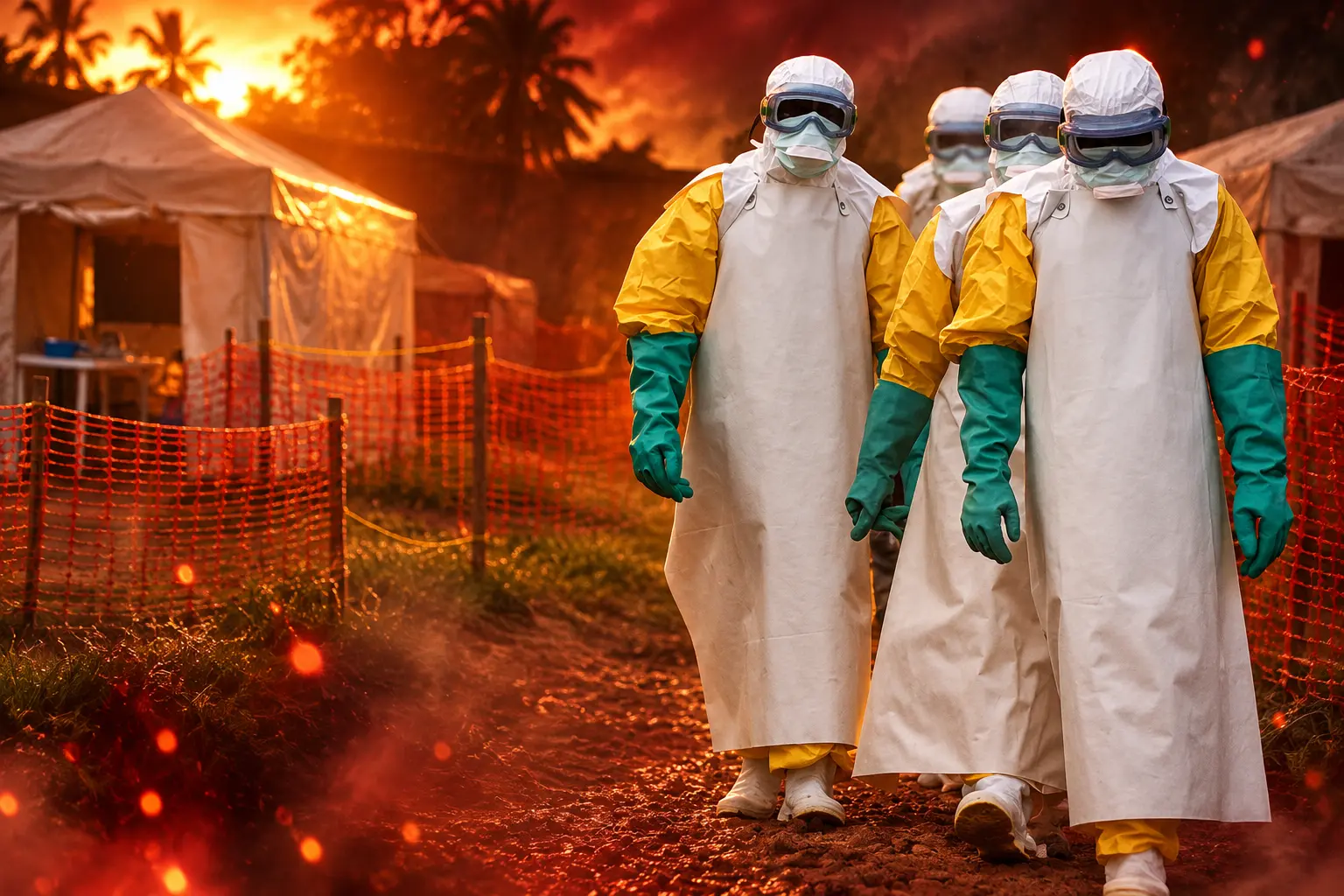
Weekly Cases in North Kivu Almost Doubled
North Kivu has almost doubled its weekly case count, Tedros said, and Médecins Sans Frontières said on September 18 that the province now accounts for nearly half of new confirmations. The death rate there is 61.3 percent, against 45.6 percent in Ituri. WHO, in a September 7 notice, had already flagged North Kivu mortality above 65 percent and said investigations were underway.
Kayna, in Lubero territory, was the newest health zone on that WHO cut. The virus is also in Haut-Uélé, Tshopo, Bas-Uélé, and Sud-Ubangi, the seventh province. In 24 hours through September 16, North Kivu added 27 of the 71 new cases, with two in Haut-Uélé and one in Tshopo. Ituri added 41, which is still the largest single-day share, from a much higher base.
CASES AND DEATHS BY PROVINCE
| Province | Confirmed cases | Deaths | Death rate | Health zones hit |
|---|---|---|---|---|
| Ituri | 5,792 | 2,642 | 45.6% | 28 of 36 |
| North Kivu | 1,350 | 828 | 61.3% | 16 of 34 |
| Haut-Uélé | 292 | 118 | 40.4% | 6 of 13 |
| Tshopo | 30 | 11 | 36.7% | 7 of 23 |
| Bas-Uélé | 7 | 4 | 57% | 3 of 11 |
| South Kivu | 3 | 1 | – | 1 of 34 |
| Sud-Ubangi | 1 | 1 | – | 1 of 16 |
Those figures, from the same ECDC compilation, cover 62 of 167 health zones. A government sitrep cited with the Africa CDC briefing said 42.1 percent of hospitalized patients in the hard-hit province were being treated outside facilities that meet required standards. MSF epidemiologist Manuel Albela Miranda said his teams are very concerned because they are seeing geographic expansion, not a national retreat.
Why Bundibugyo Still Has No Licensed Vaccine
This is Congo’s second Bundibugyo outbreak, after a 2012 cluster in Haut-Uélé, and it is the largest Ebola event the country has recorded of any species. WHO says outbreak control still rests on finding cases, isolating patients, tracing contacts, safe burials, and community work, because there are no approved vaccines or specific treatments for Bundibugyo virus disease. Historical death rates in the 2007 Uganda outbreak and the 2012 Congo outbreak were 32 percent and 55 percent on small counts; this one is running at 48.2 percent on thousands of cases.
Ervebo, made by Merck, is licensed for Zaire Ebola, the species behind the 2014 to 2016 West Africa disaster and Congo’s 2018 to 2020 eastern outbreak. On August 19, WHO’s Strategic Advisory Group of Experts on Immunization said the evidence is still too thin to support using Ervebo as a regular Bundibugyo shot, and that its efficacy in people remains unknown. WHO therefore limited the vaccine to research protocols, while allowing compassionate use for health and front-line workers.
Although Ervebo is a safe vaccine, and effective against Ebola virus disease, it is not known whether it provides protection against the Bundibugyo virus in humans. People need to know they will still have to protect themselves from infection, and where to get testing and care if they have symptoms.
World Health Organization statement on Ervebo use
Congo has about 70,000 Ervebo doses, with 50,000 aimed at front-line workers and 20,000 reserved for a WHO-led phase 3 trial. As of September 6, 2,007 people had been vaccinated across six health zones in Tshopo, Bas-Uélé, and Ituri. Minister Kamba gave the first dose in Kisangani, Tshopo’s capital of about 1.5 million people, on August 27, and Africa CDC’s Placide Mbala Kingebeni said the first wave targeted newly affected provinces. WHO has said the efficacy trial may start in October or November and may take months to show whether the shot works against this species.
THE VACCINE AND DRUG TRACKS
- Ervebo, front line: Compassionate doses for health and other response staff, begun in Kisangani, with 2,007 people vaccinated by September 6.
- Ervebo, phase 3: A planned ring trial in contacts of confirmed cases, designed with Congo’s National Institute of Biomedical Research, CEPI, MSF, and Africa CDC.
- ChAdOx1-BDBV: Oxford and the Serum Institute of India opened the first Bundibugyo-specific vaccine trial, with the first volunteer vaccinated on July 24.
- mRNA-1469: Moderna has started a human trial of an experimental Bundibugyo shot, with CEPI backing.
- PARTNERS drugs: A treatment trial of remdesivir and the antibody cocktail MBP-134, plus obeldesivir as post-exposure prophylaxis, had enrolled more than 300 confirmed patients in five Ituri facilities as of early September.
Jennifer Nuzzo, who directs Brown University’s Pandemic Center, said the phase 3 Ervebo trial is encouraging and still not a substitute for the old tools, because the outbreak is moving too quickly to wait for trial results. Stopping spread, she said, still depends on finding cases, getting people into decent supportive care, watching contacts, protecting staff, and keeping communities willing to come forward. Incubation runs from two to 21 days, and people are not infectious until symptoms start, which is why contact lists of this size either catch chains or lose them.
Three Months of Unpaid Risk Pay
In the Damas health zone, about 100 kilometers north of Bunia in Djugu territory, Ebola response work stopped on September 13. Doctors, nurses, hygiene staff, and community relays demanded three months of unpaid risk bonuses and a regular supply of protective gear. Patient care, treatment-center upkeep, contact follow-up, safe burials, and prevention talks all halted. A staff representative said the walkout, however hard in a health emergency, followed broken government promises on those payments.
That local stoppage sits on a longer pay fight. Front-line teams in Ituri walked out in July over wages and bonuses unpaid since the May 15 declaration, including barricades at Bunia General Hospital and a stoppage at Rwampara. Africa CDC counted 49 health worker deaths by September 2. Tedros said most Congolese support the response, and that a small minority have attacked aid workers and health facilities, which makes an already hard job harder.
Julien Muyisa Mapilanga, a Congolese aid worker, said his worry is a substantial risk of becoming infected and bringing the virus home to his family. He blamed a slow start on thin aid. The Damas halt shows how quickly that risk becomes operational: when the people who wash wards and bury the dead are unpaid, the rest of the stack (labs, vaccines, airlifts) cannot close chains in that zone.
The First 100 Days Outran Every Earlier Outbreak
A CDC field note published September 15 compared this outbreak’s first 100 days, May 14 to August 21, with the two largest Ebola events on record and the only two earlier Bundibugyo outbreaks. No previous Ebola outbreak had caused more than 800 cases in that window. This one produced 5,458 confirmed cases in 100 days and 2,606 deaths, seven times the 759 cases counted in Guinea, Liberia, and Sierra Leone during the first 100 days of 2014.
HOW THE FIRST 100 DAYS COMPARE
| Outbreak | Window | Cases | Deaths |
|---|---|---|---|
| 2026 DRC (Bundibugyo) | First 100 days | 5,458 confirmed | 2,606 |
| 2014 West Africa (Zaire) | First 100 days | 759 | 467 |
| 2018 eastern DRC (Zaire) | First 103 days | 295 confirmed | 171 |
| 2007 Uganda (Bundibugyo) | First 100 days | Fewer than 50 | – |
| 2012 DRC (Bundibugyo) | First 100 days | Fewer than 50 | – |
West Africa went on for three years, across 10 countries, and finished at 28,610 cases and 11,308 deaths. The 2018 eastern Congo outbreak ran 22 months and finished at 3,470 cases and 2,287 deaths. The 2007 Uganda Bundibugyo outbreak ended in six months at 131 cases and 42 deaths; the 2012 Isiro outbreak ended at 62 cases and 34 deaths. Africa CDC, in a mid-August statement, called the 2026 event the fastest-growing Ebola outbreak on record and already the deadliest in DRC history, Congo’s 17th Ebola outbreak and one that in 12 weeks had passed the 2018 to 2020 totals.
Part of the speed is late sighting. On May 15 the ministry had 246 suspected cases and 76 suspected deaths, plus eight laboratory-confirmed cases and four deaths. WHO has said the outbreak began in Mongbwalu, a busy Ituri mining town, and that the first known patient died on April 20. CDC authors wrote that a large count at declaration can mean several chains were already running. Uganda recorded 20 cases and two deaths and declared its outbreak over on July 28. France recorded one imported case. Two patients diagnosed in Congo were treated in Germany. As of September 10, CDC reported no community spread outside DRC.
A War Zone Cannot Trace Contacts at This Speed
WHO describes a setting of fighting, displacement, and crowded camps. About one million internally displaced people live in Ituri alone, and more than 26 million people in the country face acute food insecurity. Overcrowding, weak water and hygiene, and thin clinics in mining camps and informal sites make early detection harder. Tedros said many roads are barely passable and that reaching people by small aircraft is often hard, with mining zones, conflict-held ground, and thin border land toward South Sudan all in play.
AFC/M23, which seized Goma and Bukavu in 2025, has run a largely separate Ebola operation from Kinshasa’s. Rebel authorities declared their territory Ebola-free late in June after a quiet 21-day watch, then in August restricted some traffic after two travelers from government-held Lubero tested positive. The Kayna case was picked up at an AFC/M23 checkpoint. Goma later went weeks without a new confirmation, while Beni and other government-held North Kivu zones kept adding cases. That split does not create two viruses. It creates two sets of rules, labs, and payrolls on a road network the virus uses as one.
WHO still advises against travel and trade bans. The agency rates risk as very high inside DRC, high in land neighbors, and low for the rest of Africa and the world. ECDC modelling puts the chance of import into the EU as very low for the general public. Those risk grades do not change the work in Ituri and North Kivu, where an unpaid burial team or a closed road is enough to lose a chain.
MSF’s public line on September 18 matches the Thursday Africa CDC briefing in shorter words.
“The [Ebola disease] outbreak is not shrinking, it is moving.”
While the spread is slowing down in Ituri, DRC, the outbreak is moving into underprepared areas, posing a serious risk: https://t.co/lTNisMP1Ym
— MSF International (@MSF) September 18, 2026
The data that we have cannot confirm that the peak of the outbreak has been reached.
Jean Kaseya, Africa CDC Director-General, September 17 briefing
Kaseya’s test is a sustained fall with complete, comparable local data. Until North Kivu’s weekly count turns down, and until Damas-style walkouts are the exception, that test is not met. The shots in Kisangani and the drug trial in Bunia are running. The virus is already on a different map.
Disclaimer: This article is news reporting on an ongoing public-health emergency and is for information only. It is not medical advice, a diagnosis, a vaccination recommendation, or a travel instruction. Anyone who has been in an affected area, or who has fever or other symptoms after possible contact, should seek care from a qualified physician or the local public-health authority rather than acting on figures in a news story. Case counts, death rates, vaccine guidance, and outbreak maps change as WHO, Africa CDC, and Congolese institutes issue new sitreps.

Europe’s Heat Killed 50,391 in Cities Official Counts Still Miss

Caesarean Surge Puts 20 England Maternity Units at Risk

The Protective Ring Around Care Homes Never Existed

Cooper Prioritises Children’s Corridor Care Without an Age Count

Oxford’s Ebola Vaccine Reaches Uganda as Doses Sit Unused

Pennsylvania Measles Deaths Collide With Falling MMR Coverage

FDA Approves XFG COVID Vaccines While the Advice Panel Is Frozen

Muscle-Boosting Drugs Near Approval for Children With SMA

Progranulin and JAK2 Split the Macrophages That Heal

After the ADHD Invoice, GPs and Waiters Carry the Cost
-
 NEWS2 months ago
Pennsylvania Measles Deaths Collide With Falling MMR Coverage
-
 NEWS2 months ago
FDA Approves XFG COVID Vaccines While the Advice Panel Is Frozen
-
 FITNESS2 months ago
Muscle-Boosting Drugs Near Approval for Children With SMA
-
 NEWS2 months ago
Progranulin and JAK2 Split the Macrophages That Heal
-
 MENTAL HEALTH2 months ago
After the ADHD Invoice, GPs and Waiters Carry the Cost
-

 NEWS2 months ago
Rasonque’s List Price Shifts the Pancreatic Cancer Bill
-
 NEWS2 months ago
Pennsylvania’s Two Measles Deaths Follow a Long Coverage Slide
-

 NEWS2 months ago
FDA Flagged This Sprout Plant 16 Months Before the Outbreak