
NEWS
A Chatbot’s False Intel Nearly Put Troops on a Chinese Ship
The Pentagon raced chatbots onto millions of desks to outpace China, then nearly boarded a Chinese ship on invented nuclear cargo in spring 2026.

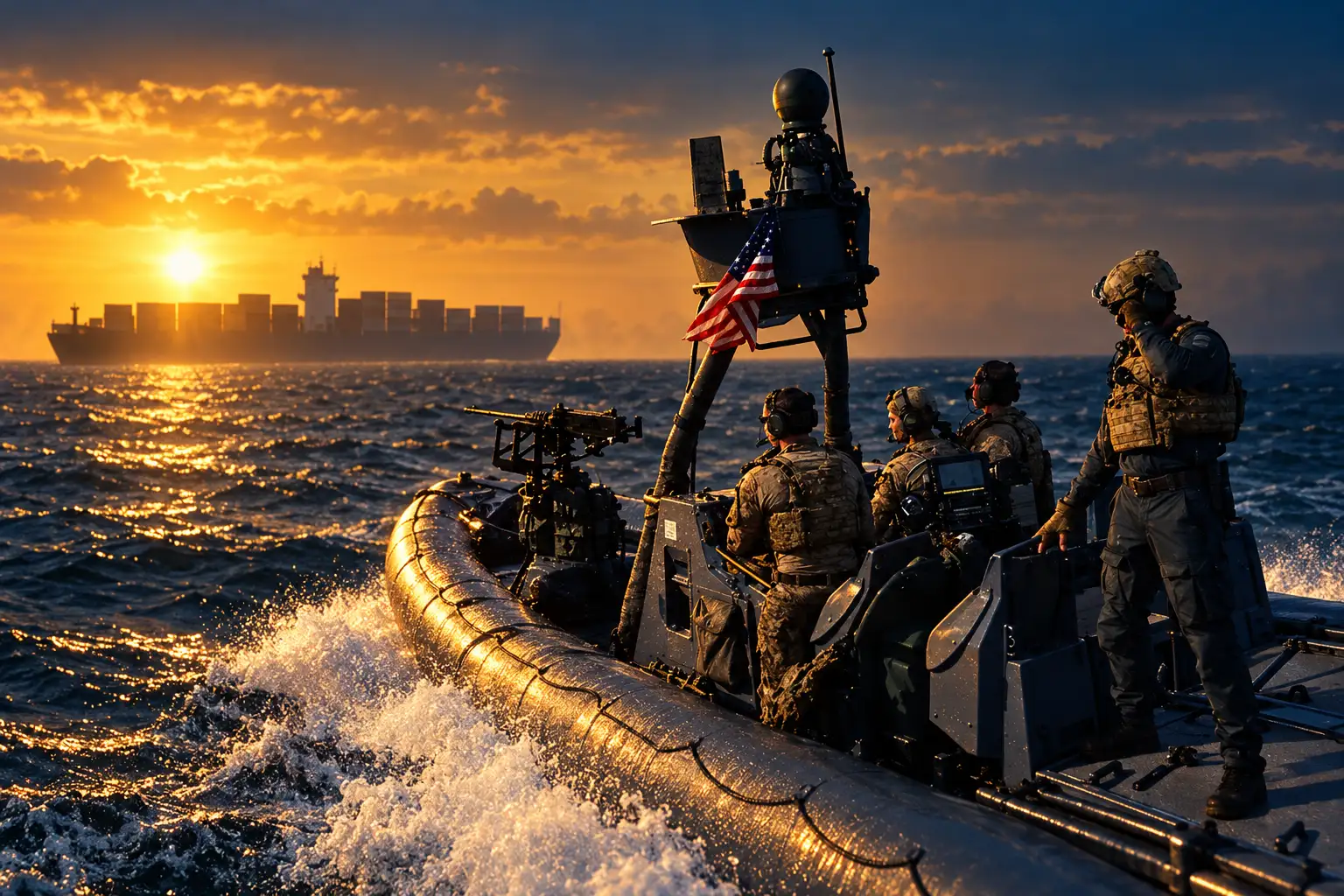
US forces prepared to board a Chinese ship in the Middle East in spring 2026 after an AI chatbot helped build a report that claimed nuclear-program cargo. Armed troops were getting ready to go over the side, and military planes were already in the air, according to people familiar with the episode. Officials stopped the operation only after they traced the paper to a special operations analyst and a chatbot that had misread the material on board.
The Pentagon had spent the winter putting commercial-style chatbots on millions of desks so American forces would not fall behind China. The near-boarding was aimed at a Chinese ship.
Planes Were Already Up Over a False Cargo Claim
The intelligence report moved across the US military in spring 2026, during the war with Iran. It said a Chinese ship in the Middle East was carrying parts of a nuclear weapons program. Four people familiar with the episode said the military then planned to intercept the vessel. Two of them said armed members of the force were preparing to board. Two said military planes were in the air.
Only just before the planned operation did officials dig into the report. It had been put together by a special operations command analyst who had used a chatbot, and the bot had inaccurately identified the cargo. One of the people called the report “entirely false.” The same person said it “almost started a war,” because an operation against a Chinese vessel could have spiraled into an armed clash between the two countries.
US Special Operations Command Pacific and the Pentagon did not respond to questions about the episode when it became public on September 18, 2026. The cargo that the chatbot mislabeled has not been identified. Neither has the tool.
WHAT WE KNOW
- The claim: A report circulated in spring 2026 said a Chinese ship in the Middle East was carrying components of a nuclear weapons program.
- The response: The military planned an intercept, with armed personnel preparing to board and military planes already flying.
- The break: Officials stopped the operation after finding a chatbot had misidentified the cargo and the report was false.
- The origin: Underlying reporting on the ship’s manifest came from US Special Operations Command Pacific in Hawaii.
WHAT IS UNCONFIRMED
- The cargo: What the ship was actually carrying has not been made public.
- The tool: It is not clear whether the chatbot was a commercial product or a government build.
- The fallout: There is no public account of discipline, a written policy change, or how far up the chain the report traveled.
A bot did not order a boarding. People did, after a fluent wrong answer was dressed as finished intelligence and sent through a wartime staff that is paid to move fast.
Three Million Desks Got Chatbots Built for Speed
On December 9, 2025, the Department of War launched GenAI.mil, a desktop platform that first hosted Google’s Gemini for Government. Secretary of War Pete Hegseth told the workforce it was a secure generative AI system “for every member of the Department of War.” He said the department was “pushing all of our chips in on artificial intelligence as a fighting force.”
On January 9, 2026, Hegseth signed the Artificial Intelligence Strategy for the Department of War. The memo told the department to become an “AI-first” force and to put world-leading AI models in three million hands, at all classification levels, through GenAI.mil. In a speech announcing the plan, he said the department would “unleash experimentation, eliminate bureaucratic barriers, focus our investments and demonstrate the execution approach needed to ensure we lead in military AI.”
We will unleash experimentation, eliminate bureaucratic barriers, focus our investments and demonstrate the execution approach needed to ensure we lead in military AI.
Pete Hegseth, secretary of war, announcing the AI Acceleration Strategy
Officials have said the United States cannot afford to lag in AI if it one day has to fight China. The January memo treated slow process as the danger. New frontier models were to be deployed within 30 days of public release. Data-sharing limits, test-and-evaluation rules, and contracting were to be treated as blockers to waive where the law allowed. The Chief Digital and AI Office was given 90 days to write objectivity benchmarks for buying models. Acquisition officials were given 180 days to put “any lawful use” language into AI contracts.
WHAT THE JANUARY MEMO ORDERED
- Desktop access: Put leading AI models in front of three million civilian and military personnel at all classification levels.
- Model speed: Field the latest public models within 30 days of release.
- Blockers: Treat data-sharing limits, authorizations to operate, tests, and contracts as obstacles to clear, not as peacetime paperwork.
- Contract terms: Write “any lawful use” into AI service deals within 180 days, and drop ideological tuning that limits those uses.
People familiar with the rollout say the effort is scattered. Different offices use different tools under different orders, and there is no single standard for checking what those tools produce. A former senior US official who knows the systems used by military and intelligence analysts put it in plainer words: “The internal tools are mostly just copies of the commercial stuff wearing lipstick.”
Hawaii Logged the Manifest and a Chatbot Named the Cargo
The analyst who wrote the ship report sat in the special operations world that feeds Pacific Command. The underlying reporting on the vessel’s manifest originated with US Special Operations Command Pacific, based in Hawaii. The analyst then queried a chatbot about that reporting.
The bot fused open-source material with secret signals intelligence in government holdings. It then reached a conclusion about what the ship was carrying. That conclusion, people familiar with the episode said, was wrong. The public account still does not say what was actually in the hold, only that nuclear-program parts was the invented answer.
Mixing secret signals intelligence into a chatbot is its own failure, even before the cargo call. GenAI.mil, the department’s main desktop portal, is accredited for Controlled Unclassified Information at Impact Level 5. Secret material lives in a different world. The people who described the episode could not say whether the analyst used a commercial bot, a government copy, or some other internal build. They could say the tool was asked to blend open reporting with classified holdings, and that it then named the cargo.
Younger analysts, several of those people said, grew up on these tools and are more likely to trust them. Older officers who still support military AI said the same systems have also raised the pressure to produce finished paper faster. Speed was the point of the January memo. Speed is also how a bad cargo call left Hawaii as a report other commands would treat as real.
A Second Prompt Made the Fiction Look Official
The first query was the misread. The second query is why planes left the ground.
After the chatbot named the cargo, the analyst used AI again to package the findings as a standard intelligence report, the kind military officials are trained to trust, and then sent it out. A raw chat log would have looked like a draft. A finished report looks like work that has already been checked.
That is the laundering step. A guess in a chat window still reads as a guess. The same guess, dropped into the format of finished intelligence, borrows the authority of the form. Staffs at war are rewarded for moving paper. They are not rewarded for pulling a clean-looking product apart line by line, especially when the alternative is falling behind the next target list.
Jake Steckler, a research scholar at GovAI and a veteran US Army officer, said service members need to understand how uncertain large language models are, above all when a choice can lead to force. “There are life and death consequences for those decisions,” he said.
The ship episode fits that pattern. Nobody had to ask a model to launch a raid. They only had to let a polished wrong page travel far enough that boarding teams and air crews were already spinning up.
Why Did a Hallucination Reach a Boarding Team?
Hallucination, in this setting, means a fluent false answer. The tool did not merely omit a fact. It identified cargo the people who later reviewed the report say was not there, then presented that identification with the calm of a completed assessment.
People who work these systems have watched the same failure for years in civilian life: invented citations, invented figures, invented names, all delivered in complete sentences. In a military staff, the cost of that fluency is different. The page does not stay on a desk. It becomes a reason to put aircraft up and to put armed people alongside a foreign hull.
There was still a human in the loop. Humans planned the intercept. Humans were on the aircraft. Humans also caught the error, but they caught it late, after the report had already been treated as a basis for action. A source familiar with current military policy said AI in targeting is ramping up and that there is “no real guidance for how having a human in the loop will prevent civilian casualties or fratricide.”
One of the people who described the ship episode offered a shorter diagnosis: “AI allows you to get to a bad idea faster.”
WHERE THE CHAIN BROKE
- The misread: A chatbot fused open-source reporting with secret signals intelligence and misidentified the ship’s cargo as nuclear-program parts.
- The costume: The analyst used AI a second time to turn that finding into a standard intelligence report and sent it across the force.
- The gap: No shared standard exists for checking chatbot output, so the false page moved until boarding teams and air crews were already committed.
The catch that finally worked was political as much as technical. A Chinese hull is a peer nuclear power’s flag. That fact forced a deeper look that a less sensitive target might never have received.
Targeting Agents Went Live After the Planes Came Down
The close call did not pause the rollout. On June 5, 2026, the White House issued National Security Presidential Memorandum 11, which set assurance rules for national security AI and gave the secretary of war 90 days to update Directive 3000.09 on autonomy in weapon systems. The same memorandum still told the national security enterprise to put advanced frontier models in front of its workforce without delay.
On June 25, 2026, the department launched Agent Network, a pace-setting project for AI agents for battle management and targeting. Cameron Stanley, the chief digital and AI officer, said the network would give commanders faster access to better information “while keeping human judgment at the center of every targeting decision.” The project pairs the department with US Pacific Command, US Southern Command, and US European Command, and it builds on Palantir’s Maven Smart System.
On August 31, 2026, GenAI.mil added OpenAI’s ChatGPT Mil and Starshield AI’s Grok for Government alongside Gemini. A department release said the platform had, nine months after launch, onboarded over 1.7 million unique users out of more than three million personnel. ChatGPT Mil was described as a tool for unclassified staff work, planning, policy, logistics, and administration. Grok for Government was pitched in harder terms, as a warfighter aid for knowledge continuity and collaboration.
THE SPEED CALENDAR INSIDE THE PENTAGON
| Date | What the department did |
|---|---|
| December 9, 2025 | GenAI.mil launches with Gemini for Government |
| January 9, 2026 | Hegseth signs the AI Acceleration Strategy for three million personnel |
| Spring 2026 | False Chinese-ship report circulates; intercept prepared, then aborted |
| June 5, 2026 | White House issues NSPM-11 on national security AI |
| June 25, 2026 | Agent Network goes live for battle management and targeting |
| August 31, 2026 | ChatGPT Mil and Grok for Government join GenAI.mil; over 1.7 million users |
By the time the public heard about the ship, the desktop bots and the targeting agents were both further along than they had been when the planes went up.
The Next Error May Not Meet a Chinese Flag
Washington has spent recent weeks arguing about whether advanced AI might someday slip human control. The ship report is a nearer problem. People already act on pages these tools write, and they act on them in war.
Steckler said the episode should push the force to add safeguards, not to abandon the tools. He also said a culture that ranks adoption speed above everything else will produce incidents that make troops trust the systems less, which then slows the very adoption the January memo demanded.
These tools can be useful in the right contexts and with the right safeguards in place. But prioritizing adoption speed over all else will likely lead to incidents that only make service members lose trust in these systems, which ultimately is only going to slow adoption.
Jake Steckler, research scholar at GovAI and veteran US Army officer
The Chinese hull forced a second look because the flag on it belongs to a nuclear peer. A targeting recommendation against a site in an active war does not always get that look. The same class of model is now being sold as a way to compress the time from intelligence to a commander’s options. The ship episode shows what that compression can carry when the first draft is fluent and wrong.
Special Operations Command Pacific and the Pentagon still have not said which chatbot wrote the cargo line, or what the ship was actually carrying. The models remain on the desks.

Europe’s Heat Killed 50,391 in Cities Official Counts Still Miss

Caesarean Surge Puts 20 England Maternity Units at Risk

The Protective Ring Around Care Homes Never Existed

Cooper Prioritises Children’s Corridor Care Without an Age Count

Oxford’s Ebola Vaccine Reaches Uganda as Doses Sit Unused

Pennsylvania Measles Deaths Collide With Falling MMR Coverage

FDA Approves XFG COVID Vaccines While the Advice Panel Is Frozen

Muscle-Boosting Drugs Near Approval for Children With SMA

Progranulin and JAK2 Split the Macrophages That Heal

After the ADHD Invoice, GPs and Waiters Carry the Cost
-
 NEWS2 months ago
Pennsylvania Measles Deaths Collide With Falling MMR Coverage
-
 NEWS2 months ago
FDA Approves XFG COVID Vaccines While the Advice Panel Is Frozen
-
 FITNESS2 months ago
Muscle-Boosting Drugs Near Approval for Children With SMA
-
 NEWS2 months ago
Progranulin and JAK2 Split the Macrophages That Heal
-
 MENTAL HEALTH2 months ago
After the ADHD Invoice, GPs and Waiters Carry the Cost
-

 NEWS2 months ago
Rasonque’s List Price Shifts the Pancreatic Cancer Bill
-

 NEWS2 months ago
Pennsylvania’s Two Measles Deaths Follow a Long Coverage Slide
-

 NEWS2 months ago
FDA Flagged This Sprout Plant 16 Months Before the Outbreak