
NEWS
Bronx Legionnaires Cluster Follows Years of Tower Rules
A Yankee Stadium cooling tower tested positive in a South Bronx Legionnaires cluster that has killed two, including on towers already filing monthly tests.

A Yankee Stadium cooling tower was one of 10 in the South Bronx that tested positive for Legionella during a Legionnaires’ disease cluster that has killed two people. City health officials said on Sept. 17 that 13 people had been diagnosed in Melrose and Morrisania.
The Health Department ordered those towers cleaned by Sept. 14. Eight of the 10, including the stadium’s, had already been meeting a monthly testing rule that took effect in May.
Ten Cooling Towers Flagged Across Two ZIP Codes
The cluster sits in ZIP codes 10451 and 10456. Officials opened the probe on Sept. 10 after five people were diagnosed and one person had died, then sampled every cooling tower in the investigation within 12 hours.
Preliminary PCR tests were finished by Sept. 12, and orders went out the same day. Inspectors tested 24 towers and got positive DNA hits on 10. Full draining, cleaning, and disinfection was required by Sept. 14, while slower culture tests continued.
The department 10 cooling towers in the South Bronx named on the list were 820 Concourse Village West, 234 E. 149th St., 1 E. 161st St., 470 E. 161st St., 1265 Franklin Ave., 567 Melrose Ave., 3339 Park Ave., 1160 Teller Ave., 890 Washington Ave., and 1085 Washington Ave.
1 E. 161st St. is Yankee Stadium. 234 E. 149th St. is Lincoln Hospital, and NYC Health + Hospitals said that tower was drained, cleaned, and disinfected. 890 Washington Ave. is Boricua College’s Bronx campus. A dialysis site and a gym were also among buildings later identified in the same two ZIP codes.
As of Sept. 12, nine people had been diagnosed: three were in the hospital, four had gone home, one was never admitted, and one had died. By Sept. 17 the count was 13 cases and two deaths, with two people still hospitalized and nine discharged.
THE WEEK THE CLUSTER SURFACED
- Late August 2026: Health officials mark this as the start of the window for people who lived, worked, or visited the two ZIP codes.
- September 10, 2026: The Health Department opens the investigation after five diagnoses and one death, and finishes sampling towers the same day.
- September 11, 2026: A PCR test is run on the Yankee Stadium tower as part of the neighborhood sweep.
- September 12, 2026: PCR work on the sampled towers is complete; nine people are tied to the cluster and clean-out orders go to the 10 positive systems.
- September 13, 2026: The stadium tower is drained and cleaned in the morning; the 10-address list is made public.
- September 14, 2026: The remediation deadline for all 10 towers lands.
- September 17, 2026: A second death is confirmed and the case count reaches 13.
Health Commissioner Dr. Alister Martin said after the second death that every tower that tested positive on the first screen had been disinfected. Staff had spoken with more than 1,700 community members, handed out more than 4,000 pamphlets, and reached more than 140 groups.
Today we ordered 10 cooling towers in the South Bronx to be cleaned and disinfected as we continue our investigation into a community cluster of Legionnaires’ disease.
Learn more: https://t.co/bvfjdERcDM pic.twitter.com/Z1SvBe6Bht
— nychealthy (@nycHealthy) September 13, 2026
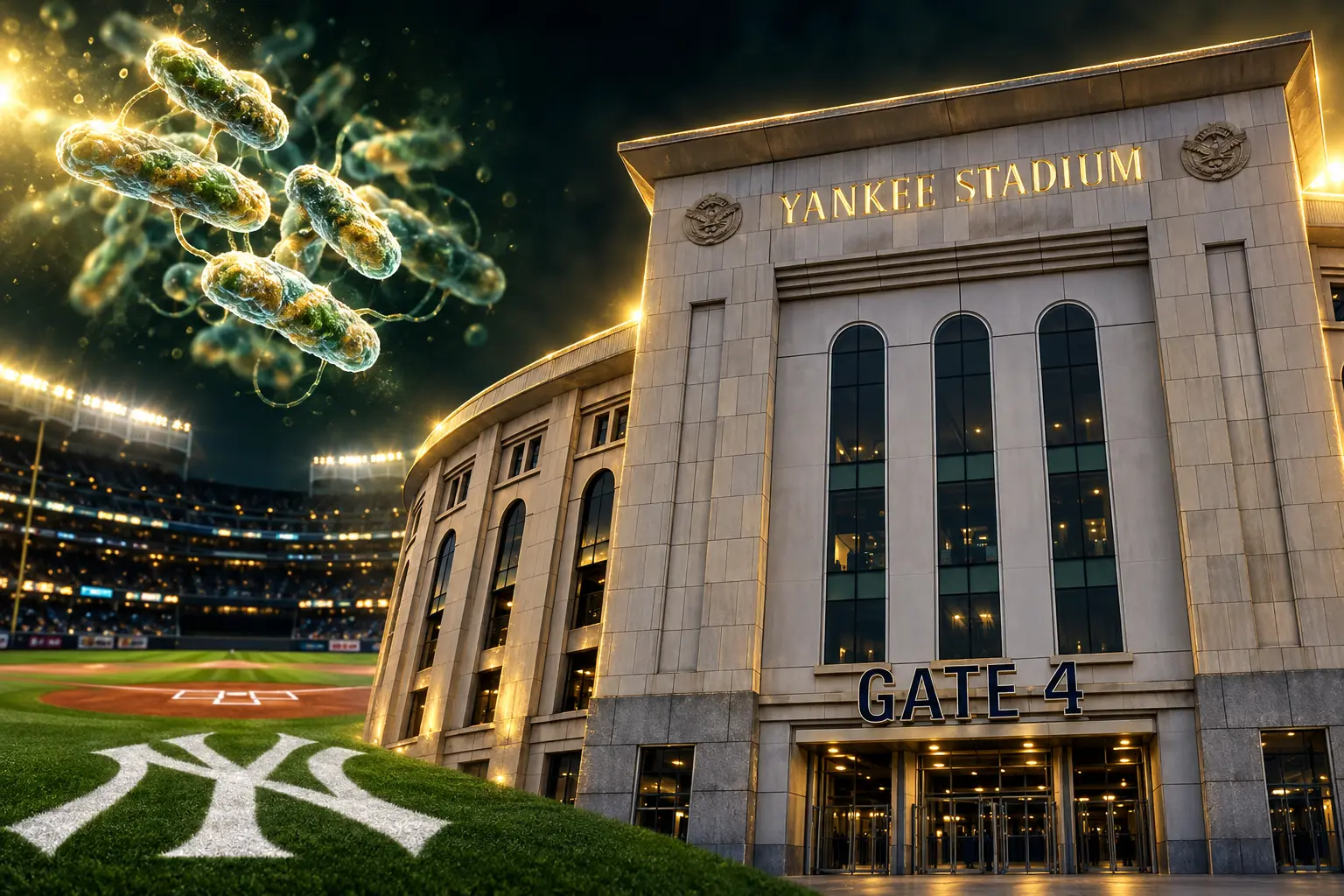
Yankee Stadium’s Tower Had Just Tested Negative
The Yankees said the ballpark’s cooling towers were installed in 2024 and are tested for Legionella each month. The club said its most recent independent Legionella test, on Aug. 20, was negative, and that weekly water-quality checks were done on Aug. 26, Sept. 2, and Sept. 9.
The city’s PCR sample on Sept. 11 still found Legionella DNA. The team called the result a trace amount and said the tower was drained, cleaned, and disinfected on the morning of Sept. 13, while a Subway Series weekend with the Mets was underway.
“No current cases have been associated with Yankee Stadium,” the Yankees said. The club added that the Health Department had not asked it to postpone games at any point in September.
City officials drew the same line in a different way: people who had been inside the stadium were not at greater risk than anyone else who had been in those two ZIP codes, and there was no added risk from being inside any of the 10 buildings on the list. Tap water, showers, and air conditioners in the area remained safe to use unless officials said otherwise.
The sharper detail sat in the compliance file. Eight of the 10 PCR-positive towers, the stadium’s among them, were already in line with the 31-day testing rule. Only 820 Concourse Village West and 1265 Franklin Ave. had failed to turn in the required testing information.
The South Bronx Has Been Here Before
Cooling towers sit on roofs and dump heat by blowing a water mist outdoors. If that water is warm and poorly treated, Legionella can grow and ride the mist into the street. New York wrote its first citywide tower law after the 2015 South Bronx outbreak, which a CDC field report later tallied at 138 cases and 16 deaths tied to a hotel tower.
In 2025 a Central Harlem cluster ended with 114 cases, 90 hospitalizations, and seven deaths. Lab work matched patient samples to towers at Harlem Hospital on Lenox Avenue and a nearby city construction site at 40 West 137th Street. At least 90 percent of those patients (104 of 114) already had a known risk factor for severe disease.
After Harlem, the City Council and the Health Department tightened the rules again. monthly Legionella sampling starting in May replaced longer gaps between tests, with no more than 31 days between samples, plus a required summer chemical shock between July 1 and Aug. 31. The city counts about 5,000 registered cooling-tower systems.
By Sept. 5, officials said 82 percent of systems were meeting the monthly testing rule. They had done more than 900 tower inspections since May 8 and collected more than $111,000 in paid fines. Annual inspections for 2025 were finished, they said, and 2026 inspections were on schedule.
NYC COOLING-TOWER CLUSTERS, SIDE BY SIDE
| Year | Neighborhood | Cases | Deaths | What followed |
|---|---|---|---|---|
| 2015 | South Bronx | 138 | 16 | First city cooling-tower registration and testing law |
| 2025 | Central Harlem | 114 | 7 | Monthly testing and summer shock rules advanced |
| 2026 | Melrose and Morrisania | 13 as of Sept. 17 | 2 | 10 towers ordered cleaned; cultures still pending |
The 2026 cluster is smaller than 2015 or 2025, and the city got swabs into the field the same day it named the ZIP codes. The pattern underneath has not moved: people get pneumonia first, then the registry is used to hunt rooftop mist.
Who Gets Sick From the Mist
Most healthy people who breathe Legionella never fall ill. The people who do are usually older, already sick, or both, which is why a ballpark headline can hide the actual ward.
New York’s own warning list matches the CDC’s: adults 50 and older, people who smoke or vape, people with chronic lung disease, people with weakened immune systems, and people on immune-suppressing drugs. In Harlem last summer, that profile covered at least 104 of 114 patients.
Bronx Borough President Vanessa L. Gibson, after the second death, urged anyone who lives, works, or has visited ZIP codes 10451 or 10456 to get care right away for flu-like symptoms, and noted the illness can be treated if it is caught early. The disease is a pneumonia, not a stomach bug, and it does not spread from person to person in ordinary contact.
WHAT TO WATCH FOR AFTER TIME IN 10451 OR 10456
- Timing: Symptoms usually start 2 to 14 days after exposure, though they can arrive later.
- Early signs: Fever, chills, muscle aches, cough, and shortness of breath, sometimes with headache.
- Other clues: Confusion, diarrhea, or nausea can show up with the lung symptoms.
- How doctors confirm it: A chest x-ray can show pneumonia; a urine test and a sputum or lung sample are used to see if Legionella is the cause.
- Treatment: Certain antibiotics work when the illness is identified early, and many patients still need hospital care.
The CDC says about 1 out of every 10 people who get Legionnaires’ disease die of it. In a health-care stay, that figure is about 1 in 4. Window units and car air conditioners do not use recirculated water, so they are not the rooftop-tower problem.
A Positive PCR Test Does Not Name a Source
The first round of Bronx tests looked for Legionella DNA. That is a fast screen, and it is also a blunt one. Dead cells, live cells, and leftover genetic traces can all light up the same way, which is why a stadium PCR hit is not the same thing as a matched outbreak strain.
This test can detect the presence of Legionella bacteria DNA but cannot determine whether the bacteria are alive or dead and does not confirm that a cooling tower is the source of exposure. Only live Legionella bacteria can cause illness.
New York City Health Department, Sept. 13, 2026 statement
Culture tests, which show whether bacteria were alive when the water was drawn, can take up to two weeks. Until those results are compared with samples from patients, no tower on the list, including Yankee Stadium’s, has been named as the source.
People get this pneumonia by breathing in mist containing Legionella, not by drinking tap water and not by sitting next to a sick relative. Cooling towers, showers, hot tubs, and decorative fountains can all throw off that mist. In a community cluster, the extra risk is the neighborhood air around a dirty tower, which is why officials keep saying the seats inside a building are not the special danger.
That distinction got lost when the stadium address hit the wire. A PCR flag on a famous roof is a reason to drain the system. It is not proof that anyone caught pneumonia at a game.
Two Deaths, and the Culture Results Still Out
Martin announced the second death on Sept. 17 and said the city was still working to cut off exposure and trace cases.
I am saddened to share that a second person has died in connection with the South Bronx Legionnaires’ cluster.
Dr. Alister Martin, NYC health commissioner
THE CLUSTER IN FOUR FIGURES
- Diagnoses: 13 people tied to the cluster as of Sept. 17, up from five on Sept. 10 and nine on Sept. 12.
- Deaths: Two, the first reported with the Sept. 10 launch and the second on Sept. 17.
- Towers: 10 PCR-positive systems out of 24 sampled, all later described as disinfected.
- Compliance gap: 8 of those 10, including the stadium, had met the 31-day testing rule; two addresses had not filed the required test information.
Virtual and in-person town halls were held Sept. 13 and Sept. 15 at Metropolitan College. Culture results that can take up to two weeks were still outstanding after Sept. 17. Until those results land, the Health Department’s advice for ZIP codes 10451 and 10456 stays the same: flu-like symptoms after time in the area since late August means a call to a doctor, not a wait-and-see.
Disclaimer: This article is news reporting on a New York City Legionnaires’ disease cluster and related cooling-tower tests, and it is for information only. It is not medical advice, a diagnosis, or a treatment plan, and it does not tell any reader whether they were exposed or whether they should start or stop a medicine. Anyone with fever, cough, or trouble breathing after time in the affected area, or anyone who is unsure about their own risk, should talk with a licensed physician or other qualified clinician before acting. Case counts, tower results, and official guidance come from the public statements cited here and can change as cultures and patient tests come back.

Europe’s Heat Killed 50,391 in Cities Official Counts Still Miss

Caesarean Surge Puts 20 England Maternity Units at Risk

The Protective Ring Around Care Homes Never Existed

Cooper Prioritises Children’s Corridor Care Without an Age Count

Oxford’s Ebola Vaccine Reaches Uganda as Doses Sit Unused

Pennsylvania Measles Deaths Collide With Falling MMR Coverage

FDA Approves XFG COVID Vaccines While the Advice Panel Is Frozen

Muscle-Boosting Drugs Near Approval for Children With SMA

Progranulin and JAK2 Split the Macrophages That Heal

After the ADHD Invoice, GPs and Waiters Carry the Cost
-
 NEWS2 months ago
Pennsylvania Measles Deaths Collide With Falling MMR Coverage
-
 NEWS2 months ago
FDA Approves XFG COVID Vaccines While the Advice Panel Is Frozen
-
 FITNESS2 months ago
Muscle-Boosting Drugs Near Approval for Children With SMA
-
 NEWS2 months ago
Progranulin and JAK2 Split the Macrophages That Heal
-
 MENTAL HEALTH2 months ago
After the ADHD Invoice, GPs and Waiters Carry the Cost
-
 NEWS2 months ago
Rasonque’s List Price Shifts the Pancreatic Cancer Bill
-
 NEWS2 months ago
Pennsylvania’s Two Measles Deaths Follow a Long Coverage Slide
-

 NEWS2 months ago
FDA Flagged This Sprout Plant 16 Months Before the Outbreak