
NEWS
U.S. Measles Elimination Status Collides With Adult Outbreaks
A PAHO panel is reviewing U.S. measles-free status. Adult cases, congenital measles, and 92.4% kindergarten coverage already show the virus circulating.

A Pan American Health Organization panel meeting in Washington through November 13 is deciding whether the United States has lost measles elimination status it has held since 2000. Federal epidemiologists have already logged 5,182 confirmed measles cases in 2026 as of November 5, more than double the 2,289 cases recorded in all of 2025, and 41% of this year’s patients are age 20 or older.
Dr. Paul Offit, director of the Vaccine Education Center at Children’s Hospital of Philadelphia, said measles already has a foothold, whatever the panel writes down. “Independent of what PAHO says, measles is now endemic in the US,” Offit said. “We’re going to see it this year, we’re going to see it next year.”
PAHO’s Vote Will Stamp a Shift Already Underway
Elimination is a technical label, not a clinical one. PAHO defines a loss as endemic transmission that has been re-established: uninterrupted circulation of the same virus genotype and lineage for 12 months or more in a defined area. Countries that still hold the label can have travel-related outbreaks. They lose it when those chains stop dying out.
The Regional Monitoring and Re-Verification Commission, an eight-member body of outside experts chaired by Jon Andrus, is holding its sixth annual meeting from November 10 to 13. It is reviewing national reports for 2025 and the first half of 2026, including coverage, lab sequences, and outbreak response. PAHO Director Jarbas Barbosa will make the final call after the closed sessions, and officials have said that public notice should follow in the week of November 16.
THE 12-MONTH CLOCK PAHO IS USING
- 1963: The first measles vaccine is licensed in the United States, after years in which 3 to 4 million people were sickened annually, about 48,000 were hospitalized, and 400 to 500 died.
- 2000: PAHO determines the country has interrupted endemic transmission after a year with 85 reported cases, all tied to importations that did not keep spreading.
- January 20, 2025: PAHO sets the U.S. review clock at the outbreak that began January 20, 2025, the start date for asking whether 12 months of continuous spread have elapsed.
- November 2025: The same commission finds measles endemic again in Canada, and it classifies the United States as sustained with major concerns, alongside Mexico, Honduras, and Venezuela.
- November 10 to 13, 2026: The commission meets in Washington to weigh genomic and case evidence and to advise Barbosa on whether U.S. transmission now meets the endemic test.
Jennifer Nuzzo, director of Brown University’s Pandemic Center, described the current pattern as a string of fires that never fully go out. “It’s just like popcorn: outbreak, outbreak, outbreak, outbreak. All over the country,” she said. They grow, shrink, and pop up somewhere else.
Genomic sequencing could still let the United States keep the label if the many 2026 clusters do not share a lineage. Nuzzo called that kind of save a technicality. Michael T. Osterholm, director of the University of Minnesota’s Center for Infectious Disease Research and Policy, was blunter: if a truck hits you at 60 miles an hour, you know you had an accident. William Moss, an infectious-disease epidemiologist at Johns Hopkins Bloomberg School of Public Health, said a formal loss would tell other countries the United States is no longer up to a job it used to lead.
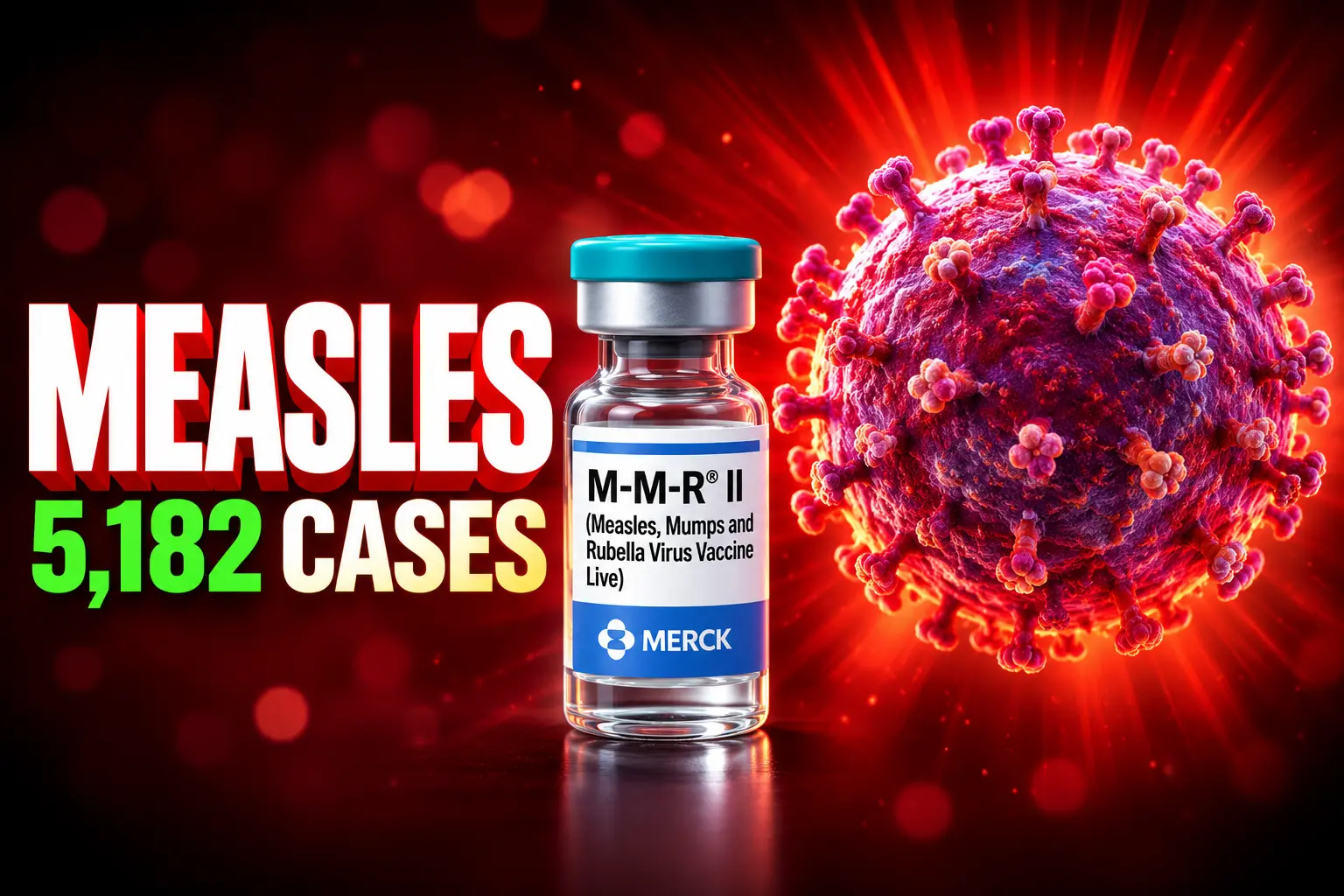
Adults Now Account for 41% of U.S. Measles Cases
Measles used to be a childhood illness. Before the 1963 shot, most children had it by age 15. The 2026 case file looks different. Of the 5,182 confirmed infections, 2,132 are in people age 20 and older. Another 2,104 are in ages 5 to 19. Only 908, or 18%, are in children under 5.
WHO IS GETTING MEASLES
| Age group | 2025 share (2,289 cases) | 2026 share (5,182 cases) |
|---|---|---|
| Under 5 years | 26% | 18% (908) |
| Ages 5 to 19 | 44% | 41% (2,104) |
| Age 20 and older | 29% | 41% (2,132) |
In Pennsylvania, the national hotspot, Offit said about two-thirds of infections have been in adults, a mix that is even older than the national 41% share for age 20 and up. That is the delayed bill from childhood gaps. People who skipped MMR years ago are meeting the virus as workers, parents, and patients in waiting rooms, not as kindergarteners.
Almost all of the spread is domestic. CDC counts 5,164 cases from 47 jurisdictions and 18 among international visitors. The visitor slice is 0.35% of the file. CDC also counts 43 new outbreaks in 2026, and 96% of confirmed cases (4,993 of 5,182) are outbreak-linked, including 1,385 still tied to chains that started in 2025. About 96% of patients were unvaccinated or had unknown status. Two MMR doses remain about 97% effective.
Pennsylvania Has Documented Congenital Measles for the First Time in Decades
The adult wave has a second, harsher edge. Pregnant patients cannot receive MMR because it is a live vaccine, so an immunity gap in that group turns into risk for the newborn. As of November 6, the Pennsylvania Department of Health said 97 of the state’s measles cases in 2026 were in pregnant women. In an October 19 alert, the department told clinicians that congenital measles, infection passed in the womb, had been identified in the state for the first time in decades. Doctors had already counted at least six babies born with measles by late October. The department does not keep a separate running congenital tally, because the definition is not fully standardized.
It’s gone from something we never see to something that we are now commonly seeing.
John Goldman, infectious-disease physician, University of Pittsburgh Medical Center in Harrisburg
Offit said the congenital risk is highest when a baby is delivered within 10 days of the mother developing a measles rash. Historical reports cited by the American Academy of Pediatrics suggest about a quarter of children born to mothers who are sick with measles in the days before labor acquire the infection. Those infants can develop pneumonia, encephalitis, or die. Pennsylvania’s first reported death in the current outbreak was a newborn. At least two babies in the state have died in this wave.
As of November 9, Pennsylvania had 1,505 confirmed cases across 45 counties, 290 hospital stays, and six measles-associated deaths. Only five of those 1,505 patients were vaccinated, less than 1%. Lancaster County midwives have been treating pregnant patients with measles since the outbreak took off there in April, including in Amish communities where childhood shot rates run well below the rest of the state. Dr. Evan Shirey, a pediatric infectious-disease physician at Penn State Health Golisano Children’s Hospital in Hershey, described babies gasping for air, children on oxygen, and patients on ventilators.
Kindergarten MMR Coverage Has Sat Below 95% for Six School Years
The adult and pregnancy cases sit on a coverage hole that opened well before this PAHO meeting. CDC’s SchoolVaxView report, posted August 17, 2026, puts national MMR coverage among kindergartners at 92.4% for the 2025-26 school year, down from 92.5% the year before and from 95.2% in 2019-20. Epidemiologists still treat 95% as the level that usually stops measles from spreading in a community. The United States has now been under that bar for six straight school years, from 2020-21 through 2025-26.
KINDERGARTEN MMR IN 2025-26
- National coverage: 92.4% of kindergartners had documented MMR, and about 280,000 kindergartners without documented MMR started school that year.
- Exemptions: 4.2% of kindergartners were exempt from one or more vaccines, up from 3.6% the year before, or about 155,000 children, with increases in 41 states and Washington, D.C.
- State spread: Only 10 states reached 95% MMR coverage, 18 states sat below 90%, and rates ran from 98.9% in West Virginia to 75.2% in Idaho.
- High-exemption states: 24 states reported exemption rates above 5%.
Andrew D. Racine, then president of the American Academy of Pediatrics, said more than a quarter of a million children started kindergarten last year without protection from the MMR vaccine. A 2.8-point national drop from 95.2% to 92.4% looks small on a spreadsheet. Measles does not need a large gap. If an infected person walks into a room of 100 unvaccinated people, about 90 are expected to catch it.
That is why blaming a single Washington tenure does not close the file. Dr. David Margolius, Cleveland’s director of public health and a director-at-large of the Big Cities Health Coalition, said vaccine hesitancy was rising before the current administration, and that pandemic-era disruptions were real. He said the health secretary could do much more to help rather than hurt, and he also said the case count is climbing in many places and could have risen under a more pro-public-health administration. Local pockets, including communities that refused shots 20 or 30 years ago, are now producing adult patients and pregnant patients. Federal messaging that casts doubt on MMR makes those pockets harder to close. Both things can be true in the same year.
What Losing Elimination Status Changes for Ordinary Patients
If a clinic or health department cannot confirm that you are immune, you can be asked for a blood test or told to stay home for 21 days. That is already happening in cities with hospital exposures, whether or not PAHO revokes the national label. Margolius has been telling Cleveland residents to locate proof of measles vaccination now, because exposure is no longer a theoretical drill.
“Now is the time to go and find that evidence, because now this is a real day-to-day life thing that could happen to you,” Margolius said. Without records, patients face an immunology blood draw or a 21-day quarantine. Cleveland teams have spent this year tracing people who shared hospital waiting rooms and elevators with measles patients, then calling adults who have never had the disease and do not think of it as their problem.
IF YOU CANNOT PROVE IMMUNITY AFTER AN EXPOSURE
- Written proof: Two documented MMR doses, or lab evidence of immunity, is what most health departments will accept to keep you out of isolation.
- A blood test: An antibody draw can stand in for a lost record, but it takes time a workplace or a school may not give you.
- Staying home: People without proof can be asked to quarantine for 21 days after their last exposure, the outer window in which measles can still appear.
- Pregnancy: MMR is not given during pregnancy, so nonimmune pregnant patients exposed to measles are steered toward immunoglobulin within six days, not toward a shot.
CDC figures put hospital care at 562 people so far in 2026, or 11% of confirmed cases. That is lower than the older rule of thumb that about one in five unvaccinated people with measles need a hospital, because the 11% is a share of all reported cases, including people whose shots are unknown. Among unvaccinated patients the hospital rate still runs higher, and it is highest in preschoolers. Offit noted that researchers have little modern U.S. data on adult measles, which is now a large share of the file. Mothers have delivered babies who already had the virus. That is a clinical problem a stamp in Washington does not create and a stamp will not reverse.
CDC and States Still Do Not Agree on How Many People Have Died
State health departments have reported eight measles-associated deaths in 2026: six in Pennsylvania, a child in New York, and an infant in Wisconsin. CDC’s public tally has stood at four and is marked as subject to change. The gap is not a rounding error. It is a fight over what the federal dashboard is for.
In late August, after Pennsylvania announced two measles-associated deaths, Health Secretary Robert F. Kennedy Jr. publicly suggested the fatalities might have been “altogether fabricated by one of the Governor’s hopeful staffers.” Pennsylvania Gov. Josh Shapiro called that claim inaccurate. CDC’s measles page then carried a note saying available information did not establish whether measles caused or contributed to the Pennsylvania deaths, or whether the people died of other causes while infected. Career staff had already accepted the state’s characterization, according to people familiar with the process. The agency later leaned on federal death records, which arrive slowly, instead of the long-standing practice of posting state outbreak deaths in near real time.
New York State’s health department reported a child’s measles-associated death in early November, the first in more than 30 years there. Wisconsin Department of Health Secretary Kirsten Johnson said an infant’s death was the first measles-linked infant death in that state in many years. Pennsylvania’s sixth death included an unvaccinated Jefferson County resident who tested positive after giving birth. None of the eight people counted by states had been vaccinated; several were infants too young for MMR. CDC still publishes a lower number. Local health departments are writing death notices while the national page lags. That is the machinery that would have to reconstruct elimination, and it is arguing with itself about the body count.
The Same Two Doses Still Stop Measles From Spreading
Brazil lost measles elimination status in 2019 and regained it in 2024 after it drove coverage back up. The U.S. path is the same one, and it does not wait on Barbosa’s letter. Two MMR doses prevent about 97% of infections. CIDRAP notes that vaccine supply is ample. Kindergarten coverage at 92.4%, with 18 states under 90% and Idaho at 75.2%, is the hole that has to close if the popcorn pattern is going to stop.
Nuzzo called a formal loss symbolic: a loss of standing, stature, and achievement. Offit called it a tremendous step backwards. For the people Margolius is calling, the symbol already arrived in an elevator. They have no personal experience with measles, he said, they have everything else going on in their life, and now they are getting this call.
Disclaimer: This article is news reporting on measles outbreaks and a pending public-health designation. It is informational only and is not medical advice, a diagnosis, or a recommendation about any person’s vaccination, pregnancy care, or isolation. Readers who think they have been exposed to measles, who are pregnant, or who are unsure of their immunity should contact a licensed physician, midwife, or local health department before acting. Case counts, death tallies, and elimination status can change as laboratories confirm infections and as PAHO issues its determination.

Falling Shot Rates Cost the U.S. Measles Elimination Status

NHS Record Snooping Gives Patients a Reason to Withhold

FDA Rejects Ivonescimab After the HARMONi Survival Miss

The Medicaid Work Delay Leaves January Checks Intact

Pelacarsen Cut Lp(a) 78%, and Heart Attacks Did Not Fall

Pennsylvania Measles Deaths Collide With Falling MMR Coverage

FDA Approves XFG COVID Vaccines While the Advice Panel Is Frozen

Progranulin and JAK2 Split the Macrophages That Heal

Alnylam Defends Amvuttra After Wainua’s ATTR-CM Trial Miss

Muscle-Boosting Drugs Near Approval for Children With SMA
-
 NEWS3 months ago
Pennsylvania Measles Deaths Collide With Falling MMR Coverage
-
 NEWS3 months ago
FDA Approves XFG COVID Vaccines While the Advice Panel Is Frozen
-
 NEWS3 months ago
Progranulin and JAK2 Split the Macrophages That Heal
-
 FITNESS3 months ago
Muscle-Boosting Drugs Near Approval for Children With SMA
-
 NEWS3 months ago
Alnylam Defends Amvuttra After Wainua’s ATTR-CM Trial Miss
-

 MENTAL HEALTH3 months ago
After the ADHD Invoice, GPs and Waiters Carry the Cost
-

 NEWS2 months ago
Rasonque’s List Price Shifts the Pancreatic Cancer Bill
-

 NEWS3 months ago
FDA Flagged This Sprout Plant 16 Months Before the Outbreak