
NEWS
Raw Oysters Carry the Deadlier Vibrio Path as Cases Surge
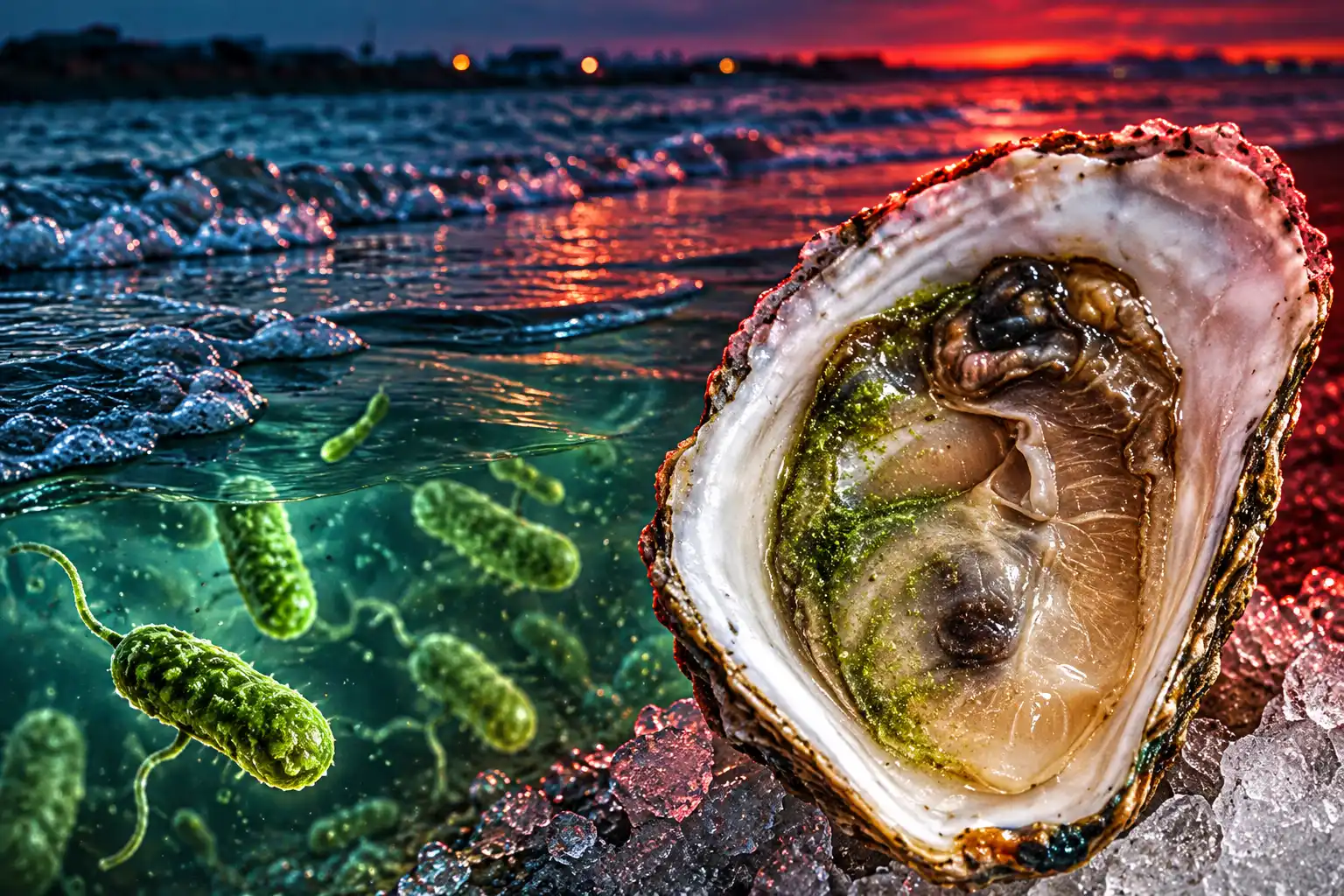
Gulf Vibrio vulnificus cases are rising through seawater wounds, while raw oysters still kill at a far higher rate in people with liver disease.

Louisiana has recorded 15 Vibrio vulnificus cases and six deaths in 2026, and 14 of those 15 began with a wound in seawater, not a raw oyster. Florida’s health department, as of September 3, 2026, listed 20 confirmed cases and four deaths. The so-called flesh-eating bacterium is having a loud summer on the Gulf, and the dinner-plate panic is aimed at the wrong pile of cases.
Wound infections now supply most of the new file. Eating raw oysters still supplies the deadlier math for a small group of patients, most of them people with liver disease, whose bloodstream infections kill far more often than a cut that meets brackish water.
Louisiana’s 2026 Cases Started in Seawater, Not on a Plate
On August 6, 2026, the Louisiana Department of Health said it had nine cases and five deaths among residents, every patient hospitalized, and every infection tied to a wound exposed to seawater. All nine people had another health problem. For the same stretch of the prior 10 years, the state had averaged seven cases and one death.
By September 2, the department’s count had moved to 15 cases and six deaths, with 14 of the 15 still listed as wound or seawater exposure. One food route sits in that file. The rest look like a beach, a cut, a shell, or an estuary, which is how Dr. Keith Schneider, a food-safety professor at the University of Florida’s Institute of Food and Agricultural Sciences, describes the ordinary accident. “Somebody steps on an oyster shell, or goes swimming with a cut in an estuary where the Vibrio vulnificus bacteria is present,” he said.
Florida’s 2026 line is quieter than its hurricane years and still fatal. The state logged 33 cases and five deaths in 2025, then 82 cases and 19 deaths in 2024 after Hurricane Helene pushed floodwater inland, and 74 cases and 17 deaths in 2022 after Hurricane Ian. The 2026 table carries no storm footnote. Four deaths on 20 cases is a 20% case-fatality rate, in line with the national “1 in 5” figure the CDC repeats for this species.
GULF COUNTS AGAINST RECENT YEARS
| Place and period | Cases | Deaths | What the file shows |
|---|---|---|---|
| Louisiana, 2026 as of Sept. 2 | 15 | 6 | 14 of 15 wound or seawater |
| Louisiana, Aug. 6 advisory | 9 | 5 | All nine wounds; all had other illness |
| Louisiana, 10-year same-period average | 7 | 1 | LDH comparison through early August |
| Florida, 2026 as of Sept. 3 | 20 | 4 | No hurricane note on the state table |
| Florida, 2025 | 33 | 5 | Full year |
| Florida, 2024 (Helene) | 82 | 19 | Flood-year spike |
| Florida, 2022 (Ian) | 74 | 17 | Flood-year spike |
A typical Louisiana year still runs around 10 cases. Fifteen by early September is already above that mark, and the warm-water season the department cites, May to October, was not over. The louder public alarm is about wading with a scrape, and that is the pattern in the Louisiana paperwork.
Raw Oysters Still Kill at Three Times the Wound Rate
National surveillance splits the story the state headlines flatten. A CDC-linked analysis of 2,989 culture-confirmed infections reported to the Cholera and Other Vibrio Illness Surveillance system from 2000 to 2022 found 1,619 non-foodborne cases (54.2%) and 656 foodborne cases (21.9%), with 714 (23.9%) unclassified. Non-foodborne infections produced about 2.5 times as many cases. Foodborne infections produced 260 deaths against 200 on the non-foodborne side, a 30% higher death count, and a fatality rate of 40% against 12%.
U.S. V. VULNIFICUS, 2000 TO 2022
- Case mix: Non-foodborne infections were 54.2% of the file; foodborne infections were 21.9%.
- Fatality gap: 40% of foodborne cases died, against 12% of non-foodborne cases, more than three times as high.
- Trend split: Five-year totals rose 70%, from 487 cases in 2000-2004 to 827 in 2018-2022, while non-foodborne cases rose 138% and foodborne cases fell 23%.
- Who got sick: 83.1% of patients were male, the median age was 62, 83% were hospitalized, and 23% died.
That is the second number hiding under the oyster scare. Wound contact now generates the surge. Swallowing the bacterium, usually in raw mollusks, still generates the worse odds of dying. Among foodborne patients with a known meal history, 78.9% had eaten raw bivalves, and raw-bivalve history raised the odds of death 3.4 times. Liver disease or alcoholism raised the odds of death 6.5 times across the full file. Foodborne transmission itself raised those odds 1.3 times. Antibiotic treatment cut them (odds ratio 0.33).
The CDC still estimates 150 to 200 V. vulnificus infections a year in the United States, with about 1 in 5 people dying, sometimes within a day or two. Broader vibriosis, which includes milder species such as Vibrio parahaemolyticus, runs about 80,000 illnesses and 100 deaths a year, most of them from May through October. V. vulnificus is the species that accounts for the seafood deaths people mean when they say flesh-eating bacteria got on a half shell.
Who Faces the Bloodstream Risk From a Raw Dozen
Healthy diners usually get a stomach illness from other Vibrio species, if they get anything. V. vulnificus is different once it reaches the blood. Florida’s health department says bloodstream infections are fatal about 50% of the time, and that people with certain preexisting conditions were 80 times more likely to develop those infections than healthy people. The department’s highest-risk list matches Louisiana’s: liver disease, cancer, diabetes, HIV, thalassemia, immune-suppressing treatment, medicines that cut stomach acid, and recent stomach surgery.
THE GROUPS STATE OFFICIALS NAME FIRST
- Liver disease: Hepatitis, cirrhosis, and heavy daily drinking sit at the top of every Gulf advisory, because the bacterium multiplies fast in iron-rich blood.
- Immune suppression: Cancer care, transplant drugs, HIV, and other immune loss leave the body with less defense against a wound or a raw oyster.
- Diabetes and stomach acid drugs: Both appear on the Louisiana and Florida lists, along with thalassemia and recent stomach surgery.
- Open skin: Fresh cuts, scrapes, surgery sites, piercings, and tattoos are the entry points in a year when 14 of Louisiana’s 15 cases started outside the kitchen.
Schneider still eats Gulf oysters. His own rule is time of year, how many he plans to swallow, and whether the restaurant keeps them alive and cold. “I don’t have any liver conditions, but I am getting on up there in age, so maybe at some point I will stop,” he said. “But I think generally the risk is fairly low, especially if you’re getting them from a reputable establishment.” He tells people to skip the cheapest raw happy-hour piles, where volume can beat careful handling, because look and smell will not warn you.
You want to make sure that they’re serving you oysters that are still alive and healthy, because if they’re not, that bacteria will start to multiply. That’s important, because you can’t tell by look or smell if an oyster is harmful.
Keith Schneider, professor of food safety, University of Florida Institute of Food and Agricultural Sciences
Very young children, older adults, pregnant people, and anyone with a weak immune system are the groups he and other clinicians tell to skip raw oysters altogether. Heat ends the food route. It does nothing for a foot that meets a shell in warm water.
The R-Month Rule Is Running Behind Warm Water
Schneider still backs the old line: eat raw Gulf oysters in months with an R in the name. “Sometimes, the old adage is just true,” he said. “Warmer waters mean that there are more pathogens in the water, and we have seen upticks in [Vibrio] illnesses in the summer for decades. These organisms just thrive in warmer water.” The 2026 file is testing how far that calendar still reaches. September has an R, and Louisiana was already past a typical year’s case count by September 2.
The bacterium grows once water is warmer than about 55°F (13°C) and thrives above about 68°F (20°C), according to the 2000-2022 surveillance paper. A Scientific Reports analysis of Eastern U.S. wound infections found an eightfold rise from 1988 to 2018, from about 10 cases a year to about 80, with the northern edge of the map moving about 48 kilometers a year. Infections that were rare north of Georgia in the late 1980s were showing up around Philadelphia by 2018. The same team’s projections put major New York-area waters inside the range by 2041 to 2060 if warming holds.
Peter Hotez, a professor and vaccine scientist at Texas Medical Center, put the live edge of that map on Long Island after the August Gulf deaths, saying cases are now appearing in more northerly latitudes in brackish water along the U.S. eastern seaboard because of climate change. Maryland has already logged an April case in 2026, and Chesapeake water has warmed about 1.8 degrees over 30 years in NOAA’s figures. The CDC’s 2023 health alert on severe infections tied to warming coastal waters was written after heat-wave cases in North Carolina, New York, and Connecticut, a geography that used to sit outside the old Gulf story.
Shoulder months are the quiet leak in the R rule. Food-protection work dating to the late 1990s found more days above 20°C in April and November, and oyster-linked illness in those months catching up with high summer. A La Niña warm anomaly in 1998 produced 13 V. vulnificus septicemia cases in a single month, then a record. Less strict time-and-temperature control outside the historic May-to-October window did part of that damage. The adage still tracks water heat. The water no longer tracks the calendar as neatly as it did when the adage was coined.
High Pressure Leaves a Safer, Softer Oyster
Gulf harvest still runs through state shellfish programs that tag sacks so a bad lot can be pulled. Schneider said health agencies move fast when a cluster appears: they can find the batch and take it off the shelf. That system tracks oysters. It does not sterilize them.
Post-harvest processing does. The Food and Drug Administration treats a validated process as one that cuts V. vulnificus to a non-detectable level, meaning fewer than 30 MPN per gram, while keeping the oyster raw in character. High-pressure processing is the method Gulf plants actually use. Prestige Oysters in Dickinson, Texas, runs it to pop the meat from the shell and knock the bacterium down, and it also stretches shelf life. Lab work on inoculated oysters has shown V. vulnificus falling more than 5.4 logs at 345 MPa during the time it takes the chamber to come up to pressure, a bigger drop than Vibrio parahaemolyticus under the same load.
Diners still argue with the result. Pressure changes texture and the briny snap people want on the half shell, which is why many raw bars stay with untreated stock and why Schneider’s “reputable establishment” test is about cold chain and live animals, not a pressure stamp. Cooking remains the blunt tool that does not ask anyone to like a softer oyster.
Heat Kills Vibrio in Minutes if You Cook Them
The CDC’s prevention page is blunt: do not eat raw or undercooked oysters if you want this risk gone, and do not let coastal water into an open wound. For people who still want oysters, the agency’s cook times are short and specific. Lemon, hot sauce, and alcohol do not do this job. There is no study behind those bar remedies.
CDC COOK TIMES FOR OYSTERS
- Shucked, boiled: boil shucked oysters for at least 3 minutes.
- Shucked, fried or broiled: fry in oil at least 3 minutes at 375°F, or broil 3 inches from the heat for 3 minutes.
- Shucked, baked: bake at 450°F for 10 minutes.
- In the shell: boil until the shells open, then 3 to 5 minutes more, or add them to an already steaming pot for another 4 to 9 minutes, and throw out any that stay shut.
Florida’s own page tells immunocompromised people not to eat raw oysters at all, and to wear shoes on shell-strewn beaches so a nick never meets the water. Gloves for shucking are on both state lists, because raw drippings in a cut are a third route that is neither a swim nor a swallow. Cross-contamination of a cooked platter with raw juice undoes the cook times in a single pass of the same knife.
Cover the Cut Before You Enter the Gulf
Louisiana’s August advisory was written for people who were going in the water, not for people ordering a dozen. Stay out of salt or brackish water with an open wound. Cover what you cannot keep dry with a waterproof bandage. Wash with soap after a scrape on a shell. Wear shoes if you are in a high-risk medical group. Dr. Theresa Sokol, an epidemiologist at the Louisiana Department of Health, put the same points in one line after the August deaths, and she included raw seafood juices next to the tide.
If you have a wound, it’s really important that you either stay out of salt or brackish water or make sure it is well covered with a waterproof bandage if you are going to go into salt or brackish water or if you’re going to have contact with raw seafood or its juices.
Theresa Sokol, epidemiologist, Louisiana Department of Health
Signs that a wound has turned are not subtle: fever, redness, pain, swelling, warmth, color change, or drainage. Bloodstream illness adds chills, a crash in blood pressure, and blistering skin lesions. The CDC tells clinicians not to wait for a lab if they suspect V. vulnificus in a water-exposed wound. A third-generation cephalosporin plus doxycycline is the first combination on the clinical sheet, because delay is how a treatable infection becomes an amputation file.
The 2026 Gulf season is still a wound story in the case counts and still an oyster story in the death rate for people with liver disease. One path is a bandage and a decision to stay on the sand. The other is a cooked oyster, or a pressure-treated one, or an empty plate if your clinician has already put you on the high-risk list. Schneider has not left the raw bar yet. The state’s own numbers say most of this year’s dead never sat down at one.
Disclaimer: This article is news reporting and analysis of public health data on Vibrio vulnificus, raw oysters, and coastal wounds. It is informational only and is not medical advice, a diagnosis, or a personal recommendation to eat or avoid any food. People with liver disease, diabetes, cancer, HIV, or a weakened immune system, and anyone with an open cut who swims, fishes, or handles raw shellfish, should talk with a physician or other qualified clinician before going in coastal water or eating raw oysters. Case counts, deaths, and water conditions change through the season and may differ from the state and federal figures quoted here.

Europe’s Heat Killed 50,391 in Cities Official Counts Still Miss

Caesarean Surge Puts 20 England Maternity Units at Risk

The Protective Ring Around Care Homes Never Existed

Cooper Prioritises Children’s Corridor Care Without an Age Count

Oxford’s Ebola Vaccine Reaches Uganda as Doses Sit Unused

Pennsylvania Measles Deaths Collide With Falling MMR Coverage

Muscle-Boosting Drugs Near Approval for Children With SMA

FDA Approves XFG COVID Vaccines While the Advice Panel Is Frozen

Progranulin and JAK2 Split the Macrophages That Heal

After the ADHD Invoice, GPs and Waiters Carry the Cost
-
 NEWS2 months ago
Pennsylvania Measles Deaths Collide With Falling MMR Coverage
-
 FITNESS2 months ago
Muscle-Boosting Drugs Near Approval for Children With SMA
-
 NEWS2 months ago
FDA Approves XFG COVID Vaccines While the Advice Panel Is Frozen
-
 NEWS2 months ago
Progranulin and JAK2 Split the Macrophages That Heal
-
 MENTAL HEALTH2 months ago
After the ADHD Invoice, GPs and Waiters Carry the Cost
-
 NEWS2 months ago
Rasonque’s List Price Shifts the Pancreatic Cancer Bill
-
 NEWS2 months ago
Pennsylvania’s Two Measles Deaths Follow a Long Coverage Slide
-
 NEWS2 months ago
FDA Flagged This Sprout Plant 16 Months Before the Outbreak