
NEWS
NICE Still Blocks Itovebi After Lifting Its Cost Ceiling
NICE has declined Roche’s Itovebi for PIK3CA-mutated advanced breast cancer even after raising its cost bar, citing price, a trial mismatch and testing gaps.

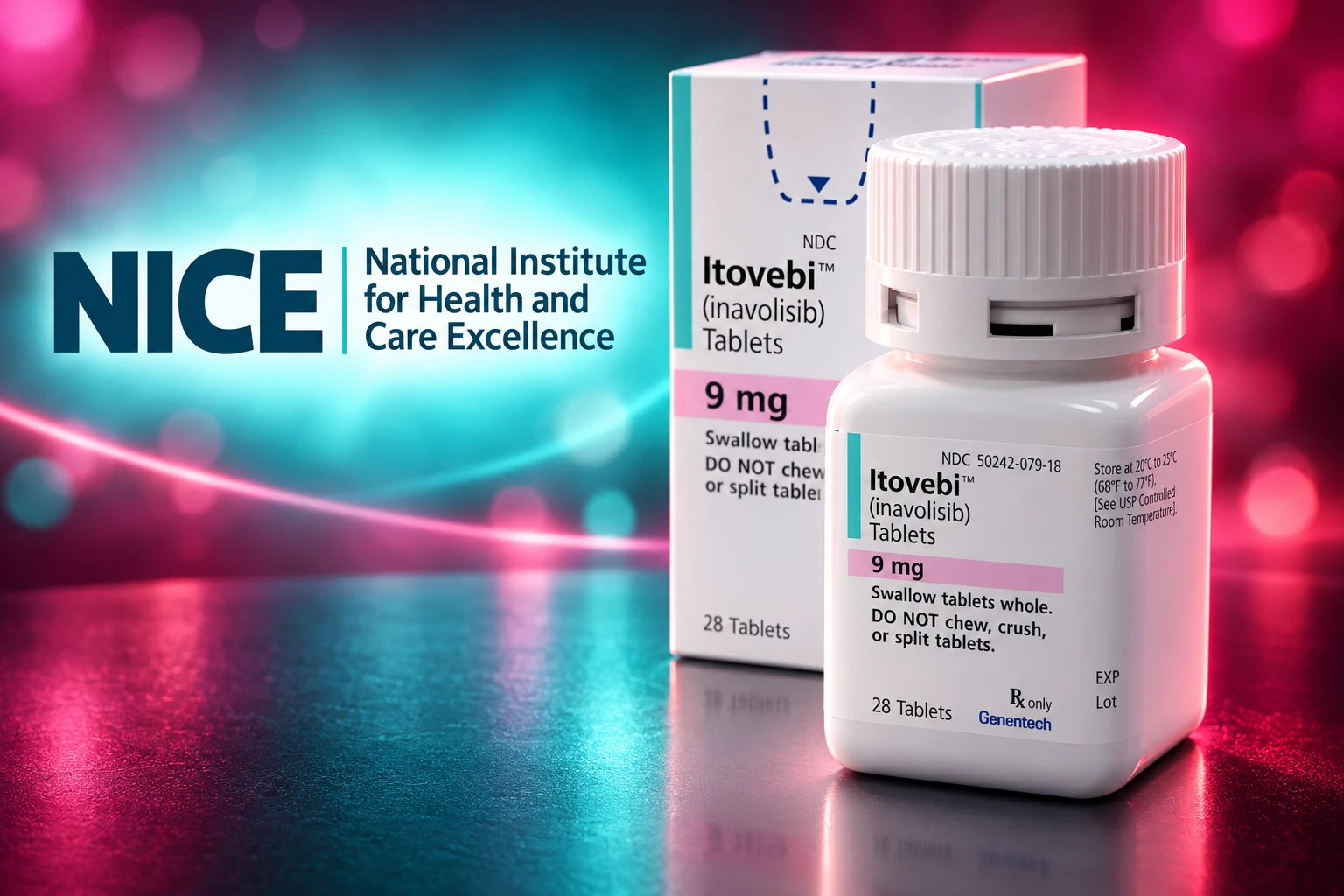
NICE has declined to recommend Roche’s breast cancer tablet inavolisib for routine NHS use after talks failed to produce a cost-effective price. The drug, sold as Itovebi, is taken with palbociclib and fulvestrant.
Final draft guidance of 15 October 2026 covers adults with HR-positive, HER2-negative, PIK3CA-mutated advanced disease that returned on or within 12 months of adjuvant endocrine therapy. Scotland’s consortium issued the same verdict on 12 October. A short consultation is open until 29 October, with publication expected on 4 November 2026.
A Draft No for Itovebi on the NHS
NICE’s committee said NHS England and Roche could not agree a price that would “make the treatment cost effective.” In the final draft guidance on 15 October, it wrote that “the available evidence does not suggest that inavolisib plus palbociclib and fulvestrant is value for money in this population” against dual therapy with a CDK4/6 inhibitor and fulvestrant.
This is still draft guidance, not a finished technology appraisal. Consultees can comment until 29 October 2026. NICE lists an expected publication date of 4 November 2026. Until that document is issued, the tablet is licensed in the UK and remains off routine commissioning in England, Wales and Scotland.
Richard Eaton, Roche Products’ UK lead for breast cancer, called the second-committee outcome “a devastating outcome for this group of metastatic breast cancer patients, denying them a vital treatment option.” The MHRA licensed the triplet on 27 November 2025. Palbociclib plus fulvestrant has been an NHS option since September 2022.
WHAT WE KNOW
- The decision: NICE’s final draft does not recommend the triplet for routine NHS use, and the Scottish Medicines Consortium is not recommended for use within NHSScotland.
- The list price: The BNF’s NHS indicative price for Itovebi 9 mg is £10,836 for 28 tablets, the usual 28-day pack at the licensed 9 mg daily dose.
- The trial gain: In INAVO120, median overall survival was 34.0 months with the triplet and 27.0 months without it, a 7.0-month difference.
- The calendar: Comments close on 29 October 2026; NICE expects to publish on 4 November 2026.
WHAT IS UNCONFIRMED
- A new Roche offer: Whether the company tables another confidential discount before publication is not public.
- An appeal: No appeal against the final draft has been posted on the appraisal page.
- English headcount: NICE has not published how many people in England would have been eligible in the first year.
The eligible group is narrow. It is not “breast cancer” as a class. It is people whose tumours carry a PIK3CA change, are HR-positive and HER2-negative, and relapsed during adjuvant endocrine therapy or within 12 months of finishing it, as first treatment for advanced disease.
Seven Extra Months Still Miss the New Spending Bar
INAVO120 randomised 325 adults (161 to inavolisib, 164 to placebo) on a shared backbone of palbociclib and fulvestrant. After a median follow-up of 34.2 months in the inavolisib group and 32.3 months in the placebo group, median overall survival was 34.0 months versus 27.0 months. The hazard ratio for death was 0.67 (P=0.02), a 33% cut in the risk of death. Professor Nicholas Turner of the Royal Marsden, the trial’s lead author, said this was the first time overall survival had been significantly improved by a PI3K pathway targeted drug.
At the same final analysis, median progression-free survival was 17.2 months versus 7.3 months (hazard ratio 0.42). An earlier primary readout, which underpinned US licensing, had put that figure at 15.0 months versus 7.3 months (hazard ratio 0.43). Confirmed responses at the final analysis were 62.7% versus 28.0%. Median time to chemotherapy was 35.6 months versus 12.6 months, a 23.0-month delay.
INAVO120 FINAL SURVIVAL ANALYSIS
| Outcome | Inavolisib triplet | Palbociclib plus fulvestrant |
|---|---|---|
| Median overall survival | 34.0 months | 27.0 months |
| Median progression-free survival | 17.2 months | 7.3 months |
| Objective response rate | 62.7% | 28.0% |
| Median time to chemotherapy | 35.6 months | 12.6 months |
| Stopped any trial drug for side effects | 6.8% | 0.6% |
Those are large clinical gaps. They still did not clear NICE’s value test. From April 2026 the institute raised the standard range to £25,000 to £35,000 per extra quality-adjusted life year, up from £20,000 to £30,000. The government presented that shift as a way to get more medicines through. NICE said it already recommends 91% of the medicines it evaluates, about 70 a year, and that the new band might add 3 to 5 extra medicines or indications a year. Cost-effectiveness estimates for this triplet sat above even that higher range, the committee said, once uncertainty was folded in.
Hyperglycaemia, mouth inflammation, gut effects and eye effects were more common with inavolisib. Most people stayed on treatment; 6.8% stopped a trial drug because of adverse events, against 0.6% on placebo. The clinical case was not the hole. The price, and how far the trial maps onto NHS care, were.
The Appraisal Was Paused So the Higher Bar Could Apply
NICE did not spring this no after a single sitting. The file was opened as GID-TA11519, then held so commercial talks could continue and so the new threshold could be used.
THE ITOVEBI APPRAISAL CLOCK
- 10 October 2024: The US Food and Drug Administration approved inavolisib on 10 October 2024 with palbociclib and fulvestrant, plus a companion blood test.
- 27 November 2025: The MHRA licenses the same triplet in the UK.
- 11 March 2026: NICE pauses the appraisal at Roche’s request for commercial discussions and until it can apply the new cost-effectiveness threshold.
- 28 May 2026: Draft guidance goes out, a first public no; comments run to 18 June 2026.
- 15 September 2026: The appraisal committee meets for a second time.
- 12 October 2026: The Scottish Medicines Consortium publishes advice against NHSScotland use.
- 15 October 2026: NICE issues final draft guidance against routine NHS use.
- 29 October 2026: The final-draft consultation closes; publication is listed for 4 November 2026.
The pause is the twist. Roche asked for time. NICE then judged the file against a more generous spending band than the one in force when the trial was published. The triplet still missed. Companies were told, when the threshold change was announced, that they would need to submit evidence swiftly and price products fairly. On this file, NHS England and Roche did not close.
Roche Controls Only One Drug in the Triplet
NICE did not price inavolisib as a lone tablet. It priced a three-drug regimen against a two-drug regimen the NHS already funds. Roche makes only the new one.
WHAT THE TRIPLET ACTUALLY CONTAINS
- Inavolisib (Itovebi, Roche): 9 mg by mouth once daily; BNF indicative price £10,836 for 28 of the 9 mg tablets.
- Palbociclib (Ibrance, Pfizer): 125 mg daily on days 1 to 21 of each 28-day cycle; already commissioned with fulvestrant on the NHS.
- Fulvestrant: 500 mg by injection on a loading schedule, then monthly; a generic endocrine therapy already in routine use.
Simon Eayrs, Roche Products’ director of market access, said it is common for the older branded partner in a combination to sit near NICE’s ceiling, “leaving little space for the new drug.” He argued that the current method “penalises innovation that delays disease progression and prolongs patient survival.” Frances Logan, Breast Cancer Now’s policy lead in Scotland, said the SMC verdict highlights the challenges faced in getting combination treatments approved on cost-effectiveness grounds.
Claire Rowney, the charity’s chief executive, put the England decision in the same frame after the 15 October draft. “Inavolisib with palbociclib and fulvestrant is a clinically proven, life-extending treatment,” she said, “making it incredibly disheartening that both NICE and the Scottish Medicines Consortium (SMC) have rejected it on grounds of cost-effectiveness.” She added that the raised threshold had been “a step in the right direction,” and that companies still needed to show more flexibility on price.
Dutch assessors at Zorginstituut Nederland, looking at the same triplet in August 2026, said reimbursement should wait on a deal that cut the price by at least 92% to meet an €80,000 per QALY bar. That figure is from a different system and a different threshold. It shows how far list price sits from European cost tests when three drugs are billed together.
A 28-day Itovebi pack at £10,836, set against a 7.0-month median overall survival gain, is the comparison that is hard to wave away in a tax-funded service. Confidential discounts exist for a reason. On this file they were not enough, or they were not offered at a level NHS England would accept.
Why the Trial Does Not Match NHS Practice
INAVO120 enrolled people whose advanced disease had not yet been treated with a CDK4/6 inhibitor. Many had chemotherapy for earlier disease (82.8% in the published cohort), and more than half already had cancer in three or more organs. That is a poor-prognosis, endocrine-resistant group. PIK3CA mutations show up in 35% to 40% of HR-positive breast cancers and are tied to faster growth and treatment resistance.
NHS practice has moved. Adjuvant CDK4/6 inhibitors are now used in some people with early high-risk HR-positive disease. The committee said it was unclear whether prior adjuvant CDK4/6 treatment, which can occur on the NHS, would change how well the Itovebi regimen works. That is not a quibble about paperwork. If the trial population is cleaner than the people who would actually be offered the triplet, the survival curves used in the cost model are optimistic.
The licence itself already hedges this. People previously treated with a CDK4/6 inhibitor in the (neo)adjuvant setting are supposed to have had at least 12 months off that class before recurrence is found. Premenopausal women and men also need an LHRH agonist with the endocrine therapy. Those clauses shrink the group again.
NHS patients in this genomic slot are not without a PI3K option later. Alpelisib (Piqray) plus fulvestrant was recommended in 2022 for PIK3CA-mutated HR-positive, HER2-negative advanced disease after a CDK4/6 inhibitor. That is a later line, and it did not carry the overall survival result Turner flagged for inavolisib. Turning down the triplet does not remove every PI3K tablet. It removes the one tested as first treatment for early relapse, on top of palbociclib.
Genomic Testing Would Need to Move Earlier
Inavolisib is useless without a PIK3CA result. NICE’s own scope said the economic model should include the cost of testing people who would not otherwise have been tested at this point in care. The committee then found that PIK3CA testing on the NHS still tends to happen later in the pathway, and that moving it forward would require “an additional step.”
Breast Cancer Now has tied that lag to other targeted drugs that already have positive recommendations but still need a genomic result before a prescription.
TARGETED DRUGS WAITING ON EARLIER TESTING
- Inavolisib (Itovebi): Needs a PIK3CA result at first treatment for early-relapse advanced disease, which is earlier than many services now test.
- Capivasertib (Truqap): An AKT inhibitor whose NHS use, the charity says, is already being blocked where genomic testing is missing.
- Elacestrant (Korserdu): An oral SERD in the same testing bottleneck, according to the same briefing.
Even a cheaper Itovebi deal would still require labs to run the right assay at diagnosis of advanced disease, not after several lines of treatment. FoundationOne Liquid CDx is the companion test named in the US licence. UK services would need an equivalent, funded route. The committee treated that shift as a real cost and a real operational change, not a rounding error.
European Hospitals Already Commission the Same Triplet
Eaton said Itovebi is already routinely commissioned for this indication in Germany, Spain, Italy and Austria, and that “patients in England and Wales deserve parity with Europe.” Spain’s health ministry agreed funding in July 2026. The European Medicines Agency has authorised the medicine for the same PIK3CA-mutated, ER-positive, HER2-negative population. The UK licence is not the missing piece. Payment is.
This negative guidance from NICE, following a second appraisal committee meeting, is a devastating outcome for this group of metastatic breast cancer patients, denying them a vital treatment option.
Richard Eaton, UK lead for breast cancer, Roche Products Ltd
Eaton also argued that NICE’s method leaves out wider effects, such as patients and carers staying in work if disease is held for longer. He said that if those effects were counted, “we believe this regimen would be deemed cost-effective.” NICE’s statute still prices health gains in QALYs for the NHS and personal social services, not lost wages. That gap is old. On this file it became the whole dispute.
Individual funding requests remain a back door in Scotland, as the SMC public summary notes, and English clinicians can still ask for exceptions. Those routes are slow, local and not a substitute for routine commissioning. For most people who meet the licence wording, the practical answer from 15 October 2026 is no, pending whatever Roche tables before 4 November.
Comments on the final draft close on 29 October 2026. NICE expects to publish the appraisal on 4 November 2026. A new confidential price can still change a draft. The last published position is that the first PI3K tablet shown to extend overall survival in this group does not meet the higher bar NICE was given to let more medicines through.
Disclaimer: This article is news reporting and analysis of a NICE draft decision and related trial data, and it is for information only. It is not medical advice, is not a treatment recommendation, and is not a guide to whether any individual should start, stop or seek a cancer medicine. Readers with breast cancer, or those supporting someone who has it, should speak to their oncologist or another qualified cancer specialist before making decisions about tests or treatment. Figures, licence terms, prices and commissioning status are those given in the cited official documents as of the dates named in the piece and can change if Roche, NHS England or NICE reach a new deal or if the final appraisal differs from the draft.

Europe’s Heat Killed 50,391 in Cities Official Counts Still Miss

Caesarean Surge Puts 20 England Maternity Units at Risk

The Protective Ring Around Care Homes Never Existed

Cooper Prioritises Children’s Corridor Care Without an Age Count

Oxford’s Ebola Vaccine Reaches Uganda as Doses Sit Unused

Pennsylvania Measles Deaths Collide With Falling MMR Coverage

Muscle-Boosting Drugs Near Approval for Children With SMA

FDA Approves XFG COVID Vaccines While the Advice Panel Is Frozen

Progranulin and JAK2 Split the Macrophages That Heal

After the ADHD Invoice, GPs and Waiters Carry the Cost
-
 NEWS2 months ago
Pennsylvania Measles Deaths Collide With Falling MMR Coverage
-
 FITNESS2 months ago
Muscle-Boosting Drugs Near Approval for Children With SMA
-
 NEWS2 months ago
FDA Approves XFG COVID Vaccines While the Advice Panel Is Frozen
-
 NEWS2 months ago
Progranulin and JAK2 Split the Macrophages That Heal
-
 MENTAL HEALTH2 months ago
After the ADHD Invoice, GPs and Waiters Carry the Cost
-

 NEWS2 months ago
Rasonque’s List Price Shifts the Pancreatic Cancer Bill
-

 NEWS2 months ago
Pennsylvania’s Two Measles Deaths Follow a Long Coverage Slide
-

 NEWS2 months ago
FDA Flagged This Sprout Plant 16 Months Before the Outbreak