
NEWS
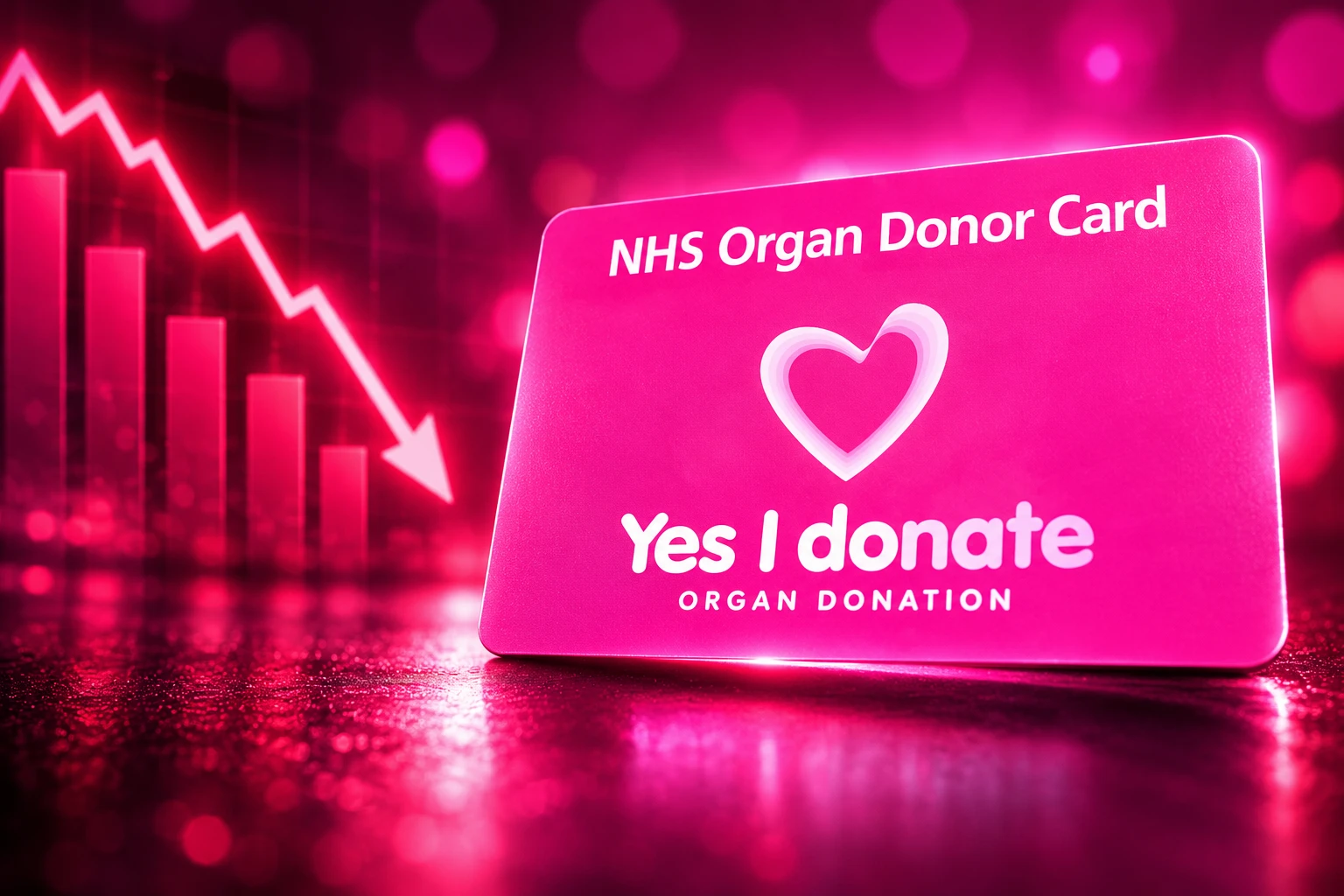
NHS Organ Donation Falls 11% Despite the Opt-Out Law
Deceased donors are 11% down and families still veto deemed consent, so the NHS is asking a million people to record a yes during Organ Donation Week.

NHS Blood and Transplant counted 591 deceased organ donors from 1 April to 13 September 2026, 11% below the 664 a year earlier. The UK transplant waiting list stands at 8691, and the agency called this one of the most challenging periods for donation in over a decade.
On 21 September 2026 it launched its first urgent response plan. It is also asking a million people who have never registered to record a yes, even though every UK nation already runs an opt-out system that treats silence as consent.
Deceased Donors Are 11% Behind Last Year
The 11% gap is the in-year count NHS Blood and Transplant issued with the plan, 73 fewer deceased donors than the same 1 April to 13 September window in 2025. Its public dashboard still showed 8691 people waiting and 1572 transplants from deceased donors since April 2026. John Richardson, assistant director of organ and tissue donation and transplantation, said the service had moved onto a footing it had not used before, with the highest list it has seen and up to nine people each week dying while they wait.
DONORS, THE LIST AND CONSENT
| Measure | Figure | Compared with |
|---|---|---|
| Deceased donors, 1 Apr to 13 Sep 2026 | 591 | 664 in the same window a year earlier |
| Fall in that window | 11% | 73 fewer donors |
| People waiting in the UK | 8691 | Highest list the service says it has seen |
| Family consent, 2025 | 57% | 67% in 2020-21 |
| Deceased-donor transplants since April 2026 | 1572 | NHS Blood and Transplant dashboard |
Anthony Clarkson, director of organ and tissue donation and transplantation, said the fall in donors and the rising wait list need urgent action, and that the service has already had to adapt to a changed donation environment. Organ Donation Week runs from 21 to 27 September 2026, which is why the plan and the public appeal landed on the same Monday.
England’s Opt-Out Law Did Not Lift Consent
England moved to deemed consent in May 2020, the change widely known as Max and Keira’s Law. Wales had gone first on 1 December 2015. Scotland followed in 2021 and Northern Ireland in 2023, so adults who have not opted out are treated as willing donors unless they fall in an excluded group. Families are still spoken to before any retrieval goes ahead.
Consent did not climb with that legal default. NHS Blood and Transplant said family consent fell from 67% in 2020-21 to 57% in 2025, the years after the English law took effect. Kate Hurley, a specialist organ donation nurse at Gloucestershire Royal Hospital who has done this work for 17 years, said families now answer that they are not sure it is what the person would have wanted, and that staff need people to go back to recording a yes on the register.
WHEN OPT-OUT ARRIVED AND CONSENT FELL
- 1 December 2015: Wales becomes the first UK nation to introduce deemed consent.
- May 2020: England begins opt-out under Max and Keira’s Law; Scotland follows in 2021 and Northern Ireland in 2023.
- 2020-21: UK family consent stands at 67%.
- 2025: Consent is 57% as the wait list keeps rising.
- 5 August 2026: NHS Blood and Transplant asks for a million first-time registrations, aiming toward 30 million names by the start of 2027.
- 21 September 2026: The first urgent response plan is announced as Organ Donation Week opens.
Hurley put the bind in one sentence. Because people can opt out, staff can say that not opting out means someone would have wanted to donate, but relatives still hear that silence as doubt. The law moved the paperwork. It did not move the conversation at the bedside.
Families Still Hold the Veto
NHS Blood and Transplant’s own facts page is blunt about who decides. Relatives are always consulted, and clinicians will never proceed if the family objects, which is why a deemed yes is only as strong as the people standing in the room. When a decision is on the NHS Organ Donor Register, families support donation in nearly 90% of cases. That support falls to around 50% when no decision is known.
Over 700 potential donations did not go ahead between April 2021 and March 2026 because families did not know for certain what the person would have wanted. Each deceased donor gives three organs on average, which the agency counted as 2127 missed transplant chances across those five years. In the most recent full-year cut it published on 5 August 2026, 167 families overruled a recorded yes, and in 602 of 1092 deemed-consent approaches the family did not support donation.
WHAT A WRITTEN DECISION CHANGES
- Known wishes: Families support donation in nearly 90% of cases when a decision is on the register.
- Unknown wishes: Support falls to around 50% when no decision is recorded.
- Five-year miss: Over 700 potential donations stopped between April 2021 and March 2026, counted as 2127 missed transplants.
- Last year’s deemed cases: 602 of 1092 families declined where consent was only presumed, 55% of those approaches.
Sue Walker, 50, from Warrington, said there was no hesitation when specialist nurses raised donation after her husband John died in November 2025, aged 48, from a pulmonary embolism. He had recorded his decision and talked about it for years, and his liver and kidneys saved three men. That is the conversation the register is built to make ordinary, and it is the one that is not happening often enough.
Most of us would accept an organ if we needed one but opportunities to save lives are being lost because families didn’t know what their loved ones wanted. Leave them certain.
Anthony Clarkson, director of organ and tissue donation and transplantation, NHS Blood and Transplant
Distrust sits in that gap. Donation after circulatory death, where treatment is withdrawn and organs are taken after the heart stops, now does more of the work, and a noisy public argument treats brain-death testing as a loophole. Families who already do not know what someone wanted have one more reason to say no. Specialist nurses cannot litigate that argument in an intensive care corridor, which is why they want a name on a register rather than a legal default.
Why the Eligible Pool Has Shrunk
Public will is only half of the squeeze. NHS Blood and Transplant says only around 1 in 100 deaths happen in conditions that allow donation, usually in intensive care after a severe brain injury, a stroke, or a sudden loss of oxygen. The pool of eligible donors has fallen by around 20% since 2019-20. Road deaths are down, and care for major trauma and major head injuries has improved, so fewer young, otherwise healthy people die in the way transplant teams can use.
THE NARROWS THAT LIMIT DONATION
- The 1 in 100: Most people do not die in intensive care in a way that makes solid-organ donation possible.
- The 20% shrink: The eligible donor pool has fallen by around 20% since 2019-20.
- Brain-death tests: The 2024-25 potential donor audit put the neurological death testing rate at 72%, so more than a quarter of suspected cases were not tested.
- Referral still high: Potential donors were referred 94% of the time, and a specialist nurse was present for 92% of family approaches.
The mix of donors has shifted with that. In 2025-26 there were 636 donors after brain death and 792 after circulatory death, so donation after the heart stops made up 55% of all deceased organ donors. That is how the service adapted as brain-death cases thinned. It still left this year’s April to September count 11% short, which is why an operational plan now sits beside the public appeal.
The Urgent Plan’s Two Tracks
The immediate work is inside hospitals. NHS Blood and Transplant said the focus is to identify and refer more potential donors, to strengthen the diagnosis of death by brain-death tests, to lift consent and authorisation, and to use every donation chance. A longer plan for a system that can last is being written in parallel. That is a staffing and testing problem as much as a poster problem, and it matches the 72% testing rate in the last full audit.
WHAT THE URGENT PLAN IS DOING NOW
- Find and refer: Raise identification and referral of potential donors in intensive care and emergency departments.
- Test for brain death: Strengthen diagnosis of death by neurological criteria so fewer eligible patients are missed.
- Lift consent: Improve family consent and authorisation rates, including the million-name register drive.
- Use every organ: Maximise each donation, including new Assessment and Recovery Centres that keep organs on machines for extra testing.
The public track is older than this week’s plan. On 5 August 2026 the agency already asked for a million first-time names and a register heading toward 30 million by the start of 2027. Almost 29 million people are already on it. Its 2025-26 accounts put the figure at 28.8 million people who chose to donate, about 42% of the UK, with 750,587 first-time confirmations that year and 2.95 million people, 4%, recorded as opted out. People aged 18 to 34 make up 11.2 million of the yes names, almost 40% of sign-ups. The new ask is for people who have never registered at all.
It takes two minutes online, on the NHS App, or on 0300 123 23 23. Each donor can save up to nine lives. The official register account opened Organ Donation Week with that same million-person call.
We are calling on one million people to confirm their organ donation decision on the NHS Organ Donor Register this #OrganDonationWeek.
It takes just two minutes to register, and each donor could save up to nine lives. 🩷https://t.co/T3LggyowMn#ODW2026 #OrganDonation
— NHS Organ Donation 💗🫀🫁 (@NHSOrganDonor) September 21, 2026
Christine Cox, who has campaigned on donation for 35 years after her brother Peter helped 17 people when he died at 24, said at least a million more names are needed in the coming months, and that families still have to be told the wish out loud. In Gloucestershire, Hurley said 98 people are waiting and 40 transplants were done in the past year, a local slice of the same national bind.
Living Donors Supply 42% of All Donors
While deceased donation has wobbled, living donation has taken more of the strain. NHS Blood and Transplant said 42% of all organ donors in the UK are living donors, people who give a kidney or part of a liver, and that living donor transplants are 22% of total transplant activity. Those are different shares of two different totals, donors against operations, and both are now load-bearing. The service said it is putting more weight on that programme as the deceased path tightens.
In 2026 the UK also opened its first Assessment and Recovery Centres, which use machine perfusion to give extra time to test and accept organs that might once have been turned down. That is an attempt to get more transplants from each donor rather than wait for the eligible-death pool to grow back. Safer roads will not reverse for the sake of transplant lists, so the organs that do appear have to travel further through the system.
Last year 434 patients died on the active wait list, and 899 were removed because they had become too unwell, many of them dying soon after. Up to nine people a week still die waiting. The register will not invent brain-death donors that trauma care has already saved, and opt-out will not speak for a family that has never heard the wish. The urgent plan is the service saying both of those things at once, then asking a million people to write the answer down.
Disclaimer: This article is news reporting on NHS Blood and Transplant figures and public statements, and it is for information only. It is not medical advice, is not a recommendation to join or leave the NHS Organ Donor Register, and is not guidance on any individual treatment, donation, or family decision. Anyone thinking about organ donation, a transplant, or a recorded decision should speak to their own doctor or to NHS Blood and Transplant through the official register channels before acting. The counts, rates, and wait-list totals here reflect the cited NHS sources as issued in August and September 2026 and can change as the UK Transplant Registry is updated.

Europe’s Heat Killed 50,391 in Cities Official Counts Still Miss

Caesarean Surge Puts 20 England Maternity Units at Risk

The Protective Ring Around Care Homes Never Existed

Cooper Prioritises Children’s Corridor Care Without an Age Count

Oxford’s Ebola Vaccine Reaches Uganda as Doses Sit Unused

Pennsylvania Measles Deaths Collide With Falling MMR Coverage

Muscle-Boosting Drugs Near Approval for Children With SMA

FDA Approves XFG COVID Vaccines While the Advice Panel Is Frozen

Progranulin and JAK2 Split the Macrophages That Heal

After the ADHD Invoice, GPs and Waiters Carry the Cost
-
 NEWS2 months ago
Pennsylvania Measles Deaths Collide With Falling MMR Coverage
-
 FITNESS2 months ago
Muscle-Boosting Drugs Near Approval for Children With SMA
-
 NEWS2 months ago
FDA Approves XFG COVID Vaccines While the Advice Panel Is Frozen
-
 NEWS2 months ago
Progranulin and JAK2 Split the Macrophages That Heal
-
 MENTAL HEALTH2 months ago
After the ADHD Invoice, GPs and Waiters Carry the Cost
-
 NEWS2 months ago
Rasonque’s List Price Shifts the Pancreatic Cancer Bill
-
 NEWS2 months ago
Pennsylvania’s Two Measles Deaths Follow a Long Coverage Slide
-

 NEWS2 months ago
FDA Flagged This Sprout Plant 16 Months Before the Outbreak