
NEWS
FDA Panel Backs Galleri but Splits on Whether It Works
Advisers called GRAIL’s Galleri multi-cancer blood test safe 10-0, then split 6-4 on whether it works, sending a cancer signal into clinics before late-stage proof.

An FDA advisory panel voted 7 to 2, with one abstention, that GRAIL’s Galleri multi-cancer blood test offers more benefit than risk for adults 50 and older. The Molecular and Clinical Genetics Devices Panel met on September 23, 2026, and split 6 to 4 on whether the test is effective, after voting 10 to 0 that it is safe.
The agency is not bound by that advice. If it later clears the test, primary care will inherit a new kind of result: a “cancer signal” that is not a diagnosis, plus a predicted origin in the body, and a workup that can include scans, endoscopy, and biopsy.
Ten Advisers Called the Blood Draw Safe
The 10 voting members answered three statutory questions for the proposed use in adults aged 50 years and older. Safety was the easy one, because the device is a blood draw. Effectiveness and benefit-risk were not.
THE THREE VOTES
- Safety: 10 to 0 that there is reasonable assurance Galleri is safe for the proposed group.
- Effectiveness: 6 to 4 that there is reasonable assurance it is effective.
- Benefit-risk: 7 to 2, with one abstention, that benefits outweigh risks for patients who meet the proposed indication.
Josh Ofman, MD, MSHS, chief executive of GRAIL, said the votes back a high evidence bar the company set for multi-cancer early detection, and that Galleri is the first PMA submission for a multi-cancer test. GRAIL filed that premarket approval application on January 29, 2026. The FDA gave Galleri Breakthrough Device designation in 2018 and is expected to decide in the coming months.
GRAIL posted its own account of the panel the same evening.
Today GRAIL announced a favorable vote from an FDA Advisory Committee for the approval of the Premarket Approval application of the Galleri multi-cancer early detection test (MCED).
The Committee considered Galleri’s safety, effectiveness, and overall benefit-risk profile for… pic.twitter.com/n0ygVZWrmB
— GRAIL (@GrailBio) September 23, 2026
Several members who voted yes still sounded unsure. Dr. Victor van Berkel, division chief of thoracic surgery at the University of Louisville, voted no on effectiveness and yes on benefit-risk. “Perhaps my yes is a hopeful rather than an accurate one,” he said.
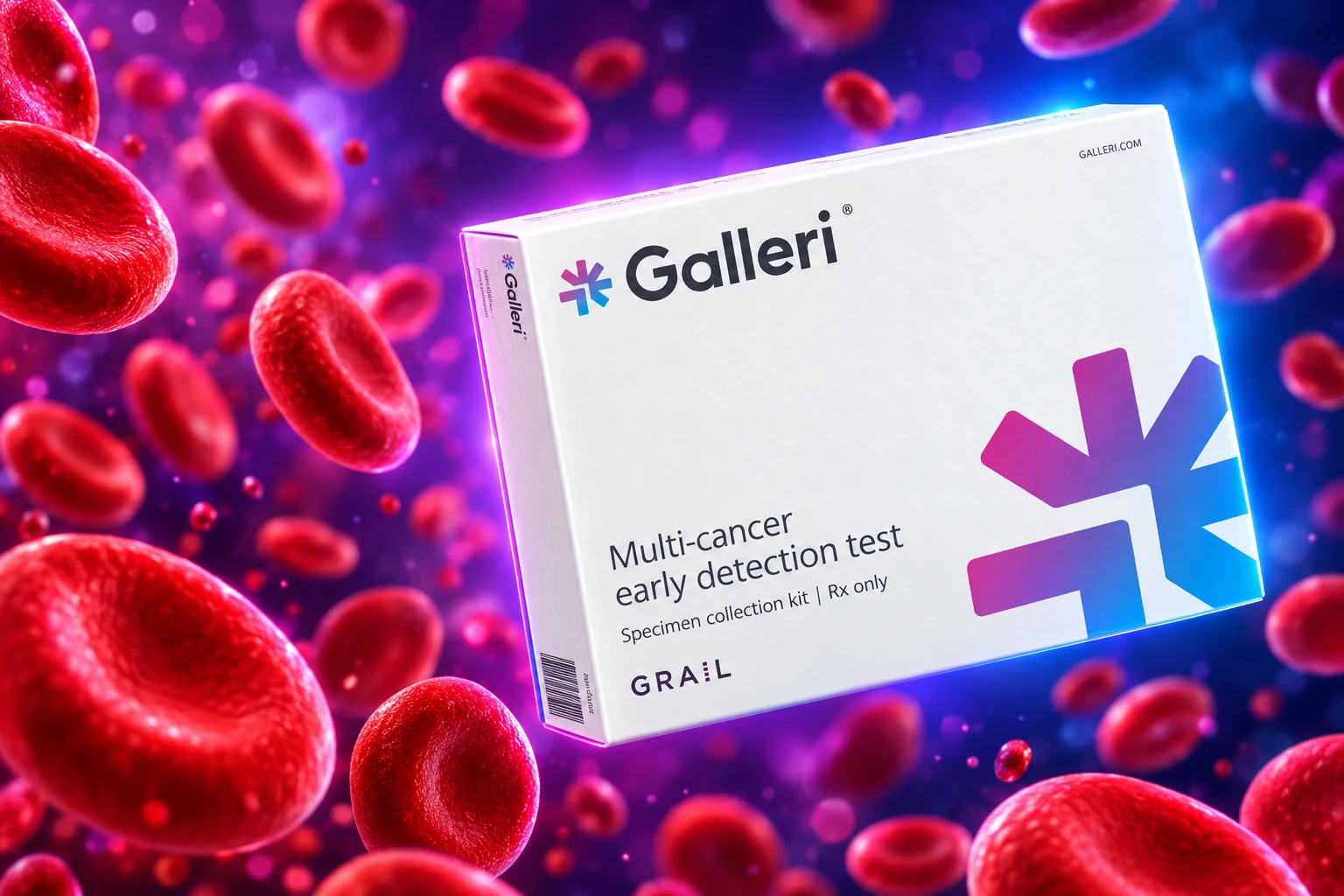
What Galleri Detects in One Tube of Blood
Galleri is a prescription next-generation sequencing test. It looks for cancer-specific methylation patterns in cell-free DNA from whole blood, then returns Cancer Signal Detected or No Cancer Signal Detected. A positive result also carries a Cancer Signal Origin prediction meant to point doctors toward a body site. GRAIL says the test can pick up more than 50 cancer types, including some with no routine screen, and that it should sit beside mammography, colonoscopy, and other guideline tests, not replace them. A negative result does not rule out cancer.
The panel reviewed a 12-month analysis of PATHFINDER 2 in North America and the first screening round of England’s NHS-Galleri trial. FDA reviewers used stored plasma retested with the current Galleri assay. That PMA package is not the same cut of data GRAIL presented at the 2026 ASCO meeting from the full 35,878-person PATHFINDER 2 cohort.
In the FDA analysis, Galleri’s 12-month episode sensitivity of 35.0% in PATHFINDER 2 meant it flagged about one in three cancers diagnosed within a year of the draw (106 of 303). Specificity was 99.85%. When the test was positive, cancer was confirmed in 77.0% of those cases (106 of 138). The false-positive rate was 0.15%, and the number needed to screen to detect one cancer was 202. Stage I sensitivity was 21.4%. Stage IV sensitivity was 63.2%.
PMA FIGURES THE PANEL SAW
| Measure | PATHFINDER 2 (FDA) | NHS-Galleri, first round (FDA) |
|---|---|---|
| 12-month episode sensitivity | 35.0% (106/303) | 31.6% (259/820) |
| Specificity | 99.85% | 99.74% |
| Positive predictive value | 77.0% (106/138) | 66.2% (259/391) |
| False-positive rate | 0.15% | 0.26% |
| Number needed to screen | 202 | 196 |
In the full PATHFINDER 2 cohort GRAIL reported at ASCO, adding Galleri to USPSTF A and B screens for breast, cervical, colorectal, and lung cancer produced a 6.5-fold rise in cancers found by screening. Of new cancers the test detected in that cohort, 70.9% were stages I to III. That ASCO cut used the investigational assay and a different accounting of positives (287 signals, 173 cancers, PPV 60.3%), so it is not a second reading of the 77.0% PMA figure.
FDA reviewers also asked whether stage-by-stage results support calling Galleri an “early” detection test. Among 268 new primary cancers in the PMA set, Galleri detected 90 (33.6%). It detected 24.9% of stage I-II new cancers (44 of 177) and 29.8% of stage I-III (62 of 208). Detection rose with stage. That pattern is why a blood test can be specific and still miss most tumors that have not yet shed much DNA.
England’s Randomized Trial Missed Its Main Goal
The New England Journal of Medicine posted the NHS-Galleri randomized results on September 22, 2026, the day before the panel sat. GRAIL funded the trial. Adults in England were assigned to annual testing plus usual care or to usual care alone.
NHS-GALLERI DATES AND COUNTS
- Enrollment: 71,122 people in the testing arm and 71,128 in control, 142,250 in all, ages 50 to 77.
- September 22, 2026: Full results publish. After three screening rounds, stage III or IV cancer among 12 prespecified types is 706 versus 688.
- Primary result: Incidence rate ratio 1.03 (0.92 to 1.14), P=0.63. The trial does not show a lower rate of combined late-stage disease.
- Key secondary: Stage IV diagnoses 342 versus 397, incidence rate ratio 0.86 (0.74 to 1.00). Stage I/II diagnoses 647 versus 559, relative risk 1.16.
The published conclusion is blunt. Investigators found no lower rate of stage III or IV cancer across those 12 types after three rounds of testing plus usual care than with usual care alone. They asked for longer follow-up to see whether the stage IV dip and the extra earlier-stage diagnoses change deaths.
In this trial, we did not observe a lower incidence rate of stage III or IV cancers across 12 prespecified cancers after three screening rounds with multicancer early-detection testing plus usual care than with usual care alone.
NHS-Galleri investigators, New England Journal of Medicine, September 22, 2026
Eric Topol, a physician-scientist, posted that conclusion the night before the hearing. The timing matters for clinics more than for GRAIL’s press release. A test already sold to people who can pay was, on the randomized question that was supposed to show fewer late-stage cancers, a miss. Panelists still had PATHFINDER 2’s extra detections, a low false-positive rate, and cancers that have no mammogram or colonoscopy equivalent. That is the gap a 6-4 effectiveness vote is made of.
False Alarms Still Send People to Endoscopy
The blood draw itself did not drive the safety debate. Follow-up did. In PATHFINDER 2’s safety set of 25,125 people with follow-up as of December 31, 2024, 218 participants with a positive investigational result went through diagnostic evaluation. Of those, 159 (72.9%) had at least one invasive procedure.
People who turned out to have cancer had more procedures, as expected (116 of them, 90.6%). The number that should follow a patient into a consent discussion is the other column: among 90 people with a positive test and no cancer diagnosed within a year, 43 (47.8%) still had an invasive procedure. Four of those 90 had surgery. Thirty-three had endoscopy. Ten had a biopsy. Median time to resolution for false positives was 75 days. Nine of 218 people (4.1%) had an adverse event during the workup.
AFTER A POSITIVE SIGNAL, IN THE FDA SAFETY SET
- Anyone with a positive: 159 of 218 (72.9%) had at least one invasive test.
- No cancer found: 43 of 90 (47.8%) still had an invasive test, most often endoscopy.
- Wait for an all-clear: 75 days median for people with a false-positive result.
- Study-related harm: 4.1% had an adverse event during evaluation; none of those events were tied to the blood draw itself.
GRAIL’s full-cohort ASCO report put invasive procedures at 0.6% of all safety-analyzable participants (213 of 35,335) and median resolution at 48 days across true and false positives. Those are different denominators from the 43 of 90 figure. The low population rate is real. So is the fact that almost half of people whose signal did not become a cancer still went under a scope or a needle.
Diana Zuckerman, president of the National Center for Health Research, told the open session that catching one in three cancers “is not as good as a coin toss.” She also warned that a negative result could delay a visit when symptoms start. Phil Castle, director of the National Cancer Institute’s Division of Cancer Prevention, told the panel that routine approval and a broad rollout would risk harm and waste resources. Neither person was a voting member. Both named the problem the 10-0 safety vote does not cover: a negative can soothe, a positive can launch months of testing, and neither result is a diagnosis.
Panelists Would Drop the Word Early
Van Berkel asked the question the label still carries. “Is it an early detection test?” He said it can find some cancers earlier than they might otherwise turn up, then added that he did not know whether that is clinically relevant. Dr. Deborah Armstrong of the Johns Hopkins Kimmel Cancer Center chaired the meeting and said the information in front of them could not settle the point. She voted yes on each question after saying that dropping the word “early” eased her hesitation.
As an oncologist, I generally look at that as outcomes, and we don’t have that data. If we approve this without that, all the subsequent tests won’t need that either. We need to set the bar here higher because it is the first one.
Dr. Stanley Lipkowitz, chief of the women’s malignancies branch, National Cancer Institute
Members asked that marketing tell people to keep routine screens. They treated a negative Galleri result as a poor reason to skip a mammogram or a stool test. FDA staff had already flipped GRAIL’s performance slides to note that the test missed about two of every three cancers diagnosed over the next year. That is the same 35.0% and 31.6% in the table, restated as misses rather than hits.
Ofman said more than 200 physicians, nurses, societies, patients, and advocates filed support on the public docket. GRAIL also argues that most U.S. cancer deaths come from types without a standard screen. The FDA executive summary puts that share at about 58% of the nearly 630,000 cancer deaths expected in 2026, with more than 2.1 million new cases and 88% of diagnoses in people 50 and older. Five-year relative survival in 2015-2021 data was 92% for localized disease, 69% for regional disease, and 35% when cancer had spread farther. Finding some of those unscreened cancers is the yes-vote case. Proving that those finds change how long people live is the data Lipkowitz said he still does not have.
Medicare Does Not Cover the Test Yet
Galleri is already sold in the United States as a prescription laboratory test without FDA approval. GRAIL’s patient site says the list price for the Galleri test is $949. Most health plans do not pay it. Self-pay orders can run $799. A need-based program can cut as much as $350, leaving a minimum out-of-pocket cost of $599. The quoted price does not cover the imaging, endoscopy, or biopsy that a Cancer Signal Detected result can trigger. Some TRICARE plans and employer programs help. Flexible spending and health savings accounts may be usable; patients have to check their own plan.
WHAT A PATIENT PAYS NOW
- List price: $949, not including follow-up diagnostic tests.
- Self-pay: $799 when billed that way, with limited-time codes on GRAIL’s site.
- Aid: Up to $350 off for qualifying household income, floor of $599.
- Medicare: No coverage today for this test.
A House bill, the Nancy Gardner Sewell Medicare Multi-Cancer Early Detection Screening Coverage Act (H.R. 842), would create a path to Medicare coverage of multi-cancer screening tests that the FDA has approved, on or after January 1, 2028, limited to one test every 11 months, with an age ceiling of 68 in 2028 that would rise by one year annually. The bill has been reported from committee. It is not a coverage decision, and it does not name Galleri. CMS would still have to find coverage appropriate after any FDA approval.
Until then, the people most likely to take the test are those who can write a check, or whose employer already bought in. That is a selected population, not the 50-and-older public the proposed label describes. A future FDA approval would not, by itself, make Galleri a default screen in a Medicare wellness visit.
Primary Care Inherits the Cancer Signal
If the agency follows the panel, the next bottleneck is not GRAIL’s lab. It is the clinic that has to explain a predicted origin, order a PET or an endoscopy, and sit with a patient for 75 days if the signal leads nowhere. It is also the clinic that has to say, after a negative, that the person still needs the screens they were already skipping. Lung screening uptake in eligible adults was about 14% in 2022 in the American Cancer Society figures the FDA summary cites. A new blood test will not fix that gap if people treat “No Cancer Signal Detected” as a hall pass.
The 10-0 safety vote is about a needle in a vein. The 6-4 effectiveness vote is about whether finding more cancers, including cancers no one screens for now, is enough when the only randomized trial has not reduced combined stage III and IV disease and when almost half of false positives still met a scope or a needle. Van Berkel called his benefit-risk yes a hopeful one. Hope is not a follow-up protocol. The FDA still has to write the label, if it writes one at all, and the first doctors to use an approved Galleri will be the ones who have to turn a methylation pattern into a next appointment.
Disclaimer: This article is news reporting and analysis of an FDA advisory committee meeting and published trial results. It is for information only and is not medical advice, a screening recommendation, or a decision aid for any individual. It does not tell readers whether to request, skip, or pay for Galleri or any other cancer test, and it does not interpret a personal result. Speak with a licensed physician or other qualified clinician who knows your history before starting, stopping, or adding any cancer screening. Vote counts, study figures, prices, and coverage rules come from the sources cited as of the dates in this article and can change when the FDA acts, when new follow-up is published, or when payers update policy.

Europe’s Heat Killed 50,391 in Cities Official Counts Still Miss

Caesarean Surge Puts 20 England Maternity Units at Risk

The Protective Ring Around Care Homes Never Existed

Cooper Prioritises Children’s Corridor Care Without an Age Count

Oxford’s Ebola Vaccine Reaches Uganda as Doses Sit Unused

Pennsylvania Measles Deaths Collide With Falling MMR Coverage

FDA Approves XFG COVID Vaccines While the Advice Panel Is Frozen

Muscle-Boosting Drugs Near Approval for Children With SMA

Progranulin and JAK2 Split the Macrophages That Heal

After the ADHD Invoice, GPs and Waiters Carry the Cost
-
 NEWS2 months ago
Pennsylvania Measles Deaths Collide With Falling MMR Coverage
-
 NEWS2 months ago
FDA Approves XFG COVID Vaccines While the Advice Panel Is Frozen
-
 FITNESS2 months ago
Muscle-Boosting Drugs Near Approval for Children With SMA
-
 NEWS2 months ago
Progranulin and JAK2 Split the Macrophages That Heal
-
 MENTAL HEALTH2 months ago
After the ADHD Invoice, GPs and Waiters Carry the Cost
-
 NEWS2 months ago
Rasonque’s List Price Shifts the Pancreatic Cancer Bill
-
 NEWS2 months ago
Pennsylvania’s Two Measles Deaths Follow a Long Coverage Slide
-

 NEWS2 months ago
FDA Flagged This Sprout Plant 16 Months Before the Outbreak