
NEWS
England Gets Enhertu After NICE Raised Its Spending Cap
NICE backed Enhertu for HER2-low breast cancer after lifting its NHS price cap, buying extra months of life while the vial discount stays secret.

NICE recommended Enhertu for about 1,000 people a year in England on 17 September 2026, after raising the sum the NHS may spend on a year of healthy life. The drug, trastuzumab deruxtecan, is for HER2-low advanced breast cancer that has already grown through chemotherapy. A confidential deal with AstraZeneca and Daiichi Sankyo comes with that new cap. The trial evidence had not changed.
Helen Knight, NICE’s director of medicines evaluation, said the go-ahead came too late for many families. Scotland has infused the same drug since December 2023.
NICE Backed Enhertu Once the Spending Cap Rose
NICE’s final draft guidance recommending Enhertu covers adults with HER2-low advanced or metastatic breast cancer whose disease has progressed after treatment. For this group, Enhertu had been the only breast cancer drug NICE could not recommend since 2018. In that stretch, 25 other breast cancer treatments won a yes and reached the NHS.
The institute said a commercial solution was agreed after changes to its methods under the UK/US Pharmaceutical Pricing Agreement. Those changes were a higher value-for-money band from April 2026, and a new way of scoring quality of life published on 27 August 2026. Dr Anne Rigg, a consultant medical oncologist and NHS England’s national specialty adviser for chemotherapy, said women could access the drug from 17 September.
The draft is still open to appeal until 5pm on 7 October 2026. That legal window has not stopped clinics from starting eligible patients. A patient advocate living with secondary breast cancer said several people who had no option before had already been offered the infusion by 22 September.
I’m pleased that a commercial solution, alongside recent changes to NICE’s cost-effectiveness thresholds and the use of new methods for assessing quality-of-life, has meant this treatment can now be provided on the NHS. However, we know this decision comes too late for many families, and our thoughts are with them today.
Helen Knight, director of medicines evaluation, NICE
Yvette Cooper, the health secretary, called Enhertu life-changing and said NHS patients would finally benefit. She tied the yes to campaigners and to changes in the NICE framework made as part of the UK-US drug deal.
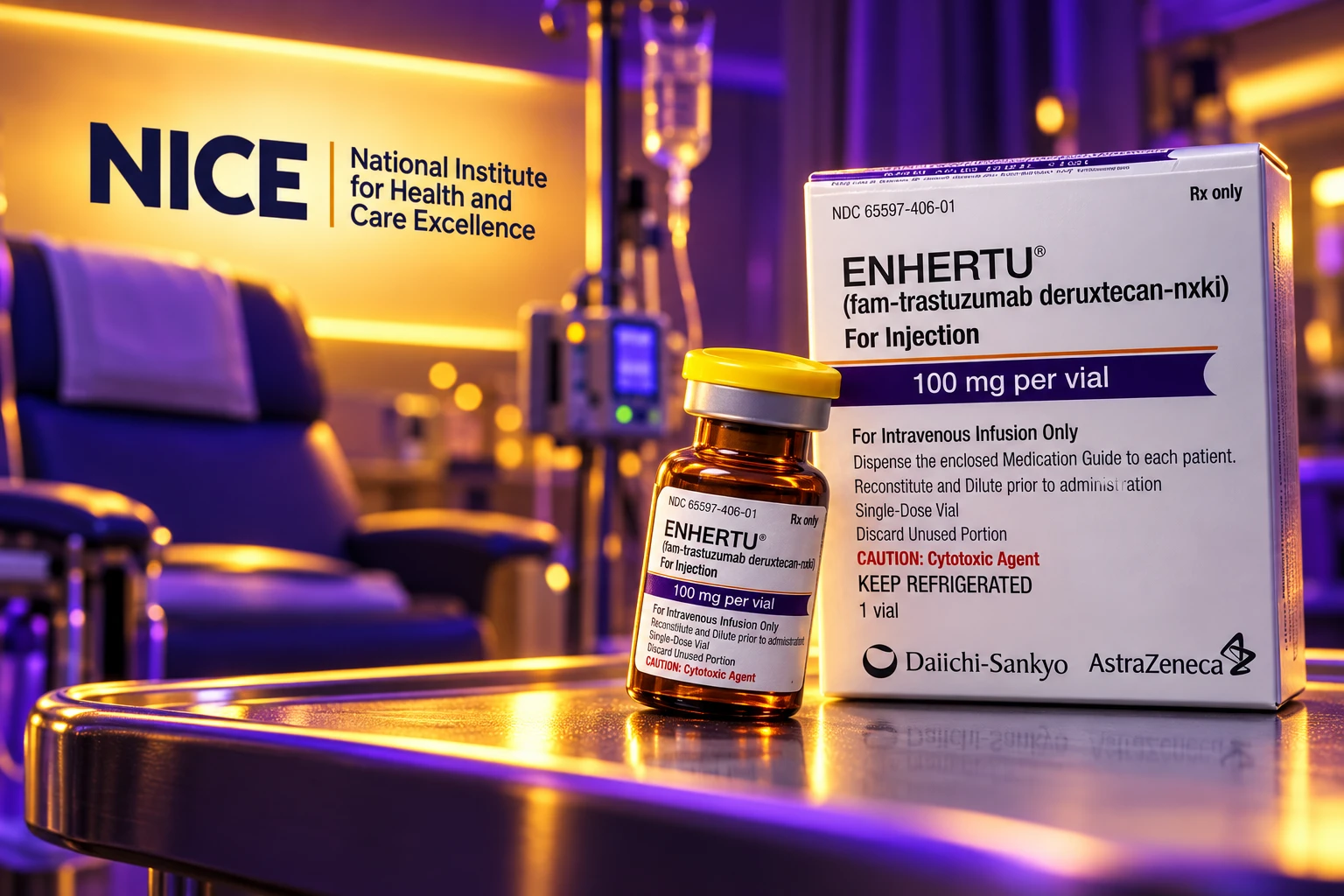
A UK-US Deal Lifted What NICE Can Pay
Until March 2026, NICE judged most new medicines against a band of £20,000 to £30,000 per extra year of life in full health, a unit it calls a QALY. From April, that band is £25,000 to £35,000. The shift followed a pharmaceutical partnership with the United States announced in December 2025, which also aimed to draw more life-sciences investment into Britain.
NICE already backed about 91% of the medicines it appraised, around 70 a year. Its own analysis said the higher band would let it recommend an extra 3 to 5 medicines or uses each year. Ministers later said nine extra medicines had been approved by 2 July 2026 that would have been unlikely under the old cap, including a brain-tumour drug for patients as young as 12 and a last-resort stomach-cancer treatment.
HOW THE VALUE-FOR-MONEY BAND MOVED
| Rule | Until March 2026 | From April 2026 |
|---|---|---|
| Lower QALY cap | £20,000 | £25,000 |
| Upper QALY cap | £30,000 | £35,000 |
| Extra yeses NICE expected | Not modelled as a lift | 3 to 5 a year |
| Extra yeses ministers counted by 2 July 2026 | Not published on that basis | 9 medicines |
Parliament’s estimate put the wider arrangement at about £1 billion in England over the current spending review. There is no published plan that rings that money off from other NHS care. The Enhertu committee judged an acceptable cost per extra healthy year at around £35,000, the new ceiling, after a confidential discount and the new quality-of-life method. The public still cannot see whether AstraZeneca and Daiichi Sankyo cut the price they refused to cut in 2024, or whether the NHS simply agreed to pay more.
Scotland Has Offered the Drug Since 2023
The Scottish Medicines Consortium accepted for use within NHS Scotland on 11 December 2023, for the same HER2-low group after chemotherapy. That is 2 years and 9 months before NICE’s English draft. Dr Scott Muir, then SMC chair, said the drug was more effective than current treatments and could increase time with loved ones.
On 29 July 2024 NICE published a final no for England. Knight said NICE and NHS England had offered as much flexibility as they could, but the companies did not put forward a new price. Around 1,000 people a year would have been eligible had the answer been yes. Rapid review was on the table if the makers returned with a lower figure. They did not, on the public record, until the cap itself moved.
THE LONG WAIT FOR THE SAME DRUG
- 11 December 2023: SMC accepts trastuzumab deruxtecan for HER2-low disease after chemotherapy in Scotland.
- 29 July 2024: NICE publishes final guidance not recommending it for the same group in England.
- December 2025: The UK-US pharmaceutical arrangement is announced, including a higher NICE cap from April.
- April 2026: NICE starts using the £25,000 to £35,000 band on new and live appraisals.
- 27 August 2026: A new quality-of-life scoring method is published.
- 17 September 2026: NICE issues final draft guidance backing Enhertu for routine NHS use in England.
- 7 October 2026: Appeal window on that draft closes at 5pm.
Claire Rowney, chief executive of Breast Cancer Now, said the wait in England was over and that Wales and Northern Ireland should now follow. The companies have said they will seek access in both. Rowney also named METUPUK and Make 2nds Count as campaign partners, and said thousands of people had missed the drug since 2024, with many dying in that gap.
What the DESTINY-Breast04 Trial Showed
HER2-low is a newer label. Tumours score 1+ on a stain test, or 2+ without gene amplification. They used to be filed as HER2-negative, so patients got ordinary chemotherapy rather than a HER2-targeted drug. About 60% of HER2-negative metastatic breast cancers fall in that low band. Enhertu is an antibody carrying chemotherapy. It locks onto the HER2 protein and releases the payload inside the tumour cell. Dr Catherine Elliott, Cancer Research UK’s director of research, described it as a targeted treatment that delivers chemotherapy directly to cancer cells.
The case for using it after chemotherapy comes from DESTINY-Breast04, a 557-person open-label trial that assigned patients 2:1 to Enhertu or the doctor’s choice of chemotherapy. Of those patients, 494 (88.7%) had hormone-receptor-positive disease and 63 (11.3%) did not. Across everyone, median time before the cancer worsened was 9.9 months on Enhertu and 5.1 months on chemotherapy. That is close to a doubling. Median life span was longer too, with a median overall survival of 23.4 months on the drug and 16.8 months on chemotherapy, a 6.6-month gain. The hazard ratio for death was 0.64.
DESTINY-BREAST04 PRIMARY RESULTS
| Outcome | Enhertu (373 people) | Physician’s choice chemotherapy |
|---|---|---|
| Median time before cancer worsened | 9.9 months | 5.1 months |
| Median overall survival | 23.4 months | 16.8 months |
| Grade 3 or worse side effects | 52.6% | 67.4% |
High-grade side effects were actually less common on Enhertu than on the older chemo list. The harm that is specific to this drug is not the usual blood-count crash. It is inflammation of the lungs.
The Infusion Can Inflame the Lungs
Adjudicated drug-related interstitial lung disease or pneumonitis showed up in 12.1% of people on Enhertu in DESTINY-Breast04. Most cases were lower grade. Grade 5 events, deaths, occurred in 0.8%. Median time to onset was 129 days, with a range from 26 to 710 days, so clinics have to keep watching well after the first cycles. Left ventricular dysfunction, a heart-pump problem also seen with older HER2 drugs, occurred in 4.6% in that trial.
Common effects in more than one in five patients included nausea, low white cells, low haemoglobin, fatigue, hair loss, vomiting and constipation. The drug is given as a drip, usually 5.4 mg per kilogram every three weeks. Anyone offered it needs a clear plan for cough, breathlessness or fever, because those can be the first signs of lung injury, and they can appear months in.
Who Can Start Treatment in England
The draft does not cover every person with secondary breast cancer, and it does not cover HER2-positive disease, which already had other NICE-backed uses of the same brand. It is for adults whose tumours are HER2-low and cannot be taken out, or have spread, after chemotherapy has already been tried in that setting, or after the cancer came back during adjuvant chemotherapy or within six months of finishing it.
WHO THE DRAFT GUIDANCE COVERS
- The tumour type: HER2-low disease, meaning an IHC score of 1+, or 2+ with a negative gene test.
- The stage: Unresectable, advanced or metastatic cancer, not early disease being treated for cure.
- Prior chemo: Chemotherapy already given after spread, or relapse during adjuvant chemo or within six months after it.
- The numbers: About 1,000 people a year in England, if clinicians judge it the right next step.
- The nations still waiting: Wales and Northern Ireland have not yet matched the English draft.
Hormone-receptor status does not by itself lock people out. Most trial patients were hormone-receptor positive, and a smaller group were not. Sacituzumab govitecan remains a possible option for some triple-negative cancers, and NICE said it could not treat the two drugs as equal on the evidence it had. The treating clinician still chooses.
The £1,455 Vial Price Stays Hidden
The BNF lists Enhertu at £1,455 ($1,950) for a 100 mg vial, hospital only, excluding VAT. The NHS pays less than that under a commercial arrangement whose size is confidential. That is the usual British pattern, and it is why nobody outside the room can say whether 2026 was a company climbdown, a taxpayer stretch, or both. In 2024, on the public record, there was no new price. In 2026, NICE named a commercial solution in the same breath as a higher cap and a new quality-of-life method.
Since 2024 when it was first rejected for use, thousands of people have missed out on access to Enhertu and tragically many have died. We remember with deep gratitude the women who stood alongside us and fought for this very moment. Women who were mums, daughters, sisters like Hannah, Jeannie and Tracy. We owe it to them to make sure this never happens again.
Claire Rowney, chief executive, Breast Cancer Now
Rowney called on government, NICE, NHS England and industry to stop forcing people with incurable secondary breast cancer to spend remaining months campaigning. For the next 1,000 people a year in England, the infusion is no longer a petition. It is a clinic booking, a lung check, and a median of 6.6 extra months against older chemotherapy, bought after the NHS raised what it is willing to pay.
Disclaimer: This article is news reporting on a NICE draft recommendation and related trial and pricing facts. It is for information only and is not medical advice, a treatment recommendation, or a substitute for a consultation. It does not tell any reader whether Enhertu is safe or suitable for them, and it does not advise on NHS funding, appeals or private purchase. Anyone considering treatment should speak to their oncologist and specialist cancer nurse, who can weigh HER2 status, prior therapy, lung and heart risk, and local funding. Figures, eligibility rules and national access (including Wales, Northern Ireland and the 7 October 2026 appeal close) reflect the sources used here and can change if final guidance, discounts or clinical practice move.

Europe’s Heat Killed 50,391 in Cities Official Counts Still Miss

Caesarean Surge Puts 20 England Maternity Units at Risk

The Protective Ring Around Care Homes Never Existed

Cooper Prioritises Children’s Corridor Care Without an Age Count

Oxford’s Ebola Vaccine Reaches Uganda as Doses Sit Unused

Pennsylvania Measles Deaths Collide With Falling MMR Coverage

FDA Approves XFG COVID Vaccines While the Advice Panel Is Frozen

Muscle-Boosting Drugs Near Approval for Children With SMA

Progranulin and JAK2 Split the Macrophages That Heal

After the ADHD Invoice, GPs and Waiters Carry the Cost
-
 NEWS2 months ago
Pennsylvania Measles Deaths Collide With Falling MMR Coverage
-
 NEWS2 months ago
FDA Approves XFG COVID Vaccines While the Advice Panel Is Frozen
-
 FITNESS2 months ago
Muscle-Boosting Drugs Near Approval for Children With SMA
-
 NEWS2 months ago
Progranulin and JAK2 Split the Macrophages That Heal
-
 MENTAL HEALTH2 months ago
After the ADHD Invoice, GPs and Waiters Carry the Cost
-
 NEWS2 months ago
Rasonque’s List Price Shifts the Pancreatic Cancer Bill
-
 NEWS2 months ago
Pennsylvania’s Two Measles Deaths Follow a Long Coverage Slide
-

 NEWS2 months ago
FDA Flagged This Sprout Plant 16 Months Before the Outbreak