
NEWS
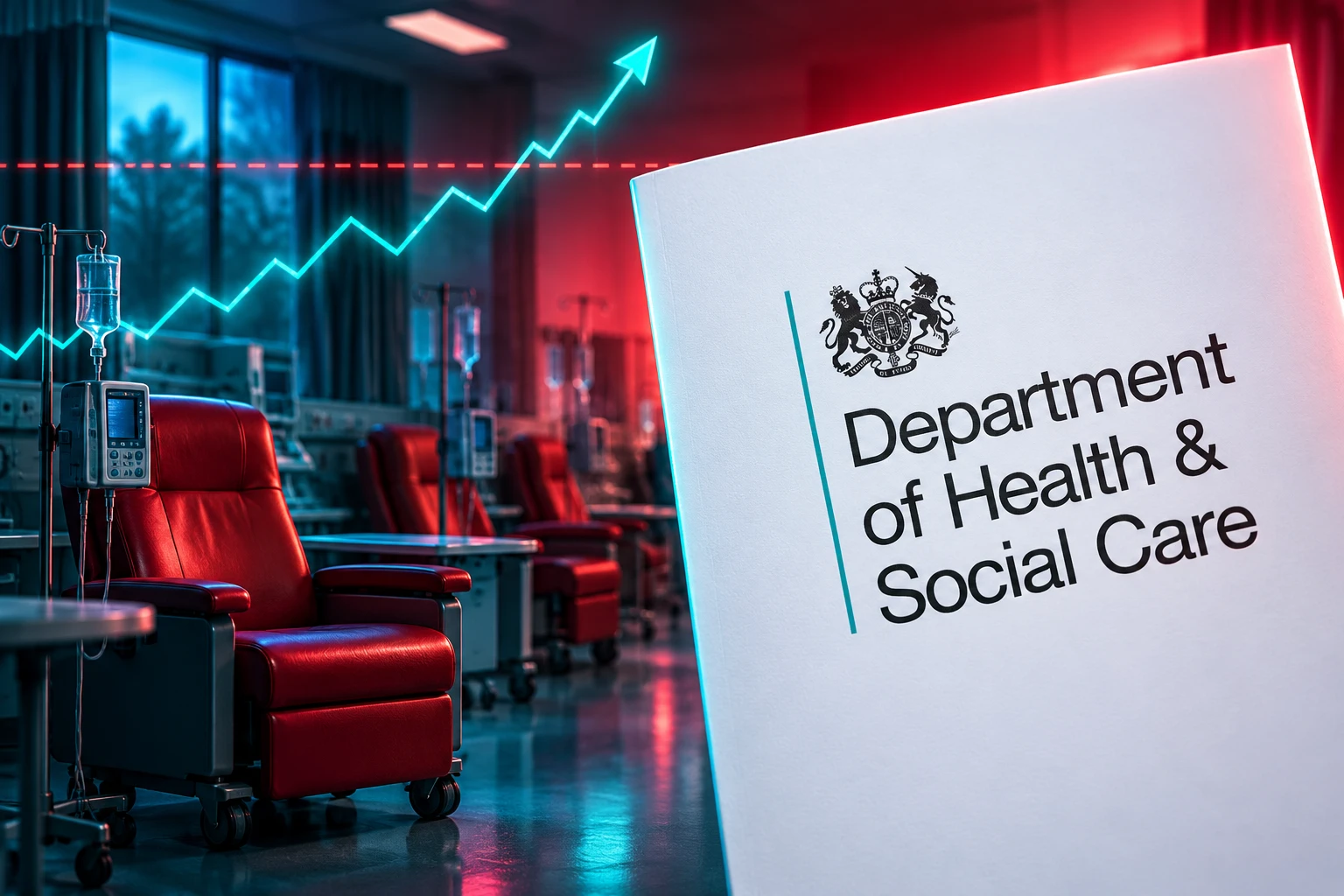
England’s 62-Day Cancer Target Slips Over Three Years
Cancer Research UK puts England’s 85% 62-day cancer treatment rate at 77.8% by 2029, with most long waits still sitting in the test queue.

Cancer Research UK projects that England will not hit an 85% 62-day cancer treatment rate until April 2032, more than three years after the March 2029 pledge.
The charity’s October 2026 model puts the share of people starting treatment within 62 days of an urgent referral at 77.8% by that deadline, 7.2 points short. Most people who already wait past 62 days still have no decision to treat, which means the delay is still in tests, not in theatre.
Cancer Research UK Puts the 85% Line in 2032
The National Cancer Plan, published in February 2026, said the NHS would meet all three waiting time standards by March 2029. For the 62-day clock, that means 85% of people who receive an urgent referral should begin first treatment within 62 days. NHS England also set stepping stones of 75% by March 2026 and 80% by March 2027.
Cancer Research UK ran those dates against the recent trend. Between March 2026 and March 2029, it estimates around 1,230,000 people in England will start cancer treatment after an urgent referral. If the recent path holds, the 85% line is projected to reach only 77.8% by March 2029 and would not be crossed until April 2032.
CRUK’S TREND PATH TO 2029
- The 2029 reading: 77.8% start treatment within 62 days, 7.2 points below the 85% standard.
- The catch-up load: About 51,500 extra people would need to start on time on top of the current path, or about 1,400 more a month.
- The extra speed: Results would still need to rise by a further 2.4 points a year above the current path.
- If the rise stalls: Holding at the 70.1% seen from October 2025 to March 2026 would mean more than 104,000 fewer on-time starts than if the targets were met, more than twice the shortfall on the improving path.
The March 2026 stepping stone of 75% was already behind that 70.1% six-month reading. The charity says there is only a short window to bend the line before the 2029 date, and that the Spending Review expected in early 2027 is the next chance to fund the missing capacity.
The 71.9% Reading From August 2026
NHS England published provisional August 2026 cancer waiting times on 8 October 2026, a day after the CRUK model began circulating. On the combined 62-day standard, 71.9% started first treatment within 62 days of an urgent suspected cancer referral, a breast symptomatic referral, an urgent screening referral, or a consultant upgrade.
That is up from 71.2% in July and 69.9% in June. Over the 12 months to August 2026, the average was 70.2%, compared with 69.0% in the year before. The constitutional standard has been 85% since the combined measure began in October 2023, and England has not met it since December 2015.
August volumes fell with the holiday month, as they often do: 27,909 people were treated against the 62-day combined standard, down from 31,519 in July. The 12-month monthly average still rose, to 29,338 from 28,129 a year earlier. More people are coming through the door. The share treated on time is crawling.
THE THREE CANCER WAITING STANDARDS IN AUGUST 2026
| Measure | August 2026 | Standard | Plan date |
|---|---|---|---|
| Told cancer or all-clear within 28 days | 78.6% | 80% | Already due from 1 April 2026 |
| First or later treatment within 31 days of a decision | 92.1% | 96% | March 2029 |
| First treatment within 62 days of urgent referral | 71.9% | 85% | March 2029 |
The 28-day Faster Diagnosis Standard is the one ministers already moved. It rose from 75% to 80% on 1 April 2026, and August came in at 78.6%, down from 79.3% in July. The 31-day standard, which starts only after doctors have decided to treat, was 92.1% against 96%. The 62-day clock runs from referral to first treatment, so it includes every lag in tests, results, and the wait after a plan is set.
Most People Past 62 Days Are Still Waiting for Tests
That last point is the part the 2029 date does not fix on its own. Cancer Research UK’s August 2026 pathway briefing counted about 16,100 people in England at the end of June 2026 who had already waited more than 62 days either to start treatment or to have cancer ruled out after an urgent suspected cancer referral.
Around 80.1% of that group still had no decision to treat. They were not queued for a theatre slot. They were still waiting for diagnostic tests and results. In the same month, only 69.9% of those who did start treatment did so inside 62 days.
WHERE THE 62-DAY CLOCK IS ACTUALLY STUCK
- Open long waits: About 16,100 people were over 62 days at the end of June 2026, waiting to start treatment or to be cleared.
- No treatment plan yet: 80.1% of them had no decision to treat, a marker of tests and results still outstanding.
- Diagnostic six-week waits: 20.7% of key tests that can be used to find cancer had waited six weeks or more in England in June 2026, against a target of under 1%.
- Lung pathway: 62-day results for lung cancers in that briefing sat at 61.3%, below the 69.9% all-cancer figure for the month.
Faster diagnosis is the front door to the 62-day clock. In August 2026, 273,664 people completed a Faster Diagnosis pathway, down from 308,370 in July, and 78.6% were told they had cancer or that it had been ruled out within 28 days. Until that door moves, the 85% treatment line cannot jump by 2.4 extra points a year on goodwill.
What a Four-Week Delay Does to Survival
Waits of this length are not only a booking problem. A 2020 systematic review in The BMJ, led by Timothy P. Hanna at Queen’s University in Kingston, pooled 34 studies covering 1,272,681 people across seven cancers. For 13 of 17 treatment indications, delay lined up with a higher risk of death.
Surgery results clustered tightly. Each four-week delay carried a 6% to 8% higher death risk (hazard ratios 1.06 to 1.08), including 1.06 for colon surgery and 1.08 for breast surgery. Head and neck radiotherapy sat at a 9% rise (1.09). Adjuvant drug treatment after colorectal surgery sat at 13% (1.13). The review did not claim every extra day is equal for every cancer, and it measured delay after diagnosis, not the full referral clock. It still gives a scale for a system that has now missed 85% for more than a decade.
Even a four week delay of cancer treatment is associated with increased mortality across surgical, systemic treatment, and radiotherapy indications for seven cancers.
Timothy P. Hanna and colleagues, The BMJ, 2020
Hanna’s group concluded that a four-week delay linked to higher death risk is large enough to shape how services are organised, and that longer delays look worse. England’s 62-day standard is already two of those four-week blocks from referral to first treatment. A person who starts at day 90 has given the tumour another month on top of a clock the NHS itself calls too long.
The Survival Goal Assumes the Clock Starts on Time
The waiting-time pledge is only the first half of the National Cancer Plan. The centrepiece is that 75% of people diagnosed from 2035 will be cancer-free or living well five years later, a shift the government said would save 320,000 more lives over the life of the plan. Wes Streeting, then secretary of state for health and social care and himself treated for kidney cancer, wrote that people in the UK are still less likely to survive cancer than people in comparable countries, and that working-class communities are failed most of all.
To feed that second half, the plan promised faster diagnostics: a £2.3 billion investment to deliver 9.5 million extra tests by 2029, more scanners, and community diagnostic centres running 12 hours a day, seven days a week where possible. It also said that once the existing waiting-time standards are met, ministers will review whether to tighten them.
That sequence only works if the first half arrives. A 75% five-year survival goal in 2035 depends on earlier stage at treatment, which depends on tests coming back in time for the 62-day clock to mean something. One in two people in England will face cancer directly in their lives, the plan said. The 1,230,000 urgent-referral treatment starts CRUK counts between March 2026 and March 2029 are the first slice of that cohort still walking into a service that last hit 85% in December 2015.
A DECADE OFF THE 85% LINE
- December 2015: England last meets the 85% 62-day standard nationwide.
- October 2023: Combined 62-day, 31-day, and 28-day standards take over from the older nine measures.
- February 2026: The National Cancer Plan recommits to 85%, 96%, and 80% by March 2029, and to 75% five-year survival from 2035.
- March 2026: The 75% 62-day stepping stone is missed; the six months to March sit at 70.1%.
- 1 April 2026: The Faster Diagnosis Standard rises to 80% as an operational line, months before the plan’s 2029 date.
- August 2026: 62-day results reach 71.9%; 28-day results sit at 78.6%.
- October 2026: Cancer Research UK publishes the trend path that does not hit 85% until April 2032.
The plan itself admitted the 85% standard had been missed “with impunity” since 2014 and had not been met nationally since late 2015. CRUK’s October model is the first full check of whether the 2029 recommitment is on the path the trend can actually walk.
Where the Extra 1,400 Monthly Starts Would Come From
Hitting 85% by March 2029, on CRUK’s sums, means about 51,500 more people starting treatment inside 62 days than the current path allows, roughly 1,400 extra on-time starts every month, and a further 2.4-point yearly rise on top of what is already baked in. That is capacity in imaging, endoscopy, histopathology, and then in surgery, radiotherapy, and drugs, not a rounding error in a dashboard.
Michelle Mitchell, chief executive of Cancer Research UK, put the human side in the same terms the model uses for volume.
Too many people are anxiously waiting to start cancer treatment and, despite the best efforts of NHS staff, these figures show that the UK government needs to urgently turn up the dial to meet its commitments. Cancer patients deserve more than ambitions. They deserve an NHS that has the staff and equipment it needs to diagnose and treat cancer on time.
Michelle Mitchell, chief executive, Cancer Research UK
Ministers have not accepted the 2032 date. The government says the charity’s model does not take account of future changes already set out in the National Cancer Plan. A Department of Health spokesperson said results against all three waiting-time standards had improved over the last year even with record demand, that new surgical hubs and a diagnostics expansion would cut waits further, and that a relaunched National Cancer Board would watch progress and tell ministers where more action is needed.
Both things can be in the same sentence without cancelling each other. August 2026 was better than August 2025. It was still 71.9% on a standard of 85%, and the 28-day door that is already supposed to sit at 80% did not. CRUK modelled the recent trend, not a fully built network of seven-day diagnostic centres. The live argument is whether that build-out arrives fast enough to supply 1,400 extra on-time starts a month before March 2029.
The charity’s own next marker is the Spending Review expected in early 2027. If the test queue is still where the June 2026 briefing left it, with four in five long waiters holding no treatment decision, the 2035 survival date will be counting people who started their treatment on a clock the 2029 plan already called too slow.
Disclaimer: This article is news reporting and analysis of NHS waiting-time figures and published research. It is for information only and is not medical advice, a diagnosis, or a guide to any individual’s treatment. Readers who are waiting for tests or treatment, or who are worried about symptoms, should speak to their GP or cancer team and should not change care on the basis of national averages. The percentages, dates, and projections here reflect Cancer Research UK’s October 2026 model, NHS England’s August 2026 official statistics, and the studies cited, and those figures can be revised as later data are issued.

Europe’s Heat Killed 50,391 in Cities Official Counts Still Miss

Caesarean Surge Puts 20 England Maternity Units at Risk

The Protective Ring Around Care Homes Never Existed

Cooper Prioritises Children’s Corridor Care Without an Age Count

Oxford’s Ebola Vaccine Reaches Uganda as Doses Sit Unused

Pennsylvania Measles Deaths Collide With Falling MMR Coverage

FDA Approves XFG COVID Vaccines While the Advice Panel Is Frozen

Muscle-Boosting Drugs Near Approval for Children With SMA

Progranulin and JAK2 Split the Macrophages That Heal

After the ADHD Invoice, GPs and Waiters Carry the Cost
-
 NEWS2 months ago
Pennsylvania Measles Deaths Collide With Falling MMR Coverage
-
 NEWS2 months ago
FDA Approves XFG COVID Vaccines While the Advice Panel Is Frozen
-
 FITNESS2 months ago
Muscle-Boosting Drugs Near Approval for Children With SMA
-
 NEWS2 months ago
Progranulin and JAK2 Split the Macrophages That Heal
-
 MENTAL HEALTH2 months ago
After the ADHD Invoice, GPs and Waiters Carry the Cost
-

 NEWS2 months ago
Rasonque’s List Price Shifts the Pancreatic Cancer Bill
-
 NEWS2 months ago
Pennsylvania’s Two Measles Deaths Follow a Long Coverage Slide
-

 NEWS2 months ago
FDA Flagged This Sprout Plant 16 Months Before the Outbreak