
NEWS
Fragmented Cellulitis Care Sends 100,000 Patients to Hospital
About 40% of cellulitis diagnoses later change, yet England still logs over 100,000 hospital stays a year as swelling goes untreated after discharge.

Over 100,000 people in England go into hospital with cellulitis each year, and about 40% later get a different diagnosis. On 18 September 2026, clinical lecturer Elizabeth LA Cross and colleagues warned that split care between GP, emergency, and ward teams makes the infection harder to clear and more likely to return.
Their argument is not that hospitals lack antibiotics. It is that a short course treats the red patch, then nobody owns the swelling, the cracked skin, or the next admission.
100,000 Cellulitis Admissions a Year in England
Cellulitis is a bacterial infection of the skin and the fat under it. Cross, who works at Brighton and Sussex Medical School and University Hospitals Sussex, wrote with consultant O Martin Williams, professor Edd Carlton, and consultant senior lecturer Fergus Hamilton that it remains one of the most common skin and soft tissue infections, with over 100,000 hospital admissions a year in England.
A linked how-to by Ottawa emergency physician Krishan Yadav and colleagues, published on 15 September 2026, put the global count at 54.8 million cases in 2019. In England and Wales, hospital admissions for skin and soft tissue infections rose 145% between 1999 and 2020, from 183 to 449 per 100,000 people.
THE SCALE OF THE HOSPITAL LOAD
- England: Over 100,000 cellulitis admissions a year.
- England and Wales trend: Skin and soft tissue admissions rose 145% from 1999 to 2020.
- Worldwide, 2019: 54.8 million cases in the Global Burden of Disease figures Yadav cited.
- Wrong label: About 40% of people first called cellulitis later receive another diagnosis.
Cross and colleagues say those numbers are made worse by uneven access and by care that fragments as the patient moves. Two days after the editorial, the same team of journals recirculated Yadav’s practical guide rather than any correction of the admission count.
Cellulitis is one of the most common skin and soft tissue infections, with over 100 000 patients admitted to hospital annually in England.
There are multiple challenges across the patient journey, which are worsened by inequities and fragmentation of carehttps://t.co/lfSvjVo99B
— The BMJ (@bmj_latest) September 18, 2026
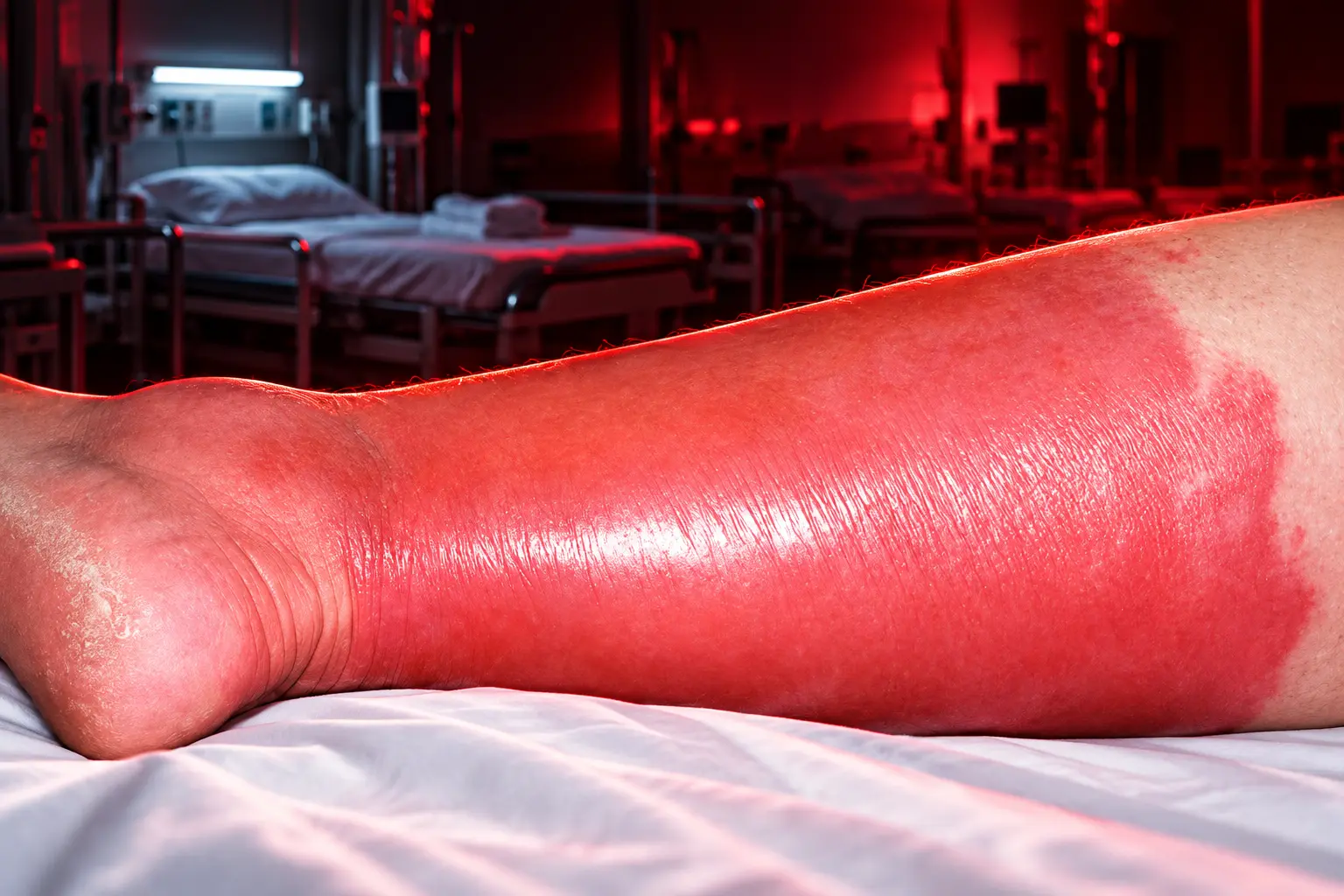
Doctors Still Diagnose Cellulitis by Eye
There is no validated blood test or scan that proves cellulitis. Yadav’s group says it is mainly a clinical diagnosis, that routine blood tests or cultures are not required in uncomplicated cases, and that people over 65 carry higher risk. Oral penicillins or first-generation cephalosporins for 5 to 7 days are first-line for uncomplicated infection and are no worse than intravenous drugs.
Their worked example is a 71-year-old woman who arrives after 48 hours of pain, redness, and swelling in the right lower leg, temperature 38.3°C, with diabetes, high blood pressure, and venous stasis dermatitis. That mix is the daily trap: the leg is red, so cellulitis is the default, even when vein disease is already on the list.
Cross writes that clinicians default to cellulitis when they see an erythematous lower limb because the lookalikes are less familiar. A nine-study review found misdiagnosis ranging from 19% to 83%, and that 54% of the errors were stasis dermatitis, eczematous dermatitis, or oedema and lymphoedema.
A scoring tool, ALT-70, tries to put numbers on the guess. Asymmetry of the legs scores 3, age 70 or older scores 2, a white cell count of 10,000 or higher scores 1, and a heart rate of 90 or higher scores 1.
ALT-70 BANDS FROM THE DERIVATION STUDY
- 0 to 2 points: About 9% chance it is cellulitis; rethink the label.
- 3 to 4 points: About 72% chance; the score does not settle it.
- 5 to 7 points: About 95% chance; treat as cellulitis unless something else is obvious.
Cross and colleagues say thermal asymmetry and scores such as ALT-70 might help, but still need more testing. A 67-patient emergency-department study that used a dermatology review as the reference found a cutoff of three points very sensitive and only moderately specific, which is why the editorial refuses to treat the tool as finished.
WHERE EXPERTS DISAGREE
- Ready for use: The 67-patient check treated a cutoff of three as a strong rule-out when the score was low.
- Not ready: Cross and colleagues still want more validation before scores or thermal imaging change practice.
Until that argument closes, the safe step is the one Yadav lists next to the antibiotics: reassess in 2 to 3 days, and ask whether the first label was wrong.
The Mimics That Fill Hospital Beds
Lower limb cellulitis is almost always on one side. Redness in both legs should push the clinician toward something else, most often vein disease, eczema, or lymphoedema, which can also sit alongside a true infection and blur the picture.
Among doctors who already treat skin infection, bilateral red legs are read as venous stasis until a fever, spreading tenderness, or one-sided heat says otherwise. The gap is not the textbook list. It is that the first clinician in a busy emergency department still has to choose a label in minutes, then hand the patient to a ward that may never reverse it.
CELLULITIS NEXT TO THE CONDITIONS IT IS CONFUSED WITH
| Feature | Cellulitis | Stasis dermatitis | Lymphoedema |
|---|---|---|---|
| Usual onset | Hours to a few days | Days to weeks, often chronic | Weeks to months |
| One leg or both | Almost always one | Often both | One or both |
| Feel of the skin | Hot, tender, spreading red | Itchy, scaly, brown staining | Tight, heavy, less pain at rest |
| Fever or feeling ill | Common | Rare | Rare unless infected |
| First treatment if the label is right | Antibiotics 5 to 7 days | Skin care, elevation, compression once the acute redness settles | Compression, skin care, swelling control |
When the wrong label sticks, people get antibiotics they did not need and miss treatment for the vein or lymph problem that will bring them back. NICE already tells clinicians, when they reassess, to consider insect bites, gout, superficial thrombophlebitis, eczema, allergic dermatitis, and deep vein thrombosis, and to treat oedema, diabetes, venous insufficiency, and eczema, not only the bug.
People Who Inject Drugs Wait Days for Care
Cross flags people who inject drugs as a group with a high burden of cellulitis and slow help-seeking, citing a UK study of 455 people. That London community survey, led by Talen Wright with Vivian Hope, Magdalena Harris, and colleagues, found that 64% reported an abscess and/or cellulitis in their lifetime, and 37% described a severe infection.
Nearly half used self-care for their worst episode. 60% waited five or more days after they first noticed symptoms before they sought medical advice, and many waited ten or more days or never went at all.
Stigma, fear of a bad outcome, and past treatment in emergency departments all delay the visit, so a treatable skin infection has more time to spread. The pathway then meets them at the wrong door: late, in A&E, with a worse infection, and with little planned follow-up once the drip comes down.
That is the equity half of the editorial. The other half is everyone with chronic swelling who is discharged with a script and no plan for the limb.
Why Cellulitis Comes Back After Treatment
A first episode is not a closed event. Each attack can scar lymph drainage, leave the skin a weaker barrier, and raise the chance of another infection. Published estimates put recurrence between 13% and 47% within a year.
The loop is mechanical. Oedema stretches the skin. Cracks and athlete’s foot let bacteria in. Antibiotics clear the acute infection. The swelling stays. Weeks later the leg is red again, and the next team writes cellulitis on the chart, sometimes correctly, sometimes not.
WHAT KEEPS THE DOOR REVOLVING
- Leftover swelling: Venous disease and lymphoedema remain after the antibiotic course ends.
- Broken skin: Athlete’s foot, ulcers, eczema, and injection sites keep offering an entry point.
- A prior episode: Once the lymphatics are damaged, the next attack is easier.
- No named owner: GP, emergency, and ward teams each treat a slice, then hand the patient on.
Informed clinicians already say the organism is not the whole problem. Repeat stays track the handoff. A person can leave hospital culture-negative and still return because nobody fitted a stocking, treated the foot fungus, or booked lymphoedema care.
Hospitals Rarely Follow the Compression Evidence
A randomised trial led by Elizabeth Webb assigned adults with chronic leg oedema and recurrent cellulitis to compression plus education or to education alone. At the planned interim look, 15% in the compression group had another episode versus 40% in the control group (hazard ratio 0.23, 95% confidence interval 0.09 to 0.59, P=0.002). The trial stopped early for efficacy. The number needed to treat was 4.
COMPRESSION VERSUS EDUCATION ALONE
| Group | Repeat cellulitis | Hospitalised for cellulitis |
|---|---|---|
| Compression plus education | 15% | 7% |
| Education alone | 40% | 14% |
88% of the compression group said they wore the garments at least four days a week, and no adverse events were recorded. Hospital stays for cellulitis were 7% with compression and 14% without. The trial was small, single-centre, and unblinded, which is why it is a signal, not a national programme. It still found a lower incidence of recurrence of cellulitis than education alone in people with chronic oedema.
Low-dose penicillin is the other prevention tool on the shelf. In the PATCH I trial, repeat episodes while on prophylaxis were 22% with penicillin and 37% without, with a reported number needed to treat of 5. NICE, in guideline NG141 from 27 September 2019, says specialists do not routinely offer antibiotic prophylaxis. They may consider a trial for adults who have had at least two hospital- or specialist-treated episodes in the previous 12 months, using phenoxymethylpenicillin 250 mg twice a day as the first choice when they do.
Improving diagnosis and management must be matched by greater attention to health equity and recurrence prevention
Elizabeth LA Cross, clinical lecturer, 18 September 2026 editorial
That sentence is the unused step. Flucloxacillin 500 mg to 1 g four times a day for 5 to 7 days is already written down. So is a 48-hour review if treatment started through a drip. What the pathway still drops is the stocking, the skin care, and a named clinic after the redness fades.
What Patients Can Do After a First Attack
NHS advice describes painful, hot and swollen skin, with redness that can be harder to see on brown or black skin, most often on the lower legs. Symptoms can worsen in the first 48 hours of tablets, then should start to ease. If they do not improve in 2 to 3 days, the GP needs to see the person again, both to check the drug and to ask whether the diagnosis was wrong.
During the acute spell, raising the limb, taking simple pain relief, moving the nearby joint, and drinking fluids are the practical steps. Compression garments wait until the acute infection has settled. After that, people with lasting swelling are the group the Webb trial was built for.
AFTER THE REDNESS STARTS TO FADE
- Finish the course: Keep taking the 5 to 7 days of tablets even when the skin looks better.
- Protect the barrier: Moisturise, treat athlete’s foot promptly, and clean small cuts.
- Ask about swelling: If the leg stays puffy, ask whether compression or a lymphoedema service is appropriate once the infection has calmed.
- Count recurrences: Two separate treated episodes in 12 months is the NICE threshold for a specialist talk about preventive penicillin.
Cross and colleagues asked for better diagnosis and for something the antibiotic chart never captures: a person who owns the leg after discharge. Until that happens, England will keep filling beds with a condition that is often mislabelled on the way in and left half-treated on the way out.
Frequently Asked Questions
Can You Catch Cellulitis From Another Person?
No. NHS guidance says you cannot catch cellulitis from someone else because it affects the deeper layers of the skin. Bacteria usually enter through a break that can be as small as a scratch, an insect bite, a cracked dry patch, or athlete’s foot, and the infection is more common on the lower limbs than on the arms or face.
How Long Do Cellulitis Antibiotics Take to Clear the Skin?
NICE expects a 5 to 7 day course for most people, and says the skin can take longer than that to look normal, so full clearing at day 5 is not the test of success. A longer course, up to 14 days in total, may be needed if the infection is slow to respond, and anyone on a drip should be reviewed by 48 hours with a view to switching to tablets.
When Is Preventive Penicillin Considered for Repeat Cellulitis?
NICE says prophylaxis should not be routine. Specialists may consider a trial in adults who have had treatment in hospital, or under specialist advice, for at least two separate episodes in the previous 12 months, taking account of severity, frequency, and the risk of resistance. The first-choice preventive tablet in that setting is phenoxymethylpenicillin 250 mg twice a day, with erythromycin 250 mg twice a day if penicillin cannot be used.
Should Compression Stockings Be Worn During an Acute Attack?
NHS advice is not to wear compression stockings until you are better, because the acute, painful, swollen limb is not the moment to force a garment on. The Webb trial enrolled people with chronic oedema and recurrent cellulitis, not those in the first days of a hot, spreading infection, and the practical sequence is antibiotics and elevation first, then compression once the acute episode has settled if swelling remains.
Which Cellulitis Symptoms Mean A&E Rather Than a GP?
Call 999 or go to A&E if cellulitis comes with a very high temperature or shivering, a fast heartbeat or fast breathing, purple patches (which may be less obvious on brown or black skin), dizziness or faintness, confusion, cold or clammy skin, or loss of consciousness. Those are signs the infection may have spread, and they sit above the usual advice to seek an urgent GP appointment for painful, hot, swollen skin.
Disclaimer: This article is news reporting and analysis of published clinical guidance and research on cellulitis. It is for information only and is not a diagnosis, a treatment plan, or personal medical advice. It does not tell you which antibiotic to take, whether you need hospital care, or whether compression or preventive penicillin is right for you. Speak to a GP, emergency clinician, or other qualified doctor before starting, stopping, or changing any treatment. Figures, trial results, and guideline recommendations reflect the sources cited and may change as new evidence and local protocols appear.

Europe’s Heat Killed 50,391 in Cities Official Counts Still Miss

Caesarean Surge Puts 20 England Maternity Units at Risk

The Protective Ring Around Care Homes Never Existed

Cooper Prioritises Children’s Corridor Care Without an Age Count

Oxford’s Ebola Vaccine Reaches Uganda as Doses Sit Unused

Pennsylvania Measles Deaths Collide With Falling MMR Coverage

FDA Approves XFG COVID Vaccines While the Advice Panel Is Frozen

Muscle-Boosting Drugs Near Approval for Children With SMA

Progranulin and JAK2 Split the Macrophages That Heal

After the ADHD Invoice, GPs and Waiters Carry the Cost
-
 NEWS2 months ago
Pennsylvania Measles Deaths Collide With Falling MMR Coverage
-
 NEWS2 months ago
FDA Approves XFG COVID Vaccines While the Advice Panel Is Frozen
-
 FITNESS2 months ago
Muscle-Boosting Drugs Near Approval for Children With SMA
-
 NEWS2 months ago
Progranulin and JAK2 Split the Macrophages That Heal
-
 MENTAL HEALTH2 months ago
After the ADHD Invoice, GPs and Waiters Carry the Cost
-

 NEWS2 months ago
Rasonque’s List Price Shifts the Pancreatic Cancer Bill
-

 NEWS2 months ago
Pennsylvania’s Two Measles Deaths Follow a Long Coverage Slide
-

 NEWS2 months ago
FDA Flagged This Sprout Plant 16 Months Before the Outbreak