
NEWS
Congo’s Bundibugyo Count Hides a Collapse in Ordinary Care
Congo’s Bundibugyo Ebola outbreak has reached 10,920 confirmed cases, and Ituri’s measles posts and maternity wards emptied while no licensed vaccine exists.

Congo has recorded 10,920 confirmed Bundibugyo Ebola cases and 5,323 deaths, according to European Centre for Disease Prevention and Control figures compiled through 7 November.
The crude death rate sits at 48.7%. The outbreak, declared on 15 May and driven by a virus with no licensed vaccine, has emptied ordinary clinics in Ituri even as treatment tents fill.
Congo Passes 10,920 Confirmed Bundibugyo Cases
The European agency’s 8 November update, drawing on ministry data through 7 November, lists 10,920 confirmed cases and 5,323 deaths inside Congo, plus 2,940 recoveries and 1,010 patients in isolation. That is already the largest Ebola outbreak Congo has recorded, and the U.S. Centers for Disease Control and Prevention calls it the second-largest on record anywhere.
Ituri still holds most of the burden, with 7,614 cases and 3,594 deaths across 28 of 36 health zones. North Kivu is next, at 2,697 cases and 1,478 deaths, and it has the harshest provincial death rate, 54.8%. Haut-Uélé, Tshopo, South Kivu, Bas-Uélé, South Ubangi and North Ubangi make up the rest of eight affected provinces. Cases have been found in 67 of Congo’s 178 health zones.
CONFIRMED BUNDIBUGYO TALLY BY PROVINCE
| Province | Cases | Deaths | Fatality |
|---|---|---|---|
| Ituri | 7,614 | 3,594 | 47.2% |
| North Kivu | 2,697 | 1,478 | 54.8% |
| Haut-Uélé | 486 | 213 | 43.8% |
| Tshopo | 96 | 31 | 32.3% |
| Four other provinces | 27 | 7 | 25.9% |
| All eight provinces | 10,920 | 5,323 | 48.7% |
The four smaller rows are South Kivu, Bas-Uélé, South Ubangi and North Ubangi. World Health Organization figures through 3 November, published on 6 November, were slightly earlier at 10,668 confirmed cases, 5,198 deaths and 2,881 recoveries, with 51 of 67 affected zones still reporting new infections in the prior 21 days.
CDC comparison charts show how fast this wave moved. The outbreak passed 1,000 confirmed cases within 40 days of response activation; Congo’s 2018 North Kivu outbreak, caused by the Zaire species, needed about 235 days to cross the same mark. At day 178 on that chart, this outbreak stood at 10,920 confirmed cases, against 5,325 in West Africa’s 2014 epidemic and 732 in the 2018 Congo wave. The 2018-2020 North Kivu outbreak finished, after 22 months, at 3,470 cases and 2,287 deaths. This one has already more than doubled those deaths in less than six months.
This is Congo’s 17th Ebola outbreak. Laboratory work at the Institut National de Recherche Biomédicale identified Bundibugyo virus, a species first named in Uganda in 2007. WHO says previous Bundibugyo outbreaks killed about 30% of known patients in 2007 and about 50% in 2012. The current crude rate, 48.7%, sits in that band, and it is lower than the 66% recorded in 2018-2020, when a licensed Zaire vaccine was already in the field.
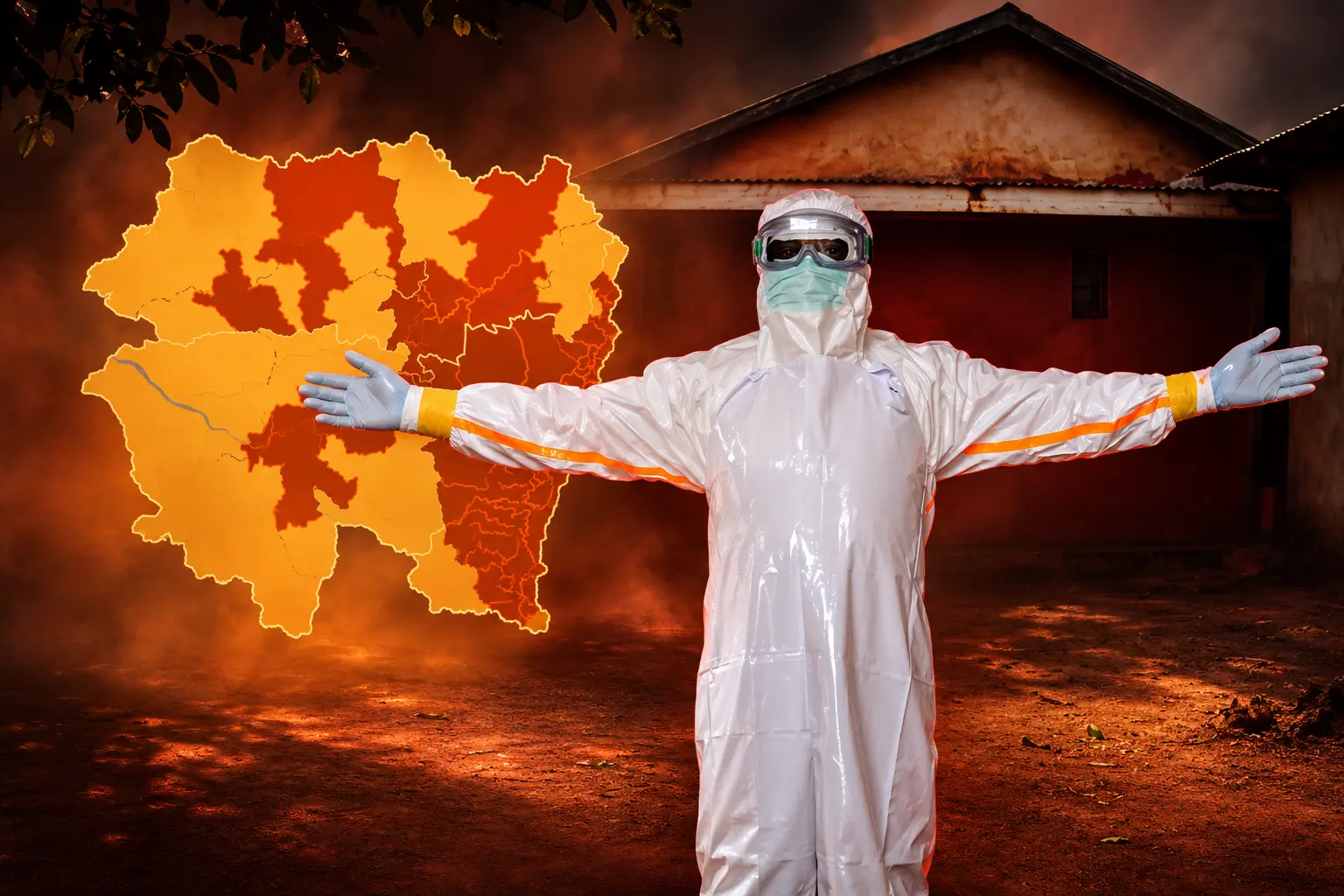
Ituri Clinics Emptied Before the Case Curve Did
The dashboard counts Ebola. It does not count the women who stopped coming in to give birth, or the infants who missed a measles dose because a health post felt like a trap.
UNICEF, using District Health Information Software data from all 36 Ituri health zones, found a 42% drop in essential care between April and June in the first hotspots of Bunia, Mongbwalu, Nizi and Rwampara, from 24,856 encounters to 14,321. Across Ituri as a whole, service use fell about 13%. No similar seasonal drop showed up in 2025.
WHAT CLOSED IN ITURI’S HOTSPOTS
- Childhood shots: Routine vaccinations fell by more than half in the hotspot zones, and first-dose measles coverage in Mongbwalu, the epicenter, fell 69%.
- Four-zone measles: First measles doses across those four hotspots fell 42.2%, from 3,666 doses to 2,119.
- Missed vials: Health facilities gave more than 23,000 fewer routine child vaccine doses in May and June than in April.
- Births in clinics: Facility-assisted deliveries fell 13% province-wide, and 38% in Bunia, 30% in Rwampara and 70% in Nizi.
- Antenatal visits: First antenatal visits fell about 28% in Bunia, Rwampara and Nizi.
John Agbor, UNICEF’s representative in Congo, said fear of infection and broken services were keeping families away. Children already die of this virus at a higher rate than adults. By 2 August, UNICEF counted 743 confirmed child cases and 330 child deaths among people aged 0 to 17. Young children under five had a case fatality rate more than double that of adults, with over 60% of confirmed cases in that age group ending in death, against fewer than 30% among adults aged 18 and older.
The data suggests that fear of infection, combined with disruptions to services, is deterring lots of children and their families from seeking care. One doctor told our team that before the current outbreak, his facility saw an average of 500 patients a month but that has dropped to almost nothing.
John Agbor, UNICEF Representative in the DRC, Bunia, 6 August 2026
Agbor later added that the outbreak was disrupting care for malaria, diarrhoea and other treatable illnesses that already kill more children than Ebola does. That is the quieter ledger. WHO Director-General Tedros Adhanom Ghebreyesus said cholera, running in parallel, had killed around 1,800 people in Congo this year, with some 60,000 cases, a death rate around 3%, and the worst cholera wave in the country in decades, concentrated in North Kivu and South Kivu.
Why Bundibugyo Still Has No Licensed Vaccine
Responders in 2018 could ring-vaccinate with Ervebo, a licensed shot built for the Zaire species. Bundibugyo is a different species. WHO says there is still no approved vaccine and no specific treatment for Bundibugyo virus disease, so control still rests on finding patients fast, isolating them, tracing contacts, burying the dead safely and keeping communities willing to report.
The virus was not unknown. It was identified in 2007 in Bundibugyo district in western Uganda, then hit Congo in 2012. Vaccine work still went to Zaire and, later, Sudan. Marion Koopmans, a virologist who leads a WHO collaborating centre on emerging infections, wrote that Bundibugyo outbreaks had been seen before, “yet vaccine development was done for ebola zaire, sudan, not bundibugyo.” Jake Dunning, an infectious-diseases consultant, noted that only two relatively small Bundibugyo outbreaks had occurred before 2026, and that some Ebola specialists were still downplaying the likely impact in May.
WHO’s own emergency guidance in late May was blunt about Ervebo: it is licensed against Zaire, evidence of cross-protection against Bundibugyo is thin, and using it outside research could create a false sense of safety if breakthrough infections followed. A limited Ervebo protocol still went out later for high-risk workers and for a trial arm, which is a research use, not a licensed Bundibugyo campaign.
FROM FIRST ALERT TO THE FIRST TRIAL
- 15 May 2026: Africa CDC reports an Ebola outbreak in Ituri; Congo’s index patient is a nurse who died in a Bunia facility.
- 17 May 2026: WHO determines a public health emergency of international concern.
- 18 May 2026: Africa CDC declares a Public Health Emergency of Continental Security.
- July 2026: The WHO-sponsored PARTNERS trial starts testing the monoclonal antibody MBP134, the antiviral remdesivir, or both, in confirmed patients.
- 23 October 2026: The Tumaini vaccine trial enrols its first participants in Bunia, using a ring design around contacts of the sick and the dead.
- 4 November 2026: WHO advisers recommend adding Oxford’s ChAdOx1, made with the Serum Institute of India, and Moderna’s mRNA-1469 after national approvals.
Incubation runs from two to 21 days, and infected people are not contagious until symptoms start, which is why a missed contact in week one becomes a funeral in week three. Early signs (fever, fatigue, muscle pain, headache, sore throat) look like malaria, and WHO says that delay is built into every late lab confirmation.
Most Recent Deaths Still Happen Outside Care
A case that reaches a treatment centre still has a chance. A death that happens at home almost always means the family has already been exposed, and that the burial team is walking into a house that did not call.
THE GAPS THAT KEEP CHAINS OPEN
- Community deaths: Of 512 deaths WHO counted from 21 October through its 3 November cut-off, 335 happened in communities and 177 in treatment centres.
- Contact target: The average share of listed contacts seen each day over 14 days was 86% of listed contacts seen, under the 95% threshold WHO says a response needs.
- Where tracing held: Bas-Uélé, North Ubangi and South Ubangi met or beat 95%; North Kivu was at 82% and Tshopo at 71%.
- Active belt: 51 of 67 affected health zones still had at least one new case in the 21 days before 3 November, with Beni, Bunia and Mandima the hottest.
In that same 21-day window WHO counted 1,463 new confirmed cases: 710 in Ituri, 640 in North Kivu, 77 in Haut-Uélé, 31 in Tshopo and 5 in North Ubangi. North Kivu logged the most cases in the last seven days of that report, 232, a sign the epicenter is no longer only Ituri. Recoveries, 2,940 through 7 November, are real. A video from a Mongbwalu centre showed staff in full protective gear dancing as the last two patients walked out. Tedros said of that clip that the outbreak was far from over, but that every life saved was worth celebrating.
Sephora Bgosi, with the Ebola burial team in Ituri, has said some people still do not seem to understand the seriousness of the situation even though they are directly exposed. Safe burials remain one of the few tools that work without a vaccine, and they only work when families let the team in.
Health Crews Strike as Attacks Continue
The people who run those burials and tents have been working without steady pay. In Nia Nia, in Ituri, surveillance and community officers walked out last month over unpaid bonuses owed since late August, a pattern responders say has repeated across affected localities. CDC has warned that violence against health workers, and shortages of protective gear, are putting the same crews at risk of infection while they treat patients.
Armed conflict, poor roads and mistrust were already in the ground when the first cases were confirmed. More than five months after the declaration, health workers were still being attacked. In late October a nurse was killed and another worker badly hurt while answering an Ebola alert in Bafwasende, in Tshopo. Africa CDC Director-General Dr. Jean Kaseya has said Ebola is crossing borders and that the response has to move faster, with stronger coordination and political leadership.
Strikes and assaults do the same damage as a missed contact list. A closed treatment centre leaves patients in living rooms. An unpaid tracer stops knocking. The 95% contact target is a staffing number as much as an epidemiology number.
Kenya Contained a Cluster the Epicenter Could Not
Nine confirmed Bundibugyo cases and two deaths in Kenya, all tied to one imported patient, show what contact tracing looks like when it actually closes a ring. The first patient, a Kenyan who had been living in Congo, travelled through Uganda, reached Nairobi, and died in isolation. Eight further cases (four relatives and four health workers) were already under quarantine when they fell ill. WHO says there is no evidence of spread outside that cluster, and no new confirmed Kenyan case since 19 October.
Five of the nine had been discharged by 3 November; European officials said six had recovered by 8 November, with one patient still in care. Of 135 contacts, eight became cases and nine left the country. Speaking in Nairobi on 10 November, Kenya’s health cabinet secretary, Aden Duale, said WHO’s Africa director, Prof. Yakub Janabi, had pointed to those 135 contacts and to three consecutive weeks without a new confirmed case. Kenya had screened 760,415 travellers at designated entry points by 5 November. WHO says Kenya’s 42-day countdown to declare the cluster over starts only after the last patient is discharged.
Nigeria reported one imported case on 20 October; the patient was evacuated to Geneva on 26 October, and 62 contacts were listed. Uganda’s linked outbreak, 20 confirmed cases and two deaths, had its last confirmed case on 21 June and was declared over in August. France’s single case is also closed. Switzerland and the United Kingdom have taken medically evacuated patients, including a British health worker moved to London on 5 November. CDC says no cases have been confirmed in the United States from this outbreak, and it puts the risk of spread there as very low.
Those contained sparks are the argument for surveillance. They are also the contrast. Congo is still adding cases by the hundred. European officials counted 179 new confirmed cases and 93 deaths between their 6 November and 8 November updates, 99 of them in Ituri.
A Trial Named Hope Will Not End This Wave
Tumaini, Swahili for hope, is a Phase 2/3 ring trial led by Congo’s Institut National de Recherche Biomédicale with the University of Antwerp, WHO, Epicentre, Médecins Sans Frontières, the Institute of Tropical Medicine of Antwerp, Africa CDC and the health ministry. Four vaccination rings were already up when WHO published its 6 November notice, with more being prepared. On 4 November, WHO’s Technical Advisory Group on Candidate Vaccines Prioritization recommended adding two Bundibugyo vaccine candidates, ChAdOx1 and mRNA-1469, after national approvals. WHO has said that would be the first time shots built for this species are tested during an outbreak of the same disease. Trial results are expected in early 2027.
L’épidémie d’#Ebola causée par le virus #Bundibugyo frappe de plein fouet les populations, avec déjà plus de 5 000 décès. En appui à la réponse sanitaire de la #RDC 🇨🇩, l’OMS et ses partenaires accélèrent la recherche sur les vaccins et les traitements. https://t.co/EELZXIq1a9 pic.twitter.com/VUYds61MJG
— OMS RDC (@OMSRDCONGO) November 5, 2026
WHO’s Congo office, posting the same week, said the epidemic had already passed 5,000 deaths and that the agency and partners were speeding vaccine and treatment research. The PARTNERS treatment study, launched in July, is still asking a basic question: whether MBP134, remdesivir, or the pair together can keep confirmed patients alive. Supportive care (fluids, fever control, treatment of malaria and bacterial infection) remains the care most patients actually get.
A shot that reports results in early 2027 will not rewind the measles doses missed in May, or the births that left the ward in Nizi. It will not pay the bonuses in Nia Nia. It may, if it works, give the next Bundibugyo wave a tool this one never had.
Until then the work is still the unglamorous list WHO keeps repeating: find people early, keep them in care, see 95% of contacts, bury the dead without infecting the family, and keep the rest of the clinic open so a labouring woman does not have to choose between Ebola and a haemorrhage. Kenya showed that list can close a cluster. Ituri is still waiting on the same list, at 10,920 confirmed cases, with no licensed vaccine in the bag.
Disclaimer: This article is news reporting and analysis of an active outbreak for general information. It is not medical advice, a diagnosis, a treatment plan, or guidance on travel, vaccination, or infection control for any individual. Readers who have symptoms, possible exposure, or questions about Ebola, measles, cholera, pregnancy care, or vaccines should speak with a licensed physician or local public-health authority before acting. Case counts, death rates, trial status and service figures reflect the WHO, UNICEF, CDC and ECDC sources cited and can change as ministries revise their data.

Falling Shot Rates Cost the U.S. Measles Elimination Status

NHS Record Snooping Gives Patients a Reason to Withhold

FDA Rejects Ivonescimab After the HARMONi Survival Miss

The Medicaid Work Delay Leaves January Checks Intact

Pelacarsen Cut Lp(a) 78%, and Heart Attacks Did Not Fall

Pennsylvania Measles Deaths Collide With Falling MMR Coverage

FDA Approves XFG COVID Vaccines While the Advice Panel Is Frozen

Progranulin and JAK2 Split the Macrophages That Heal

Alnylam Defends Amvuttra After Wainua’s ATTR-CM Trial Miss

Muscle-Boosting Drugs Near Approval for Children With SMA
-
 NEWS3 months ago
Pennsylvania Measles Deaths Collide With Falling MMR Coverage
-
 NEWS3 months ago
FDA Approves XFG COVID Vaccines While the Advice Panel Is Frozen
-
 NEWS3 months ago
Progranulin and JAK2 Split the Macrophages That Heal
-
 FITNESS3 months ago
Muscle-Boosting Drugs Near Approval for Children With SMA
-
 NEWS3 months ago
Alnylam Defends Amvuttra After Wainua’s ATTR-CM Trial Miss
-

 MENTAL HEALTH3 months ago
After the ADHD Invoice, GPs and Waiters Carry the Cost
-

 NEWS2 months ago
Rasonque’s List Price Shifts the Pancreatic Cancer Bill
-

 NEWS3 months ago
FDA Flagged This Sprout Plant 16 Months Before the Outbreak