
FOOD
Foremost Farms Drops Block Cheddar and a Wisconsin Plant
Foremost Farms will close Marshfield in December and end 40-pound block cheese, even as protein drinks and mozzarella pull dairy’s new plant money.

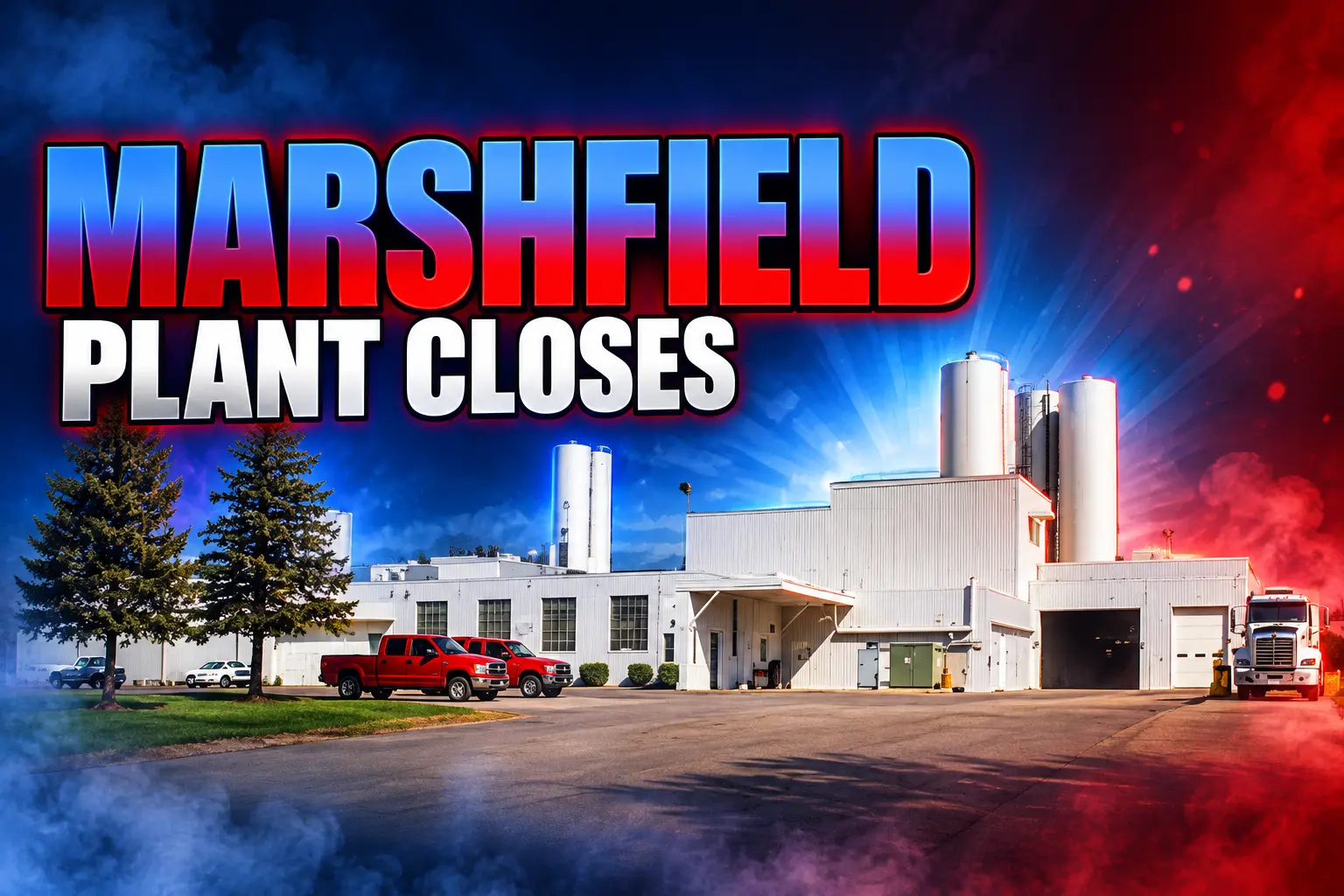
Foremost Farms will close its Marshfield, Wisconsin, cheese plant on December 15 and stop making 40-pound block cheese. The farmer-owned co-op told workers on August 24 and made the plan public two days later. 68 jobs go with the vats.
Dairy companies are still pouring plant money into protein drinks, yogurt, mozzarella and ultrafiltered milk. Marshfield makes the other kind of cheese, the 40-pound cheddar block that cut-and-wrap shops and foodservice kitchens have used for decades, and that format is the one Foremost is dropping.
Marshfield Stops 40-Pound Blocks in December
Foremost Farms USA, owned by hundreds of Midwest farm members across Illinois, Indiana, Iowa, Michigan, Minnesota, Ohio and Wisconsin, said the Marshfield close follows a review of “changing dairy market dynamics, including increased US cheese production capacity and shifting consumer demand.” Production keeps running through the transition. Operations are set to end in December.
Brenda Dehart, president and chief executive officer, put the blame on the market, not the floor crew.
This is not a reflection on our employees in Marshfield. The Marshfield team has consistently demonstrated dedication, professionalism and excellence. This decision was incredibly difficult and is based solely on changing market conditions and long-term needs of our cooperative.
Brenda Dehart, President and CEO, Foremost Farms USA
The plant at 1511 E. 4th Street dates to the 1950s. Its house brand, 1950-127, still carries the state’s old plant number and grader number. A 2024 co-op flyer said the site had taken 27 product awards in recent contests, and that its medium cheddar won Best of Class at the World Championship Cheese Contest that year. Awards did not keep the line open.
THE CLOSE CALENDAR
- August 24, 2026: Kari Paterson, vice president of human resources, files a permanent close of all 68 jobs with the Wisconsin Department of Workforce Development and notifies Teamsters Local 662 business agent Dan Boley and Marshfield Mayor Nick Poeschel.
- August 26, 2026: Foremost tells members and customers it will end 40-pound block cheese and shut the Marshfield plant as part of a product shift.
- December 15, 2026: All operations at the plant are set to end, with 65 of the 68 workers separated that day.
- January 15, 2027: The maintenance supervisor, production manager and maintenance manager are scheduled to leave.
Workers are to be paid wages and agreed benefits through their last day. Anyone who does not get a full 60 days of notice is to be paid regular wages and benefits for each missing day. Foremost also said staff can apply at other plants and will get training and human resources help during the move.
What a 40-Pound Cheddar Block Is For
A 40-pound cheddar block is the old workhorse pack of American cheese. Processors age it, then cut it into slices, shreds and chunks for retail and foodservice. It is also the unit the CME Group cash cheese market trades, so the pack still sets a price that other fresh cheese follows even when mozzarella is the bigger volume cheese in U.S. plants.
Marshfield was built around that pack. The co-op’s own plant sheet said the floor turned out 61 million pounds of cheese a year for foodservice and cut-and-wrap customers, and that 40-pound block cheddar for aging, colored and white, sat at the top of the list.
WHAT LEAVES WITH THE PLANT
- 40-pound blocks: Colored and white cheddar packed for aging, the format Foremost said it will stop making.
- Everyday American styles: Mild cheddar, Colby, Monterey Jack, brick and Gouda for the same cut-and-wrap trade.
- Foodservice melts: Pizza cheese and queso quesadilla, plus kosher cheese for Passover.
- The leftover stream: Condensed whey from the vats, a side product of the same make.
Foremost is not walking away from cheddar as a cheese. Its Lancaster, Wisconsin, plant still makes 640-pound cheddar blocks for customers who cut them into consumer sizes. The loser is the smaller industrial block, the one tied to the cash market and to a 1950s Marshfield floor that also ran a mixed American-style list.
That is a quiet exit. Protein drinks and cottage cheese get the new labels and the new plants. A 40-pound block does not, and there has been almost no public argument about dropping it.
Protein Plants Keep Getting the Checks
The International Dairy Foods Association’s September tracker puts planned U.S. spending at more than $14.4 billion for processing capacity between 2025 and 2030. Milk output is expected to rise 15 billion pounds by 2030, enough to fill more than 1.7 billion gallon jugs. The association counts about 1,200 dairy plants buying milk from nearly 24,000 farm families.
An October 2025 tally of more than 50 building projects across 19 states showed where that first wave of money was aimed. Cheese still led the list. The cheese dollars are not headed at 40-pound blocks in old Midwestern plants. They sit beside even larger bets on milk, yogurt and cultured products that sell as protein.
WHERE THE 2025 PROJECT LIST PUT THE MONEY
| Product | Listed investment |
|---|---|
| Cheese | $3.20 billion |
| Milk and cream | $2.97 billion |
| Yogurt and cultured dairy | $2.81 billion |
| Butter and powders | $1.60 billion |
| Ice cream | $530 million |
Cottage cheese sales rose about 20 percent in the year leading up to June 2025, according to Circana figures cited by the association. That is the consumer habit on the other side of Marshfield’s notice: shoppers paying for protein in a tub, a bottle or a yogurt cup, not for a 40-pound block that a plant then shreds.
New York led that 2025 state map at $2.8 billion. Texas followed at $1.5 billion. Wisconsin, still America’s dairyland on the slogan, ranked third at $1.1 billion. Idaho was listed at $720 million and Iowa at $701 million. Wisconsin is getting cheese and dairy money. It is not getting it on East 4th Street in Marshfield.
Land O’Lakes is putting $34 million into its Tulare, California, plant so the site can make ultrafiltered milk as an ingredient, Heather Anfang, president of dairy foods, said, with the aim of ramping in the first quarter of 2027. Chobani’s high-protein milk plant in Pennsylvania is the same wager at a much larger scale. The winners make protein that can go in a bottle. The Marshfield list does not.
Foremost Is Spending on the Other Line
The split is inside the co-op, not only across the industry. On April 20, Dehart announced expansions at Reedsburg, Wisconsin, and Greenville, Michigan, and said those projects “strengthen Foremost Farms for the long term.” Reedsburg is the butter and milk-balancing hub. Greenville, a dairy campus opened in 2018 on 96 acres and built to take up to six million pounds of milk a day, is being set up for membrane work and liquid ultrafiltered milk products, including milk protein isolates and concentrates for high-protein drinks and cultured foods.
Four months later the same chief executive closed the 40-pound block plant. Member milk is not being orphaned. It is being steered toward butter, protein and the Italian-style cheese plants that already dwarf Marshfield.
FOREMOST PLANTS ON TWO TRACKS
| Plant | What it makes | Scale | Next step |
|---|---|---|---|
| Marshfield, Wis. | 40-lb cheddar, Colby, Jack, pizza cheese | 61 million lb cheese a year | Closes December 15 |
| Appleton, Wis. | Mozzarella and other cheeses | 140 million lb mozzarella a year, 173 workers | Stays open |
| Clayton, Wis. | Provolone, mozzarella, whey protein | 50 million lb cheese a year | Stays open |
| Lancaster, Wis. | 640-lb cheddar blocks | Cut-and-wrap cheddar | Stays open |
| Greenville, Mich. | Ultrafiltered milk, protein isolates | 96-acre campus, up to 6 million lb milk a day | Expanding |
Appleton alone makes more than twice Marshfield’s cheese weight, and it makes mozzarella, the pizza and foodservice cheese that still grows with menus. Clayton, bought in 1991 and running since 1937, is the northern Italian-style plant. Richland Center left barrel cheddar in 2000 and moved to mozzarella loaves for pizza. The network Foremost is keeping is the one that sells melt and protein. The network it is dropping is the 40-pound American block.
Headquarters stays in the Wisconsin Trade Center in Middleton. After December the co-op will have six manufacturing plants plus that office, down from seven plants. Butter remains in Reedsburg, a site with roots in 1914 that Foremost is now building up as a component hub.
68 Jobs Leave With the Vats
The WARN roster is a small-town food plant, not a corporate overlay. Fourteen general laborers are the largest group. Seven people work maintenance and seven are production supervisors. Five are cheesemakers. The rest of the 68 are the intake, separator and evaporator operators, lab techs, clean-up, shipping, inventory, automation and quality roles that keep a 24-hour cheese floor legal and running.
WHO THE NOTICE NAMES
- Floor and make: 14 general laborers, 5 cheesemakers, 3 clean-up staff.
- Milk and whey kit: 5 intake operators, 5 separator operators, 5 evaporator operators.
- Upkeep: 7 maintenance workers, 1 preventative maintenance planner, 1 automation controls engineer.
- Quality and flow: 4 laboratory technicians, 4 shipping and receiving, 1 inventory associate, 2 plant ops associates.
- Oversight: 7 production supervisors, 1 quality control supervisor, plus 3 managers whose last day is January 15, 2027.
They are represented by Teamsters Local 662. The layoffs are listed as permanent. Foremost said the choice was not about how the Marshfield crew did the work. The roster still reads like a plant that made cheese every day of the year, which the co-op says its remaining sites still do.
Dairy Farmers of America idled its St. Albans, Vermont, milk plant in August and cut about 80 jobs there, another co-op shrinking an older site while milk is sent through a wider network. Foremost’s remaining Wisconsin and Michigan plants are the parallel for Marshfield milk: the volume is supposed to keep moving, just not through East 4th Street.
Wisconsin Still Gets Cheese Money
Wisconsin’s $1.1 billion slice of the 2025 project map is the awkward neighbor to this close. The state is still winning dairy capital. It is winning it for different vats.
Associated Milk Producers is converting its Blair, Wisconsin, cheddar plant to cottage cheese, and it has said U.S. cottage cheese capacity is stretched and not enough for the growth it sees. That is a cheddar floor being rebuilt for the protein tub. Marshfield is a cheddar floor being switched off. Same state, same old American cheese, two different bets on whether the make can be retooled.
Foremost already retooled once in this direction. Richland Center left barrel cheddar for mozzarella 26 years ago. Appleton doubled mozzarella in a $50 million project that took annual output from 65 million pounds toward 130 million, and the co-op now lists 140 million pounds a year there. The Italian-style plants were the last generation’s winners. Protein isolates at Greenville are this generation’s. Forty-pound blocks did not get a third act.
Member farms still need a plant that will take the milk. Foremost’s pitch is that Reedsburg, Greenville, Appleton, Clayton, Lancaster and Richland Center will do that job, and that dropping one product line protects the rest of the co-op. Farm members own the decision as much as Dehart does. They also own the 68 people on the Marshfield roster until December 15.
Member Milk Still Has Somewhere to Go
Foremost did not say where each Marshfield tanker will be retimed after the last vat. The April expansion note said the Reedsburg and Greenville work would improve how milk and dairy ingredients move through the network and cut complexity. That is the closest the co-op has come to naming the replacement path: components and protein, not another 40-pound block line.
Pizza cheese and queso from Marshfield will have to come from someone else, or from a different Foremost make. Lancaster’s 640-pound cheddar blocks can still feed cut-and-wrap customers who want cheddar in a bigger industrial pack. Appleton’s mozzarella already serves “some of the world’s most recognized brands,” in the co-op’s phrasing. The hole is the 40-pound unit itself, and the 61 million pounds of mixed American-style cheese that rode with it.
On December 15 the Marshfield floor goes dark. Three managers lock up a month later. The co-op will still make cheese, butter and dairy ingredients in six plants, and it will still sell protein liquids out of Michigan. The 40-pound block, the pack that priced a lot of American cheddar for everyone else, is the product that does not make that cut.

Presley Gerber Was Cremated With the Cause Still Blank

Pennsylvania Ties CDC Measles Help to Four Counted Deaths

NHS Trusts Told to Lock Out Staff on Snooping Suspicion

Heidi Overton Affirms MMR Safety and Inherits Three FDA Files

Zanvastro’s All-Ages Nod Rests on a Small Walking Trial

Muscle-Boosting Drugs Near Approval for Children With SMA

The New Heart Attack Definition Recodes Women’s Missed Cases

Pennsylvania’s Two Measles Deaths Follow a Long Coverage Slide

Progranulin and JAK2 Split the Macrophages That Heal

Roche and Lilly Wager Alzheimer’s Care on a Blood Test
-
 FITNESS1 month ago
Muscle-Boosting Drugs Near Approval for Children With SMA
-
 NEWS4 weeks ago
The New Heart Attack Definition Recodes Women’s Missed Cases
-
 NEWS1 month ago
Pennsylvania’s Two Measles Deaths Follow a Long Coverage Slide
-
 NEWS2 months ago
Progranulin and JAK2 Split the Macrophages That Heal
-
 NEWS1 month ago
Roche and Lilly Wager Alzheimer’s Care on a Blood Test
-

 NEWS1 month ago
Pennsylvania Measles Deaths Collide With Falling MMR Coverage
-

 NEWS1 month ago
FDA Flagged This Sprout Plant 16 Months Before the Outbreak
-

 NEWS1 month ago
NHS HPV Home Testing Kits Follow a Path Already Measured