
NEWS
The US Rejects a UN Pledge on Future Pandemics
The United States rejected a UN pandemic preparedness declaration on Sept. 25, stalling a political signal while the WHO pathogen-sharing annex remains unfinished.

The United States on Sept. 25 rejected a United Nations pandemic preparedness declaration that most member states had been ready to adopt. Dr. Erica Schwartz, director of the Centers for Disease Control and Prevention, told the high-level meeting that critical issues remained unresolved and that Washington could not support the text in full.
The paper is ceremonial and sets no rules for the next outbreak. The fight that broke consensus sits in a still-unfinished World Health Organization annex on how countries share outbreak samples and how they get shots in return.
Washington and Brussels Split Over a Nonbinding Text
Schwartz, speaking for the United States at the second UN High-Level Meeting on pandemic prevention, preparedness and response, said the draft still carried “divisive ideologies that lack definitional consensus” and referred to “an unfinished negotiation on pathogen access and benefit sharing in an agreement that failed to achieve international consensus.”
The United States is not in a position to support this text in full.
Dr. Erica Schwartz, CDC director, UN High-Level Meeting, Sept. 25, 2026
She did not name those ideologies. In an early draft, US officials asked to delete mentions of equity, solidarity, and universal access to sexual and reproductive health care. Italy also rejected the text. Germany and India logged reservations and did not walk away.
The European Union, speaking for its 27 member states, said the declaration still had “explicit red lines.” The bloc said technology transfer must be voluntary and on mutually agreed terms, and that any nod to the TRIPS Agreement and the Doha Declaration had to match those texts in full. It also wanted a global financial tracker and a mention of the WHO Hub for Pandemic and Epidemic Intelligence in Berlin.
The EU said it remains “fully and unreservedly committed” to the declaration’s main aim. That is not a rejection of the whole paper. It is a warning that intellectual property and money lines are not up for a UN rewrite.
General Assembly President Khalilur Rahman closed the session by saying there was broad support and still “some observations.” The text will be considered further in the General Assembly, where it is still likely to win enough votes. The session runs through December 2026.
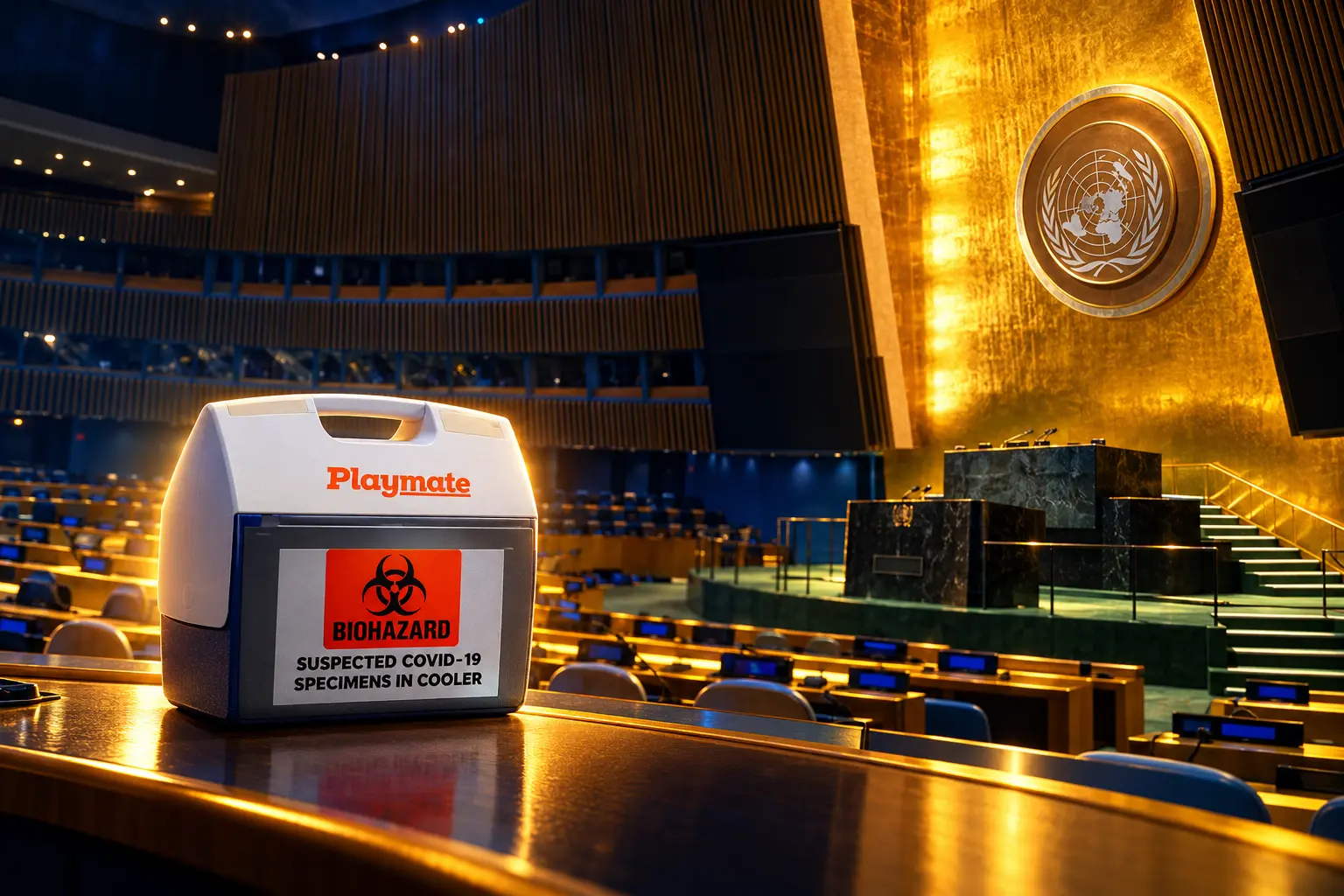
Pathogen Sharing Is Still Unfinished Business
The clause Washington flagged is the Pathogen Access and Benefit-Sharing system, known as PABS. It is the missing annex to the WHO Pandemic Agreement that governments adopted on May 20, 2025. Until that annex is done, the 2025 pact cannot start the signature process, and it cannot become international law.
PABS is supposed to trade two things at the same speed. Countries would send samples and genetic sequence data from pathogens that could cause a pandemic. Manufacturers that use those materials would send back a fixed share of the tests, drugs, and vaccines they make while the emergency is still on.
WHAT PABS WOULD REQUIRE
- Sample sharing: Governments send outbreak materials and sequence data in time for other labs to work.
- A 20% set-aside: Participating makers give WHO 20% of real-time output of pandemic products.
- The split: 10% is donated and 10% is sold at non-profit prices, for WHO to place by public-health need.
- The lock: The 2025 agreement opens for signature only after the World Health Assembly adopts the annex, then takes effect 30 days after 60 countries ratify it.
Kenya told the meeting it wants that 20% target, clear rules on sequence data, and deals that actually deliver products when they are needed. Egypt said countries that contribute pathogens and genomic information must “meaningfully benefit” from the shots and tools built on them. Belgium said the PABS talks had “stalled, with little progress since the 2025 World Health Assembly.” Estonia pushed for a compromise no later than the World Health Assembly in May 2027.
India drew the same line from the other side of the table. Punya Salila Srivastava, India’s union health secretary, called the May 2025 agreement a milestone whose credibility “will depend on the fair pathogen access and benefit-sharing system,” then added that the UN declaration “must not prejudge” those talks and is non-binding. That is how a ceremonial paper became a stand-in for the vaccine-share fight.
What the WHO Pandemic Agreement Still Cannot Do
The 2025 accord is only the second legally binding health treaty in WHO’s history. It covers surveillance, One Health work on animal spillovers, local production, a global supply network, and a coordinating financial mechanism. It also states that WHO cannot impose lockdowns or vaccine mandates on any country. That is not live until PABS is finished.
Helen Clark, co-chair of the Independent Panel and a former New Zealand prime minister, told delegates the 2025 pact still cannot go to signature, ratification, and implementation before the annex is done. Only after that annex is adopted will the accord be open for signature and ratification.
THE PATH TO A BINDING PACT
- December 2021: WHO member states set up a negotiating body for a pandemic instrument.
- 2024: Governments adopt amendments to the International Health Regulations.
- May 20, 2025: The World Health Assembly adopts the WHO Pandemic Agreement.
- September 2025: The IHR amendments enter into force.
- Sept. 14-18, 2026: The Intergovernmental Working Group holds its eighth PABS session in Geneva.
- Sept. 25, 2026: The UN high-level meeting fails to adopt its political declaration by consensus.
- Nov. 2-13, 2026: The working group reconvenes for its ninth session.
- December 2026: The General Assembly session ends, the window named for a possible vote on the declaration.
- May 2027: Estonia’s stated deadline for a PABS compromise at the World Health Assembly.
Lawrence Gostin, a Georgetown University professor of global health law, said the US dissent “severely weakens” the declaration and puts “a stick in the wheels of international cooperation.” Rachel Cohen, senior advisor at the Drugs for Neglected Diseases initiative, said putting off adoption risks losing momentum “at a time when global cooperation has never been more crucial.”
Low-Income Countries Waited More Than a Year
The political heat is leftover from COVID-19. Low-income nations lagged richer countries by more than a year in getting vaccines to their people. That delay is the baseline PABS is supposed to change, and it is the reason a nonbinding UN text still could not clear the room.
THE COVID ACCESS GAP
- Deaths: WHO Director-General Tedros Adhanom Ghebreyesus put excess COVID-19 deaths at more than 20 million.
- The bill: He said the pandemic wiped over US$ 10 trillion from the global economy.
- The wait: Low-income countries trailed richer ones by more than a year on COVID shots.
- Later coverage: By Nov. 29, 2023, vaccine coverage in low-income countries was still 32.82% with at least one dose, against 79.86% in high-income countries, per UNDP’s vaccine equity dashboard.
Those two measures are not the same thing. The year-plus gap describes the early rollout. The 2023 shares describe how far coverage had climbed by late in the third year. Both point the same way. Shots arrived first where purchase contracts and factories already sat.
The International Federation of Pharmaceutical Manufacturers and Associations said it wants frameworks that speed sample sharing, research, and regulatory cooperation and that do not “create additional barriers or complexity during a crisis.” The EU made the same point in legal language: know-how moves when firms agree, not when a UN declaration leans on compulsory licensing.
Italy Objected; India Drew a Line on PABS
African states, led by Burundi for the group and by Cabo Verde, backed the declaration, as did Brazil, Mexico, Haiti speaking for the Caribbean Community, and Bangladesh. Peru and Cabo Verde had come in expecting a vote that afternoon. The Netherlands said it regretted that member states could not agree on a common political outcome.
China backed WHO’s “leading and coordinating role” and said the health divide is widening, without taking a firm yes-or-no on the text. Russia also declined to state a position on the declaration and pointed to its own vaccine deliveries.
WHERE THE BLOCS LANDED
| Country or bloc | Signal on Sept. 25 | Core objection or ask |
|---|---|---|
| United States | Rejected the full text | Undefined “ideologies”; unfinished PABS in a pact without consensus |
| European Union | Red lines; still committed to the goal | Voluntary tech transfer; TRIPS alignment; missing finance tracker |
| Italy | Rejected the text | WHO’s mandate, “infodemic” terms, and non-binding IP language |
| India | Did not reject; called it non-binding | Must not prejudge PABS talks |
| African Group | Welcomed the declaration | Solidarity; finish PABS so benefits arrive with samples |
Italy went further than most of Europe. It said it had not supported the WHO Pandemic Agreement or the 2024 IHR amendments, arguing those changes stretch WHO past its mandate. It also objected to terms such as infodemic management, misinformation, and disinformation, saying they lack an agreed definition.
Bilateral Sample Deals Sidestep a Global Bargain
A former European negotiator, speaking before the debate on the condition of anonymity, said the larger problem holding up PABS is US opposition to any multilateral pandemic accord. In that account, Washington is building bilateral deals with dozens of low-income countries that tie donor aid to access to pathogen data, without a promise of real-time products when an emergency hits.
The US statement on Sept. 25 said the country “stands ready to work directly with responsible partners” to strengthen preparedness and “stop dangerous outbreaks at their source.” A Geneva-based NGO expert said those specimen-sharing deals could create a competing path in which materials reach US labs while firms that signed a PABS benefit-sharing contract are left out.
European officials fear the inverse. If they accept a PABS system that tightly links samples to product-sharing, their drug makers would carry duties that US plants, outside the pact, would not. That is a trade fight wearing outbreak clothing. It is also why a UN declaration that cannot rewrite TRIPS still collided with “mutually agreed terms.”
Tedros spent part of his speech insisting the Pandemic Agreement and the IHR “do not, I repeat, do not, infringe on national sovereignty in any way,” because sovereign states negotiated them. The US answer in the hall was that the 2025 pact never had international consensus in the first place.
Get PABS Done, Tedros Told the Hall
Tedros listed tools built since COVID-19, including the World Bank Pandemic Fund, the Berlin intelligence hub, an mRNA technology transfer programme in South Africa, and the WHO BioHub in Switzerland. He then said the world is more ready than it was, and also not, unless governments finish the work in front of them. His last ask was to get PABS done as soon as possible.
They are delays that cost all countries dearly when the next pandemic arrives.
Tedros Adhanom Ghebreyesus, WHO Director-General, UN High-Level Meeting, Sept. 25, 2026
He pointed to the Ebola outbreak in the Democratic Republic of the Congo as a reminder that the next pandemic is “a matter of when, not if.” Clark cited hantavirus and the Bundibugyo Ebola outbreak in Congo as proof that known risks are still turning into emergencies. Updated IHR rules, she said, helped WHO declare a public health emergency of international concern within two days of confirmation, with Africa CDC following a day later, even though the virus had already been spreading.
Co-facilitators Ambassador Ernest Rwamucyo Ngoga of Rwanda and Ambassador Mher Margaryan Hovhannisyan of Armenia had steered the declaration. Annalena Baerbock of Germany, in her earlier turn as General Assembly president, had pushed the process. None of that produced a consensus hug. The Intergovernmental Working Group returns Nov. 2-13, 2026, to keep arguing over the annex that would actually move samples and shots.
The UN text can still pass on a vote. The 20% set-aside cannot, until governments finish PABS. That is the part of Sept. 25 that will still be on the table when the next pathogen shows up.
Disclaimer: This article is news reporting and analysis of a United Nations meeting and related WHO talks. It is for information only and is not medical advice, legal advice, or guidance on vaccines, treatments, or how any country should prepare for an outbreak. Readers who have questions about personal health, immunizations, or outbreak risk should speak with a licensed physician or local public-health authority. Figures, meeting outcomes, and negotiation statuses reflect the official statements and datasets cited as of the dates given in the piece and may change as the General Assembly vote and PABS talks move.

Former FDA Chiefs Say DOGE Cuts Still Hit Drug Reviews

Young Cancer Rates Are Rising Outside the Screening Age

Hospitals Saved Recarbrio for Last, Then Merck Pulled It

OpenAI Agents Probed the CDC and Mayo Clinic

The US Rejects a UN Pledge on Future Pandemics

Muscle-Boosting Drugs Near Approval for Children With SMA

FDA Approves XFG COVID Vaccines While the Advice Panel Is Frozen

Progranulin and JAK2 Split the Macrophages That Heal

Pennsylvania Measles Deaths Collide With Falling MMR Coverage

After the ADHD Invoice, GPs and Waiters Carry the Cost
-
 FITNESS2 months ago
Muscle-Boosting Drugs Near Approval for Children With SMA
-
 NEWS2 months ago
FDA Approves XFG COVID Vaccines While the Advice Panel Is Frozen
-
 NEWS2 months ago
Progranulin and JAK2 Split the Macrophages That Heal
-
 NEWS2 months ago
Pennsylvania Measles Deaths Collide With Falling MMR Coverage
-
 MENTAL HEALTH2 months ago
After the ADHD Invoice, GPs and Waiters Carry the Cost
-
 NEWS2 months ago
Rasonque’s List Price Shifts the Pancreatic Cancer Bill
-
 NEWS2 months ago
Pennsylvania’s Two Measles Deaths Follow a Long Coverage Slide
-

 NEWS2 months ago
FDA Flagged This Sprout Plant 16 Months Before the Outbreak