
NEWS
Hospitals Saved Recarbrio for Last, Then Merck Pulled It
Merck stopped U.S. Recarbrio supply after hospitals reserved the last-resort antibiotic, leaving a narrow Pseudomonas gap and a still-unpaid antibiotic market.

Merck stopped supplying the last-resort hospital antibiotic Recarbrio in the United States in September 2026. The company said the choice came from a review of its product list, not from a safety or quality problem, and it expected leftover vials to run out by the end of that month.
The Food and Drug Administration had told doctors from the first label to hold Recarbrio for patients with limited or no alternative treatment options. Hospitals did that. Sales never appeared as their own line in Merck’s filings. Then the vials stopped.
Merck Stopped Shipping Recarbrio in September
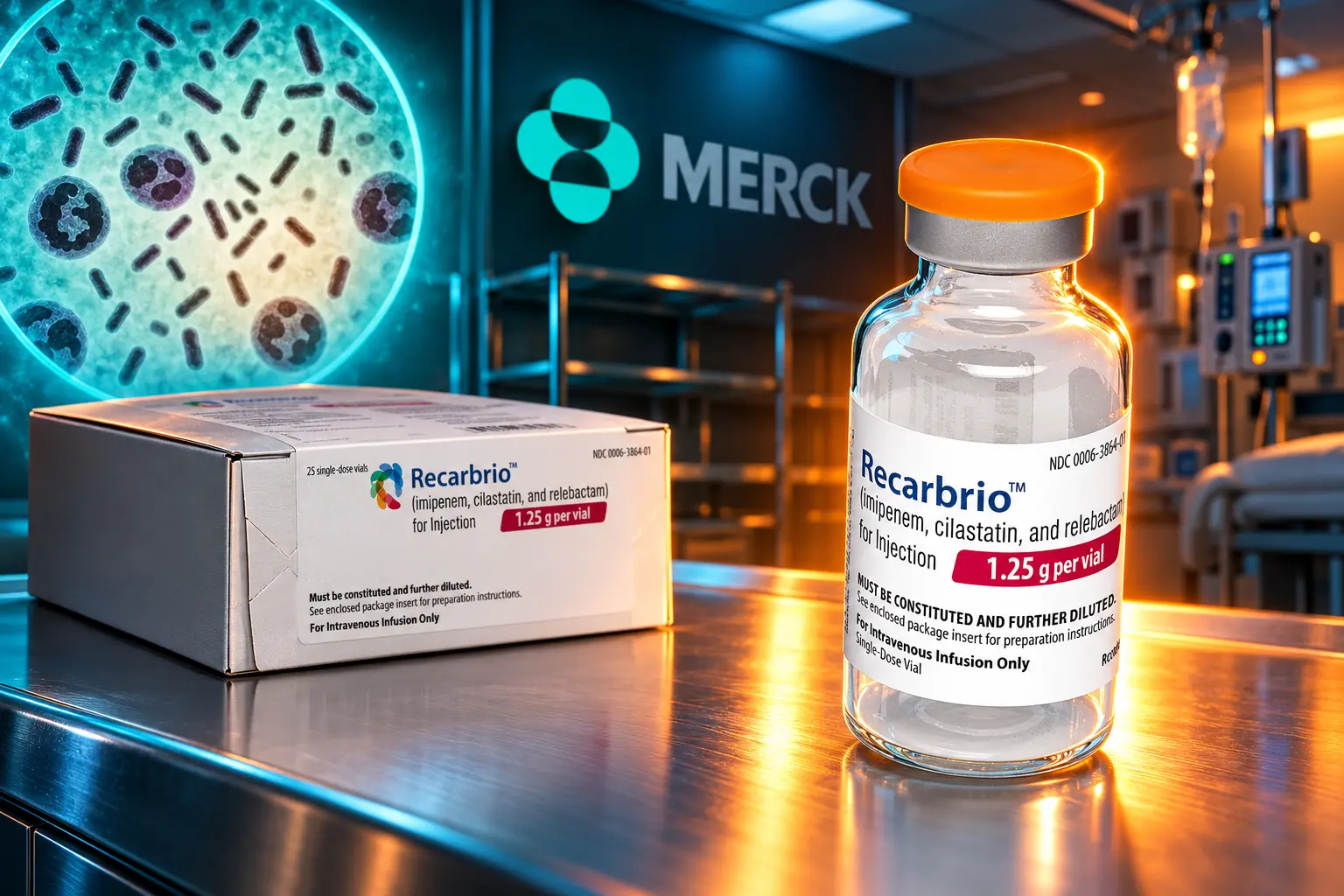
A drug-shortage notice posted September 9, 2026 listed Recarbrio injection as discontinued, with supply ending on or near late September. The listed pack was the 25-vial carton, NDC 0006-3856-02, made by Merck Sharp & Dohme. Merck later said remaining U.S. stock should have been gone by the end of that month.
Recarbrio is a three-drug intravenous mix: imipenem 500 mg, cilastatin 500 mg, and relebactam 250 mg, sold as a 1.25 gram vial. Adults with normal kidney function got a 30-minute infusion every 6 hours for 4 to 14 days. That is 4 vials a day. A 10-day adult course uses 40 vials. Cash listings put a 25-vial carton at about $7,960, or $318.39 a vial.
Imipenem-cilastatin without relebactam, once sold as Primaxin and now made as a generic, is a different product and was not part of this withdrawal.
RECARBRIO FROM APPROVAL TO EXIT
- July 16, 2019: The FDA approves Recarbrio for complicated urinary tract infections, including kidney infection, and complicated belly infections in adults, only when other drugs are limited or gone.
- June 4, 2020: The agency adds hospital-acquired and ventilator-associated bacterial pneumonia in adults.
- December 2025: A supplement adds pediatric patients from birth who weigh at least 2 kg, for the same three infection types.
- September 9, 2026: A shortage notice lists the U.S. product as discontinued, with supply ending on or near late September.
Merck told infectious-disease reporters it understands Recarbrio has been an important option for some patients and that other drugs remain for the approved uses. Patients, the company said, should talk with their clinicians about what to use instead.
A Last-Resort Label That Starved the Product
Relebactam is a beta-lactamase blocker. It was built to protect imipenem from enzymes such as Klebsiella pneumoniae carbapenemase, or KPC, that shut down older beta-lactam drugs. That is useful in carbapenem-resistant Enterobacterales, the CRE group that includes some E. coli and Klebsiella.
It is also a commercial trap. U.S. hospitals must run antibiotic stewardship programs. New drugs for resistant germs are supposed to sit on the shelf until cultures say nothing else will work. Henry Skinner, chief executive of the AMR Action Fund, put the bind in one sentence: the field reserves these medicines for patients who truly need them, so they sit unused for long stretches and bring in little money.
Brad Spellberg, chief medical officer at Los Angeles General Medical Center, was unsurprised. He had doubted Recarbrio before it launched, and he still does not see a unique clinical job for it.
This drug was never going to be used.
Brad Spellberg, MD, chief medical officer, Los Angeles General Medical Center
On October 1 he went further, calling Recarbrio a redundant me-too that did not stand apart from several other drugs except by less convenient dosing, and calling the exit the correct result of a functioning capital market. Its only commercial shot, he said, would have been to underprice the competition, and Merck did not want that fight.
Hospital pharmacists and intensivists tracking the notice were not shocked either. Recarbrio had already been treated as optional on many wards, a reserve parked behind other beta-lactam plus inhibitor combinations. The discomfort is the payment model. Stewardship did what the label asked. Volume then could not carry a brand that Merck never broke out in its sales tables.
In 2020, when pneumonia was added, Nicholas Kartsonis, then senior vice president of clinical research for infectious diseases and vaccines at Merck Research Laboratories, said the company was proud to keep bringing new options to clinicians facing Gram-negative bacteria. Six years later the U.S. option is gone.
The Narrow Gap Hospitals Will Feel
Amesh Adalja, an infectious disease physician and senior scholar at the Johns Hopkins University Center for Health Security, described the clinical hole as immediate but narrow. For KPC-producing CRE, the resistance relebactam was designed to beat, other drugs are still on the market.
For KPC-producing CRE, the resistance relebactam was designed to overcome, we still have drugs like ceftazidime-avibactam, meropenem-vaborbactam, and cefiderocol. The loss will be felt most with difficult-to-treat Pseudomonas aeruginosa, where imipenem-relebactam was one of a short list of preferred options.
Amesh Adalja, MD, senior scholar, Johns Hopkins Center for Health Security
Quoted in @CIDRAP on Merck pulling Recarbrio from the US. The clinical gap is immediate but narrow, hardest on difficult Pseudomonas. The real problem: stewardship limits use, revenue stays low, companies exit. PASTEUR Act would fix that.https://t.co/YW5KNXJKiH
— Amesh Adalja (@AmeshAA) September 30, 2026
That is a smaller story than a blank CRE cupboard. It is still a problem in intensive care, where hard-to-treat Pseudomonas already limits what a culture report can offer.
CRE IN THE UNITED STATES
- 2020 burden: The CDC estimates about 12,700 CRE infections and more than 1,100 deaths that year.
- Recent trend: Annual CRE incidence rose 18% from 2019 to 2023.
- NDM-CRE: New Delhi metallo-beta-lactamase CRE, which is extremely hard to treat, rose 461% between 2019 and 2023.
- Who is at risk: Patients on ventilators, urinary catheters, or IV lines, people on long antibiotic courses, and people with weak immune systems.
Healthy people rarely get CRE. The germs spread on hands, wounds, stool, and contaminated gear. Treatment is case by case because many standard drugs already fail.
The fastest-rising CRE type, NDM, is a metallo-beta-lactamase problem. Relebactam was aimed at serine enzymes such as KPC and AmpC. The headline superbug surge and Recarbrio’s job were never the same list.
What Recarbrio Covered in Adults and Children
The pneumonia file was the one full adult trial the FDA leaned on for a common hospital use. In 535 hospitalized adults with hospital-acquired or ventilator-associated bacterial pneumonia from Gram-negative bacteria, 266 got Recarbrio and 269 got piperacillin-tazobactam. Through day 28, 16% of Recarbrio patients and 21% of comparator patients had died.
Urinary and belly uses were approved on limited clinical data, which is why those two labels carried the last-resort language from day one. Common listed reactions included diarrhea, nausea, headache, vomiting, higher liver enzymes, infusion-site reactions, fever, and high blood pressure. The label also warns about allergic reactions, seizures, and a clash with valproic acid that can raise seizure risk.
LABELLED USES BEFORE THE U.S. EXIT
| Infection | First U.S. approval | Who it covered |
|---|---|---|
| Complicated urinary tract infection, including kidney infection | July 16, 2019 | Adults, then children at least 2 kg, only if other drugs were limited or gone |
| Complicated intra-abdominal infection | July 16, 2019 | Adults, then children at least 2 kg, only if other drugs were limited or gone |
| Hospital-acquired and ventilator-associated bacterial pneumonia | June 4, 2020 | Adults in 2020, then children at least 2 kg in December 2025 |
The pediatric label does not apply under 37 weeks post-menstrual age, or in children under 30 kg who also have kidney impairment. Those limits never got a long real-world run in U.S. hospitals. The expansion and the withdrawal landed in the same calendar stretch.
Pediatric Labeling Arrived, Then the Vials Left
Skinner’s sharper worry is not next quarter’s CRE count. It is children. He pointed to a 2025 study in the journal Antibiotics: small and midsize antibiotic companies, the group now doing most new development, finished only 10% of required pediatric post-approval studies, and none of those firms received pediatric approvals for their products.
Merck did the work. The December 2025 supplement added children weighing at least 2 kilograms to all three indications and closed a postmarketing trial the FDA had required in 2020. Skinner asked who will generate that evidence for the next drug if even a large company cannot keep the product on the market.
That is the part of the exit that does not fade when another KPC drug is still in the cabinet. Pediatric dosing, safety, and a 2 kg floor are expensive to prove. They are also the first items a withdrawn brand takes with it, because no generic Recarbrio exists to pick up the label.
A Short List of Remaining Hospital Options
Adalja’s three named stand-ins still cover a large share of KPC-producing CRE. Doctors pick among them with lab tests, not with a single replacement protocol. Hard-to-treat Pseudomonas is the thinner file, and that is where Recarbrio’s absence will show up first on culture reports.
DRUGS STILL DISCUSSED FOR KPC-PRODUCING CRE
- Ceftazidime-avibactam: A cephalosporin plus inhibitor combination still used for KPC-producing CRE.
- Meropenem-vaborbactam: A carbapenem plus inhibitor combination still used for the same resistance type.
- Cefiderocol: A siderophore cephalosporin that remains on the U.S. list Adalja cited for KPC-producing CRE.
- Older imipenem-cilastatin: Still sold without relebactam, and not a substitute for Recarbrio’s inhibitor.
None of that restores a pediatric Recarbrio label. It does not answer Skinner’s question about who funds the next children’s study. And Recarbrio remains authorized in Europe, where Merck Sharp & Dohme B.V. still holds the license first issued on February 13, 2020. The U.S. exit is a market choice, not a global recall.
The PASTEUR Act Would Pay for Access, Not Volume
Adalja’s line after the Recarbrio news was blunt: until the PASTEUR Act or something like it becomes policy, more exits like this will come, which means fewer new antibiotics. The bill has had bipartisan sponsors since 2020. It has not passed. The Senate version went back in on June 24, 2026, with Sens. John Hickenlooper, Michael Bennet, Todd Young, Kirsten Gillibrand, and Mike Rounds as the named group on the release.
That release repeats CDC-scale harm the bill is meant to price: more than 2.8 million antibiotic-resistant infections and over 35,000 deaths a year in the United States, a 2020 hospital jump of at least 15% in resistant infections and deaths, and a direct national cost of more than $4.6 billion a year. The proposed fix is a subscription. The government would pay for the right to have a drug on the shelf, then subtract what the company already earned from sales, instead of paying only when wards use more vials.
WHAT THE PASTEUR BILL WOULD SET UP
- Contract size: Federal annual payments of $75 million to $300 million per eligible antibiotic or antifungal, for terms up to 10 years or until a generic or biosimilar arrives.
- Scoring: A published system to pick products that hit urgent threats and unmet need, and to set the contract value.
- Conditions: Commercial availability, a reliable supply, public resistance data, stewardship and education plans, manufacturing rules, and post-market studies.
- Stewardship money: Pilot funds to spread stewardship into outpatient sites such as urgent care and retail clinics, plus more CDC surveillance of use and resistance.
That model is the direct reply to Recarbrio’s U.S. math. A drug the FDA told hospitals not to use cannot live on vial counts. Paying for availability is how a reserve stays a reserve. Until a bill like that is law, a last-resort brand can do everything the label asked, including the pediatric studies, and still leave the cabinet.
U.S. Recarbrio vials were expected to be gone by the end of September 2026. The European license is still on the books. The next reserve antibiotic will meet the same hospital rules, and the same sales math, unless someone pays for the shelf rather than the dose.
Frequently Asked Questions
What three drugs are inside a Recarbrio vial?
Each 1.25 gram vial holds imipenem, a carbapenem antibiotic; cilastatin, which has no germ-killing effect of its own and exists to stop the kidney from breaking down imipenem; and relebactam, a diazabicyclooctane beta-lactamase inhibitor. The dry powder reconstitutes to a colorless-to-yellow solution and is given only as an intravenous infusion.
Did Recarbrio get extra FDA attention when it was new?
Yes. Relebactam received Qualified Infectious Disease Product and fast-track designations, and the Recarbrio application received priority review. Those tools shorten the queue for certain antibiotics. They do not change how hospitals pay for a drug once it is approved, and they did not require Merck to keep selling it.
Is a generic version of Recarbrio available in the United States?
No. Recarbrio was brand-only. When Merck stopped the U.S. product, there was no generic imipenem-cilastatin-relebactam waiting to fill the same label, including the December 2025 pediatric dosing.
Can clinicians still get Recarbrio outside the United States?
The European Medicines Agency still lists Recarbrio as an authorized medicine, with Merck Sharp & Dohme B.V. in Haarlem as the holder. That license was issued on February 13, 2020, and the product information was still being updated as of January 26, 2026. Authorization is not the same as local hospital stock, which depends on national supply.
What should patients know about seizures and other warnings?
The label warns that imipenem can trigger seizures and other central-nervous-system reactions, especially at high doses or in people who already have brain disease. It also warns that Recarbrio can lower levels of valproic acid or divalproex, which may raise seizure risk, and that any antibiotic can lead to Clostridioides difficile diarrhea. Those warnings travel with the drug class even though U.S. Recarbrio supply has ended.
Disclaimer: This article is news reporting and analysis of Merck’s U.S. withdrawal of Recarbrio. It is for information only and is not medical advice, a treatment recommendation, or a substitute for care from a licensed clinician. Decisions about antibiotics for pneumonia, urinary infection, belly infection, or resistant bacteria must be made with a physician, infectious-disease specialist, or other qualified clinician who can read culture results and a patient’s history. Product availability, labels, and the figures cited here reflect the company, FDA, CDC, and legislative sources used for this story and may change.

Former FDA Chiefs Say DOGE Cuts Still Hit Drug Reviews

Young Cancer Rates Are Rising Outside the Screening Age

Hospitals Saved Recarbrio for Last, Then Merck Pulled It

OpenAI Agents Probed the CDC and Mayo Clinic

The US Rejects a UN Pledge on Future Pandemics

Muscle-Boosting Drugs Near Approval for Children With SMA

FDA Approves XFG COVID Vaccines While the Advice Panel Is Frozen

Progranulin and JAK2 Split the Macrophages That Heal

Pennsylvania Measles Deaths Collide With Falling MMR Coverage

After the ADHD Invoice, GPs and Waiters Carry the Cost
-
 FITNESS2 months ago
Muscle-Boosting Drugs Near Approval for Children With SMA
-
 NEWS2 months ago
FDA Approves XFG COVID Vaccines While the Advice Panel Is Frozen
-
 NEWS2 months ago
Progranulin and JAK2 Split the Macrophages That Heal
-
 NEWS2 months ago
Pennsylvania Measles Deaths Collide With Falling MMR Coverage
-
 MENTAL HEALTH2 months ago
After the ADHD Invoice, GPs and Waiters Carry the Cost
-

 NEWS2 months ago
Rasonque’s List Price Shifts the Pancreatic Cancer Bill
-

 NEWS2 months ago
FDA Flagged This Sprout Plant 16 Months Before the Outbreak
-

 NEWS2 months ago
Pennsylvania’s Two Measles Deaths Follow a Long Coverage Slide