
NEWS
New NHS AI Rules Collide With Scribes Already in Use
A UK commission wants 44 new NHS AI rules, including learner plates and a right to know, while GP scribes already sit outside device law.

A UK commission published 44 recommendations on 10 September 2026 for new laws on AI in healthcare. Lawrence Tallon, chief executive of the Medicines and Healthcare products Regulatory Agency, said patients will soon see AI as a normal part of NHS care.
But the note-taking tools already listening in many GP rooms sit outside the medical-device rules that blueprint would rewrite, and patients who know a recorder is on can go quiet at the worst moment.
Forty-Four Recommendations, None of Them Law Yet
The National Commission into the Regulation of AI in Healthcare was set up by the MHRA on 26 September 2025 as an independent advisory body. Professor Alastair Denniston, an NHS ophthalmologist at University Hospitals Birmingham, chaired it. Professor Henrietta Hughes, England’s Patient Safety Commissioner and a GP, was deputy chair.
Over the course of a year the commission took evidence from more than 12,000 people, including patients, clinicians, NHS leaders and developers, with extra public work from the Health Foundation. The MHRA and the government will now consider the 44 recommendations for a future framework. A formal response is still to come, so none of this is statute.
Tallon said the current medical-device rules were written for hip replacements, knee replacements, stethoscopes and plasters. Those rules can still fit a simple tool trained to spot a known finding on a scan. They struggle with models that keep changing once they are in use.
THE COMMISSION’S FOUR HEADLINE ASKS
- Learner-style approval: New models would start under close watch, then gain a fuller licence only after they show they work in real clinics.
- Life-long monitoring: Approval would no longer be a single moment; tools that fail or fade could be pulled.
- A right to know: Patients would be told when AI is used in their care, and could look up safety information on named products.
- Harder penalties: The MHRA would get stronger powers against developers whose products miss the required standard.
Denniston called AI an exceptional chance for healthcare, on a scale he compared with antibiotics and MRI. The same report treats that chance as conditional. People will live with AI in the NHS, the chairs said, if it is safe, watched by a human, and if they know it is there.
The Scribes in Four in Ten Consulting Rooms
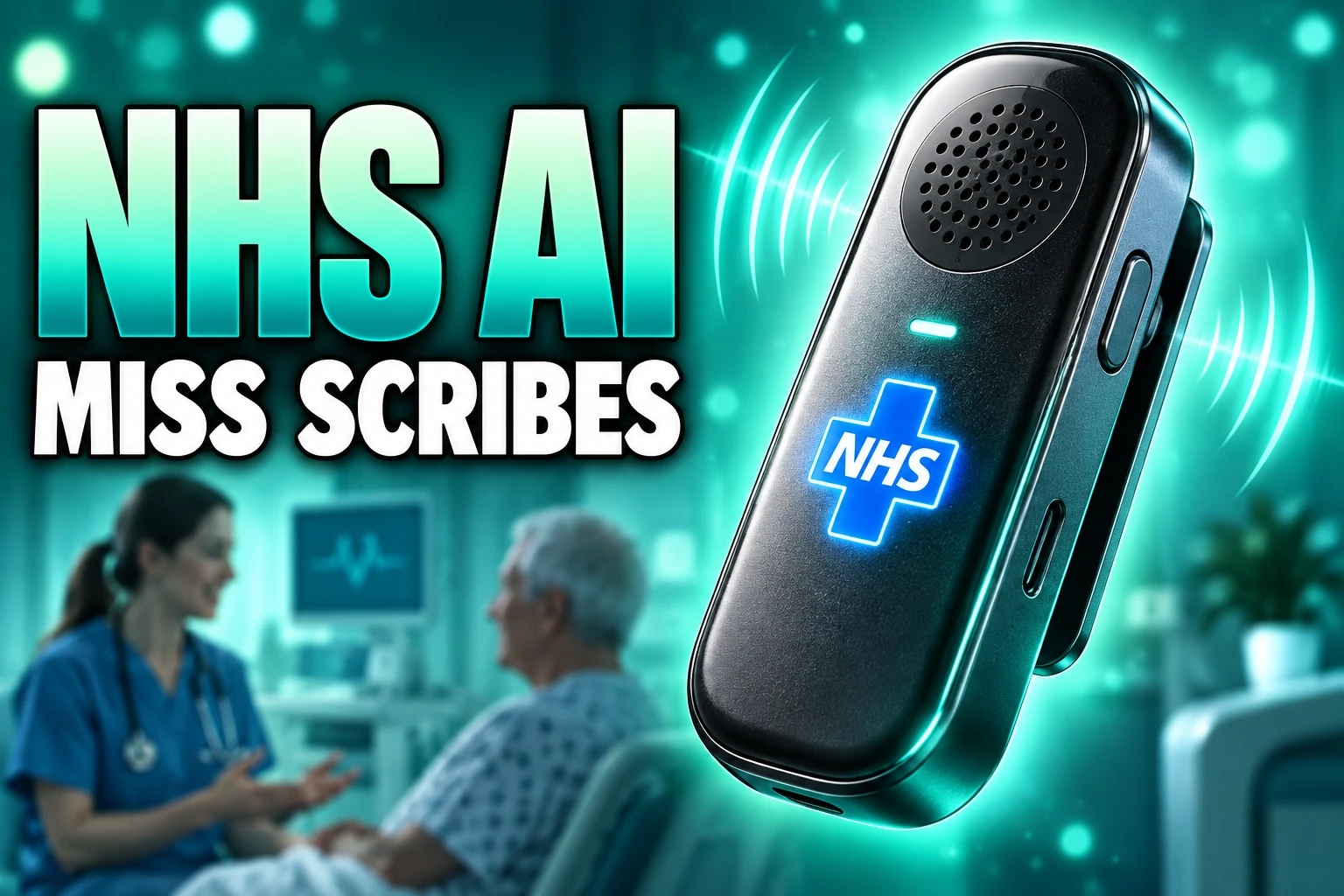
The gap between that future rulebook and the present is already open in general practice. Ambient voice tools, often called AI scribes, listen to a consultation, turn speech into text, and draft notes and letters.
A survey of 598 UK GPs led by Dr Christina Derksen at Queen Mary University of London, published in npj Digital Medicine, found 40% were current users. A further 23% had used a scribe before. That leaves 37% who had never used one. Current users put the tools into a mean of 60% of their consultations.
HOW 598 GPS SAID THEY USE AI SCRIBES
| Group | Share of GPs | Share of their consultations |
|---|---|---|
| Current users | 40% | Mean 60% |
| Past users | 23% | Mean 40% |
| Never users | 37% | 14% of this group said they had no plan to start |
GPs named 34 different products. Heidi Health and Accurx Scribe were the most common. Derksen said uptake has been informal, driven more by peers than by a national rollout, and that safety and legal worry remain common, especially among doctors who do not use the tools.
On 29 July 2026 the MHRA, working with NHS England, drew a bright line under current law. Products meant only for transcription, summaries, draft letters, or suggested clinical codes for a clinician to check are not regulated as medical devices. Tools that support diagnosis or treatment, or that place orders without a clinician’s review, still are.
Rob Thompson, NHS England’s chief digital, data and technology officer, said the health service would start rolling the technology out “safely, consistently and at scale.” Clinicians still have to check every draft. The commission’s new device rulebook does not automatically cover the recorders already in those rooms.
Patients Hold Back the Stories the Notes Need
The commission wants patients told when AI is part of their care. That demand matches what the public told researchers. It also sits on top of evidence that disclosure changes what people will say.
Researchers at the University of Edinburgh reviewed 27 papers on ambient scribes, with findings published on 3 September 2026 in BMJ Digital Health and AI. The tools can free a doctor from typing. They also miss faces, gestures and tone, and they tend to keep the clinical facts while dropping the patient’s own account of being ill.
The same review found patients may hold back sensitive history, including substance use, domestic abuse and mental health, once they know a recording is being processed by AI. Dr Lucas Seuren, a research fellow at the university’s Centre for Biomedicine, Self and Society, said clinicians like the promise of less paperwork, “but the experiences of patients are poorly considered, and there are real risks that the patients’ stories are lost.”
Patients have told us that to trust AI is safe, they want to know when it’s used, that it supports rather than replaces clinicians, and that there is clear accountability if things go wrong.
Professor Henrietta Hughes, Deputy Chair, National Commission into the Regulation of AI in Healthcare
Hughes, who still sees patients as a GP, said some of them are content with a scribe in the room and some are not. “Some say, ‘I don’t want to talk to a robot’, and that is also fine,” she said. Doctors, she added, have to correct the notes when the model is wrong.
That opt-out is easy to defend as a right. It is harder to square with a learning system that is supposed to get better from the conversations it hears. The facts most likely to vanish are the ones a later model, or a later doctor, may need.
Learner Plates for Models That Keep Changing
Tallon put the technical problem in plain terms. Unlike a hip implant, these products keep changing after they are authorised. “As new data gets fed in, they learn, they adapt, they drift,” he said. He also said he could not point to any country that has fully solved the regulation of that kind of product.
Recommendation 14 asks the MHRA to allow staged authorisation. The commission likens it to L-plates for learner drivers: a new model would go out under tight limits, then earn a wider licence if real-world evidence holds up. Recommendation 15 asks the agency to keep using regulatory sandboxes and to widen them so novel tools have a path to market.
Professor Neil Lawrence, DeepMind Professor of Machine Learning at the University of Cambridge and chair of the commission’s technology group, said generative AI can behave differently in different settings and can evolve after it is first deployed. A single approval, he said, is not the end of the job.
HOW THE UK GOT TO A NEW RULEBOOK
- Spring 2024: The MHRA opens the AI Airlock, a sandbox for AI used as a medical device.
- 26 September 2025: The agency sets up the National Commission to rewrite the healthcare AI rulebook.
- 8 April 2026: The Department of Health and Social Care funds the Airlock at £1.2 million a year for 2026 to 2029.
- 29 July 2026: Ambient scribes used only for notes and letters are placed outside device law.
- 10 September 2026: The commission publishes its 44 recommendations, including L-plate approvals and life-long monitoring.
The United States is on a parallel track, not a finished one. In August 2025 the Food and Drug Administration set out how firms can file planned updates without a new filing if those updates stay inside an agreed change plan. That is a way to let locked models improve on a schedule. It is not the same as letting a model retrain itself in the wild and hoping the licence still fits.
Dr Haris Shuaib, an NHS consultant clinical scientist, said performance can change once systems are in routine use. Continuous monitoring is the commission’s answer to that. It is also a running cost, and a reason smaller vendors may struggle to stay in a market that can yank a product after it ships.
What Class I Status Leaves Unchecked
Most software and AI medical devices in the UK are still self-declared as Class I, the lowest risk band, because the classification scheme was not built for this kind of product. The commission says that leaves a thin view of benefit and harm. Recommendation 1 asks the MHRA to update the UK Medical Devices Regulations so software and AI can be classed in a more tailored way, with a closer look at self-declared Class I tools and a lighter touch only where risk to patients is low.
That rewrite is aimed at devices. It does not, on its own, pull a note-taker back into device law if the maker says the intended purpose is admin. The July guidance already told boards to watch for function creep: a scribe that starts to steer diagnosis or place orders would cross the line. Until it does, the safety case sits with the clinician who clicks “accept” and with the trust that bought the licence.
Enforcement is the other half of the bet. The commission wants the MHRA able to punish developers when a product falls short, and able to take a failing model off the list. For a hip implant, that logic is familiar. For a model that changes with every week of new notes, the file never closes, and the agency will need staff and data it does not yet have at that scale.
Staff Want the Tools, and the Public Wants a Human Check
Jennifer Dixon, chief executive of the Health Foundation, said people are open to a bigger role for AI in their care, and that this openness depends on trust. The foundation’s deliberative workshops in March and April 2026, with 78 members of the public in Cardiff, Milton Keynes and York, fed the commission. Accuracy came first. Human oversight was a condition. Rules should match risk. No group should get worse care.
A larger Health Foundation tracker, based on 8,000 members of the public and 2,000 NHS staff, shows the same split in harder numbers. Some 38% of the public think AI will improve the quality of care, up from 33% in 2024, and 19% think it will make care worse. Support among staff is much higher: 80% backed AI for patient care, against 54% of the public.
When the tracker forced a choice, the public picked caution. Some 70 percent prefer a human check on an AI tool’s output, even if results are slower. Some 72% want a lot of evidence that tools work, even if that delays access. Some 71% want strict rules, even if that puts off firms. On accuracy versus being able to explain a result, the split was 50% to 50%.
WHAT THE PUBLIC PICKED WHEN FORCED TO CHOOSE
| Priority | Share | The other option | Share |
|---|---|---|---|
| Strong evidence the tools work | 72% | Tools available quickly | 28% |
| Strict rules | 71% | Make it easier for firms to build AI in the UK | 29% |
| A human checks the output | 70% | Faster test results | 30% |
| The tool is as accurate as possible | 50% | We can explain why it produced a result | 50% |
Hours after the recommendations appeared, they had barely registered as a public fight. That silence fits the pattern on the ground. The argument is happening in clinics, where scribes are already on, and in a regulator some patients already distrust, not on a launch-day feed.
Dixon said the MHRA’s role is only part of the test. The NHS still has to have the staff, skills and systems to watch these tools at the scale now being asked of it.
A Rulebook Waiting on Whitehall
Tallon said he expects patients to see AI as part of ordinary NHS care, and that this has to happen in a way that keeps their trust. The commission’s answer is disclosure, human oversight, L-plate approvals, life-long monitoring and the power to punish a product that drifts.
The same week, four in ten GPs in a national survey were already using a scribe that current law treats as paperwork if the maker stays on the admin side of the line. Patients who are told about that recorder may share less. Models that learn from those thinner notes will still change after they are approved.
The file now sits with ministers and the MHRA. Until they answer, the recorders keep running under the July guidance, and the patients who do not want to talk to a robot keep that choice.
Disclaimer: This article is news reporting and analysis of UK regulatory proposals for AI used in healthcare. It is for information only and is not medical, legal or clinical advice, and it is not a guide to whether any specific AI scribe, scan reader or chatbot is safe to use in your care. Patients should speak to their own clinician, and organisations should take advice from a qualified clinical-safety or regulatory professional, before changing how they record consultations or deploy AI tools. Figures, product statuses and the 44 recommendations reflect the cited sources as of 10 September 2026 and may change when the government and the MHRA respond or when further evidence is published.

Presley Gerber Was Cremated With the Cause Still Blank

Pennsylvania Ties CDC Measles Help to Four Counted Deaths

NHS Trusts Told to Lock Out Staff on Snooping Suspicion

Heidi Overton Affirms MMR Safety and Inherits Three FDA Files

Zanvastro’s All-Ages Nod Rests on a Small Walking Trial

Muscle-Boosting Drugs Near Approval for Children With SMA

Pennsylvania’s Two Measles Deaths Follow a Long Coverage Slide

The New Heart Attack Definition Recodes Women’s Missed Cases

Progranulin and JAK2 Split the Macrophages That Heal

Roche and Lilly Wager Alzheimer’s Care on a Blood Test
-
 FITNESS1 month ago
Muscle-Boosting Drugs Near Approval for Children With SMA
-
 NEWS1 month ago
Pennsylvania’s Two Measles Deaths Follow a Long Coverage Slide
-
 NEWS4 weeks ago
The New Heart Attack Definition Recodes Women’s Missed Cases
-
 NEWS2 months ago
Progranulin and JAK2 Split the Macrophages That Heal
-
 NEWS1 month ago
Roche and Lilly Wager Alzheimer’s Care on a Blood Test
-

 NEWS1 month ago
Pennsylvania Measles Deaths Collide With Falling MMR Coverage
-

 NEWS1 month ago
FDA Flagged This Sprout Plant 16 Months Before the Outbreak
-

 NEWS1 month ago
NHS HPV Home Testing Kits Follow a Path Already Measured