NEWS
Progranulin and JAK2 Split the Macrophages That Heal
Iowa State’s Cell Reports study shows progranulin plus JAK2/STAT3 matures leukemia cells and marks the embryonic macrophages that close wounds.

Human leukemia cells matured in an Iowa State dish only after progranulin was paired with JAK2/STAT3 signaling. The Cell Reports paper went online June 10, led by Raquel Espin Palazon, an associate professor of genetics, development and cell biology at Iowa State University.
The same pair marks the zebrafish macrophage lineage that closes a wound. Labs already inject macrophages into people for organ repair.
Progranulin Floods Macrophages Without a Known Job
In aggressive leukemias, bone marrow stops finishing its daily run of hundreds of billions of blood cells. Some precursors stall as immature progenitors, then pile up until healthy marrow is crowded out.
“They never finish. They never become what they should be. Because they are progenitor cells, they don’t really have a function and just expand and collapse our bone marrow,” Espin Palazon said.
The new work started with a quieter puzzle. Progranulin is a secreted protein found across plants and animals, used in growth, repair, and inflammation. It is also the most expressed gene in human macrophages, the large white cells that swallow pathogens. “Nobody had linked a function in macrophages with this protein. But there must be some reason it’s so highly expressed,” she said.
Mammals make the protein from one gene in many tissues. Turn that gene off and the damage is too wide to read in blood cells. First author A. McCune and colleagues, writing in Cell Reports volume 45, issue 6, article 117477, treated that gap as a design problem, not a dead end.
Hematology papers from 2020 and 2021 had already measured serum progranulin as a possible AML marker. Those studies asked what the protein’s level predicted. This team asked what the protein is for when a myeloid cell tries to grow up.
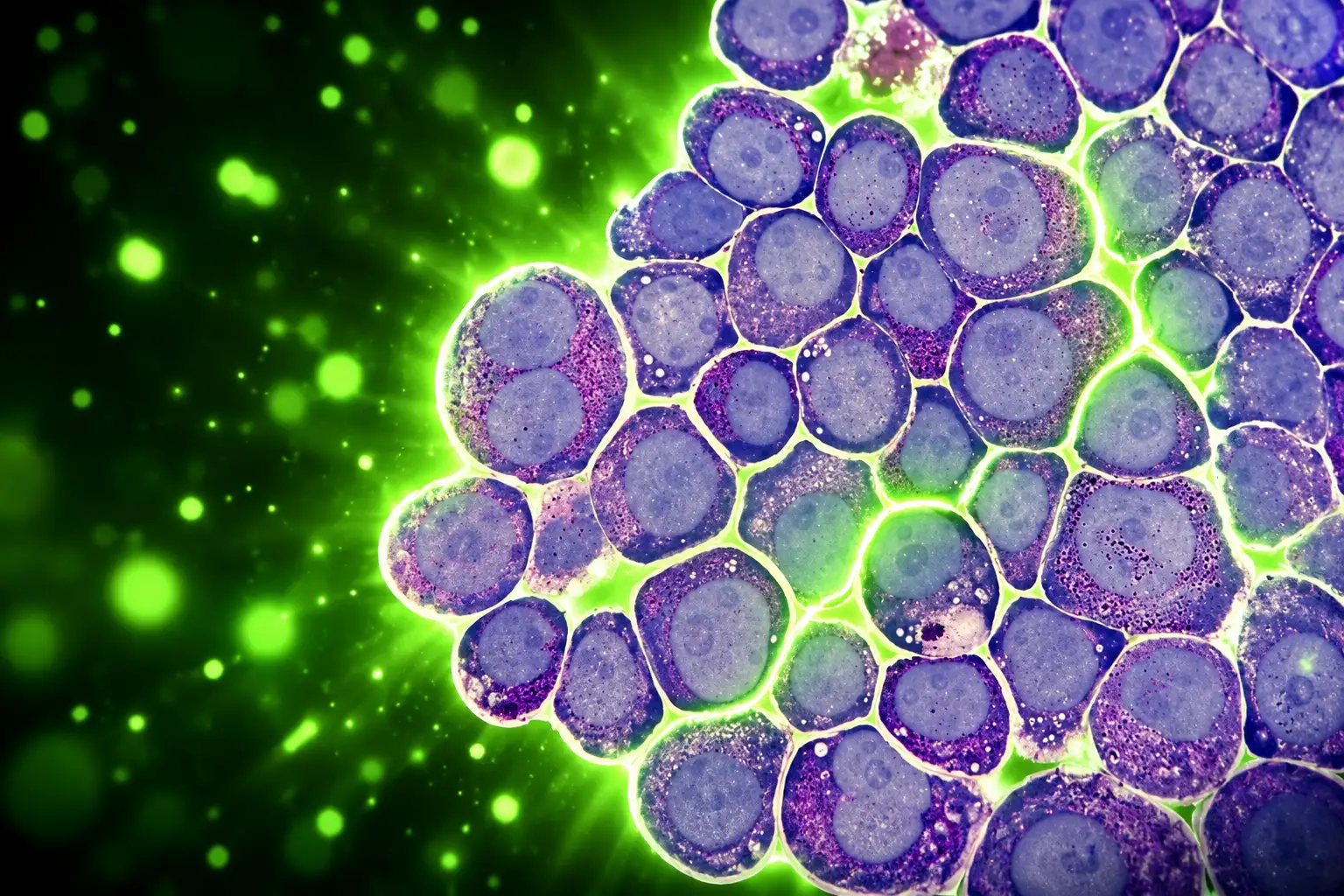
The Blood-Only Copy in Zebrafish
Zebrafish carry two progranulin genes. In the 2021 zebrafish granulin knockout in Blood Advances (Feb. 9, 2021; 5(3):796-811), Espin Palazon’s group showed that one copy is active in blood. That copy was required for myeloid progenitors to become macrophages and neutrophils.
The 2026 paper used that split to ask which embryonic wave of myelopoiesis actually needs the protein. Fish separate those waves in space and time, which mice do not.
WHY THE FISH MODEL WORKS HERE
- Two genes: One zebrafish progranulin gene is blood-restricted, so a knockout does not wreck the whole animal the way a single mammalian gene would.
- Two places: Primitive myeloid cells arise from mesoderm at the rostral blood island; EMP-derived cells arise later from hemogenic endothelium at the posterior blood island.
- Two clocks: The team could score macrophages at 24 hours after fertilization, before the EMP wave, and again at 48 hours, after that wave is in place.
- Live wounds: Lineage tracing and imaging let them watch which embryonic macrophages actually moved into an injury.
Mutants lacking blood-cell granulin a (grna) still had a normal count of mfap4-positive primitive macrophages at 24 hours. The 2021 work had already found a clear drop by 48 hours, once EMP-derived myelopoiesis is running. Grna is skippable for the first wave and required for the second.
Why Progranulin Alone Failed in Leukemia Cells
Progranulin by itself did not mature the human leukemia line. The group went back to zebrafish that lack blood-cell granulin and found a JAK2/STAT3 defect. In K562 cells, extra GRN worked only with interleukin-6, which turns that path on.
JAK2/STAT3 carries chemical news from outside a cell to DNA. The paper shows a loop in hematopoietic precursors: Stat3 induces grna, and grna then amplifies stat3, pushing myeloid fate over erythroid fate. That loop runs in definitive myelopoiesis, not the primitive wave.
Press writeups said adding progranulin to leukemia cells that already had JAK2/STAT3 on was enough. The human test in the Grna and Stat3 myeloid-fate study was stricter. Overexpression of human GRN differentiated a human erythroleukemia line into the myeloid lineage only when it was combined with IL-6.
The line was K562. The methods describe a stable GRN pool with an average vector copy number of 2.9, against 1.4 in mock-transduced cells, then 100 ng/mL IL-6 for 24 hours. GRN without that cytokine did not finish the job, which is why the first human attempts looked like a failure.
It was super exciting to see the differentiation, that blockage in the human leukemia line being overcome.
Raquel Espin Palazon, associate professor of genetics, development and cell biology, Iowa State University
“Adding progranulin, the missing component, could be a potential therapeutic target,” she said. JAK2/STAT3 is often hyperactivated in leukemias and many solid tumors, and the authors call GRN a possible way to correct JAK2/STAT3 errors in blood. STAT3 knockout kills embryos, so most STAT3 work has been in cell lines, and the paper notes that no clinical drug yet hits STAT3 directly.
APL’s 95% Differentiation Cure
Forcing a blast to finish its life cycle is an old leukemia idea. It has worked in one subtype at a level chemo rarely matches, and it has mostly stalled everywhere else.
- Early 1980s: Acute promyelocytic leukemia, a slice of AML, was found to be unusually sensitive to retinoic acid, according to later clinical reviews.
- ATRA plus arsenic trioxide: Cleveland Clinic describes these as the differentiation agents used in APL. OncLive has put the cure rate above 95 percent without standard chemotherapy.
- February 9, 2021: The Iowa State zebrafish granulin paper in Blood Advances tied a blood-restricted protein to myeloid maturation.
- June 10, 2026: The Cell Reports paper shows GRN plus JAK2/STAT3 as a conserved maturation switch, including in K562 cells.
Cleveland Clinic notes that APL is more sensitive than other AML types to drugs that make cells mature. All-trans retinoic acid is tretinoin, a form of vitamin A. Arsenic trioxide is a form of arsenic. Both can trigger differentiation syndrome in APL, often within one to two weeks.
HealthTree, citing the same class of drugs, puts that syndrome around 25 percent of people treated with ATRA and arsenic. Reviews of non-APL AML still describe most patients as refractory or relapsing on older differentiating agents. IDH inhibitors later joined the list of drugs that can push some AML cells to mature. A progranulin-based approach would sit in that family, a maturation drug, not another cell-killing chemo, and it would still have to clear toxicity work the Iowa State paper does not do.
Only One Embryonic Macrophage Heals a Wound
Some macrophages form in the embryo, move into organs such as brain and heart, and renew themselves for life. Espin Palazon’s team split those embryonic cells into two programs. Only one needs progranulin and JAK2/STAT3. That one is the better healer.
| Trait | Primitive macrophages | EMP-derived macrophages |
|---|---|---|
| Origin in zebrafish | Mesoderm at the rostral blood island | Hemogenic endothelium at the posterior blood island |
| When they were scored | 24 hours after fertilization | 48 hours, after the EMP wave is established |
| Need for grna and Jak2/Stat3 | Independent of that pair | Required |
| Injury | Failed to respond efficiently | Highly recruited, with successful tissue repair |
“This opens up possibilities for studying and dissecting the two different types of embryonic macrophages,” Espin Palazon said. “How else are they different? Does one population specifically colonize specific organs but not others?”
Lifelong tissue-resident macrophages, the paper notes, seem to come mostly from embryonic cells, mesodermal or EMP-derived. Mouse genetics has struggled to separate those waves because both start in the yolk sac and overlap in time. The fish experiment is the cleaner cut, and it says the healer is the EMP-derived cell that runs the Grna/Stat3 loop.
What Lab-Made Macrophages Still Get Wrong
Researchers already grow macrophages in dishes and have injected them into people for liver disease, stroke, and wounds. Espin Palazon said only the lineage that needs progranulin and JAK2/STAT3 repaired tissue well in zebrafish. A lab product that skips that pair may be the weaker cell.
A 2023 review in Experimental & Molecular Medicine found eleven macrophage cell-therapy trials among 366 ClinicalTrials.gov hits for “macrophage.” Nine of the eleven used ex vivo polarization and adoptive transfer. Two were CAR-macrophage cancer studies.
TRIALS ALREADY PUTTING MACROPHAGES IN PEOPLE
- Liver cirrhosis: Long-term follow-up of MATCH01 phase 2, reported in 2026 in Cell Stem Cell, compared 26 patients who received autologous monocyte-derived macrophages with 24 on standard care.
- Death or transplant: The macrophage group’s rate in the follow-up window was 30.8 percent, against 58.3 percent with standard care, with 252 extra days of restricted mean survival and no rise in serious harm tied to the cells.
- Chronic anal fissure: A phase 3 study (NCT00507364) injected activated human macrophages around the ulcer in 199 patients; complete recovery was 27 percent with cells and 6 percent in controls.
- Non-acute stroke: A phase 1 study (NCT01845350) gave 13 patients intrathecal M2-polarized autologous cells; NIH Stroke Scale improvement was reported in 75 percent of the treated group and 18 percent of controls.
Those products were built from adult blood or marrow monocytes, then polarized in a dish. They are not the EMP-derived embryonic cell the zebrafish tagged with grna and Stat3. The Iowa State finding does not scrap those trials. It gives them a molecular test they did not have: does the manufactured cell actually run the healer program?
The MATCH cirrhosis follow-up on macrophage therapy in cirrhosis is the nearest clinical neighbor. If only one embryonic macrophage heals, a factory that treats all macrophages as interchangeable is guessing.
Interest From Drug Makers Will Set the Pace
A leukemia drug from this map is not close. Espin Palazon said it usually takes a decade or more to go from discovery to clinical treatment, and that pharmaceutical interest would have to drive development. Collaborators included the Children’s Hospital of Philadelphia, the University of Salamanca, Benha University in Egypt, and Iowa State’s veterinary pathology group. Funding included the Roy J. Carver Charitable Trust and the National Institute of Diabetes and Digestive and Kidney Diseases at NIH.
The human result is still one line, K562, and only with GRN overexpression plus IL-6. Heterozygous GRN mutations already cause frontotemporal dementia, so any plan to raise progranulin in people will have to watch brain and lysosome effects, not just marrow. JAK/STAT drugs already aim at blood cancers by turning the path down. This paper’s leukemia idea runs the other way: keep JAK2/STAT3 on and add the missing protein so blasts finish and die on a normal clock.
Espin Palazon’s case for the fish is blunt. “Animal models are sometimes essential to drive discovery because they allow us to understand biology within the complexity of an intact organism, something that laboratory-generated systems cannot yet fully reproduce,” she said. The first human dish test missed the second ingredient. The intact animal supplied it. Support from the Carver Trust and NIDDK paid for that loop; a company would have to pay for the decade after it.
Frequently Asked Questions
What Does the GRN Gene Make Besides a Blood Signal?
GRN encodes a secreted precursor that is cut into cysteine-rich granulin peptides. The Cell Reports introduction lists wound healing, mixed inflammatory effects, and a role in tumor growth among its jobs, and it notes that human heterozygous GRN mutations cause frontotemporal dementia. Suggested partners include Sortilin, Notch, and TNF receptors, though the paper says those links are still poorly mapped.
Why Can Zebrafish Separate Macrophage Waves Better Than Mice?
In mice, primitive and EMP-derived waves both start in the yolk sac and overlap in time, so genetic maps blur. In zebrafish, the paper says those waves do not start together and arise from two sites, the rostral and posterior blood islands. That layout is why a 24-hour score and a 48-hour score can mean two different cell types.
How Is Differentiation Syndrome Treated in APL?
Cleveland Clinic says signs often start within one to two weeks after ATRA, arsenic trioxide, or both. European LeukemiaNet guidance, as summarized in clinical reviews, is to start dexamethasone at the first suspicion and to stop ATRA or arsenic only in severe cases, defined in one scheme as three or more signs. The Iowa State study does not test whether a future progranulin drug would carry the same risk.
Why Is STAT3 Hard to Study and Hard to Drug?
STAT3 binds a DNA motif of the form TTCN2-4GAA and can drive opposite outcomes, including B-cell growth and monocyte growth arrest, depending on cell type. Full STAT3 deletion is lethal in embryos and stem cells, which is why so much STAT3 biology comes from cell lines rather than whole animals. The 2026 paper states that no clinical drug directly targets STAT3, even though the path is a long-standing aim in blood cancers.
Disclaimer: This article is news reporting and analysis of a published laboratory study. It is informational only and is not medical advice, a treatment recommendation, or a prognosis for leukemia, dementia, liver disease, or any other condition. Readers should consult a licensed oncologist, hematologist, or other qualified physician before considering any therapy, trial, or supplement discussed here. Figures, trial statuses, and mechanistic claims reflect the cited papers and institutional pages as of August 21, 2026, and may change as follow-up work appears.


Europe’s Heat Killed 50,391 in Cities Official Counts Still Miss

Caesarean Surge Puts 20 England Maternity Units at Risk

The Protective Ring Around Care Homes Never Existed

Cooper Prioritises Children’s Corridor Care Without an Age Count

Oxford’s Ebola Vaccine Reaches Uganda as Doses Sit Unused

Pennsylvania Measles Deaths Collide With Falling MMR Coverage

Muscle-Boosting Drugs Near Approval for Children With SMA

FDA Approves XFG COVID Vaccines While the Advice Panel Is Frozen

After the ADHD Invoice, GPs and Waiters Carry the Cost

Rasonque’s List Price Shifts the Pancreatic Cancer Bill
-
 NEWS2 months ago
Pennsylvania Measles Deaths Collide With Falling MMR Coverage
-
 FITNESS2 months ago
Muscle-Boosting Drugs Near Approval for Children With SMA
-
 NEWS2 months ago
FDA Approves XFG COVID Vaccines While the Advice Panel Is Frozen
-
 MENTAL HEALTH2 months ago
After the ADHD Invoice, GPs and Waiters Carry the Cost
-
 NEWS2 months ago
Rasonque’s List Price Shifts the Pancreatic Cancer Bill
-
 NEWS2 months ago
Pennsylvania’s Two Measles Deaths Follow a Long Coverage Slide
-

 NEWS2 months ago
FDA Flagged This Sprout Plant 16 Months Before the Outbreak
-
 NEWS2 months ago
The New Heart Attack Definition Recodes Women’s Missed Cases