
NEWS
Young Cancer Rates Are Rising Outside the Screening Age
Early-onset cancer is climbing in England, the US and the Netherlands, fastest in people still too young for NHS bowel and breast screening.

Cancer rates in people under 50 rose faster than in older groups in England, the United States and the Netherlands, a World Cancer Research Fund analysis found. Bowel cancer in that age band more than doubled in England between 2001 and 2023, while NHS home testing still begins at 50.
The review of 12 cancer types, published on 6 October 2026, also recorded steep rises in prostate, kidney and womb cancer among younger adults. Cancer is still much more common after 60. The people now picking up the fastest rises sit outside the programmes built to find tumours early.
England’s Under-50 Cancer Rates, 2001 to 2023
World Cancer Research Fund International compared registry figures for cancers occurring before the age of 50 in England, the United States and the Netherlands. For England it used age-specific rates for 2001 and 2023. For the other two countries it used age-adjusted rates for 2000 and 2023. Trend tests asked whether year-to-year changes were real, not chance noise.
ENGLAND UNDER-50 RATES PER 100,000
| Cancer | 2001 | 2023 | Change |
|---|---|---|---|
| Prostate (men) | 1.0 | 3.6 | More than threefold |
| Bowel | 3.9 | 8.4 | More than doubled |
| Womb (women) | 1.8 | 3.9 | More than doubled |
| Kidney | 1.5 | 3.0 | Doubled |
| Breast (women) | 42 | 47.5 | Up about 13% |
Liver and pancreatic cancers also rose in England’s under-50 group, and the sex-specific lists include cervix and stomach in women. In the United States, kidney cancer in people under 50 went from 2.5 per 100,000 in 2000 to 5.3 in 2023, more than double, while bowel, womb and pancreatic cancers each rose by more than 50% and breast cancer by about 20%. Dutch data showed clear rises in bowel, kidney, liver and cervical cancer. Lung cancer in under-50s fell in all three countries, in line with less smoking.
Dr Giota Mitrou, executive director of research and policy at the World Cancer Research Fund, called the path “concerning.” She said the England picture is wider than bowel cancer alone, and that younger generations now need to be treated as a research and prevention priority. Age is still the main risk for cancer overall, and the median age at diagnosis in rich countries remains above 60.
Bowel Screening Now Starts at 50 and Stops There
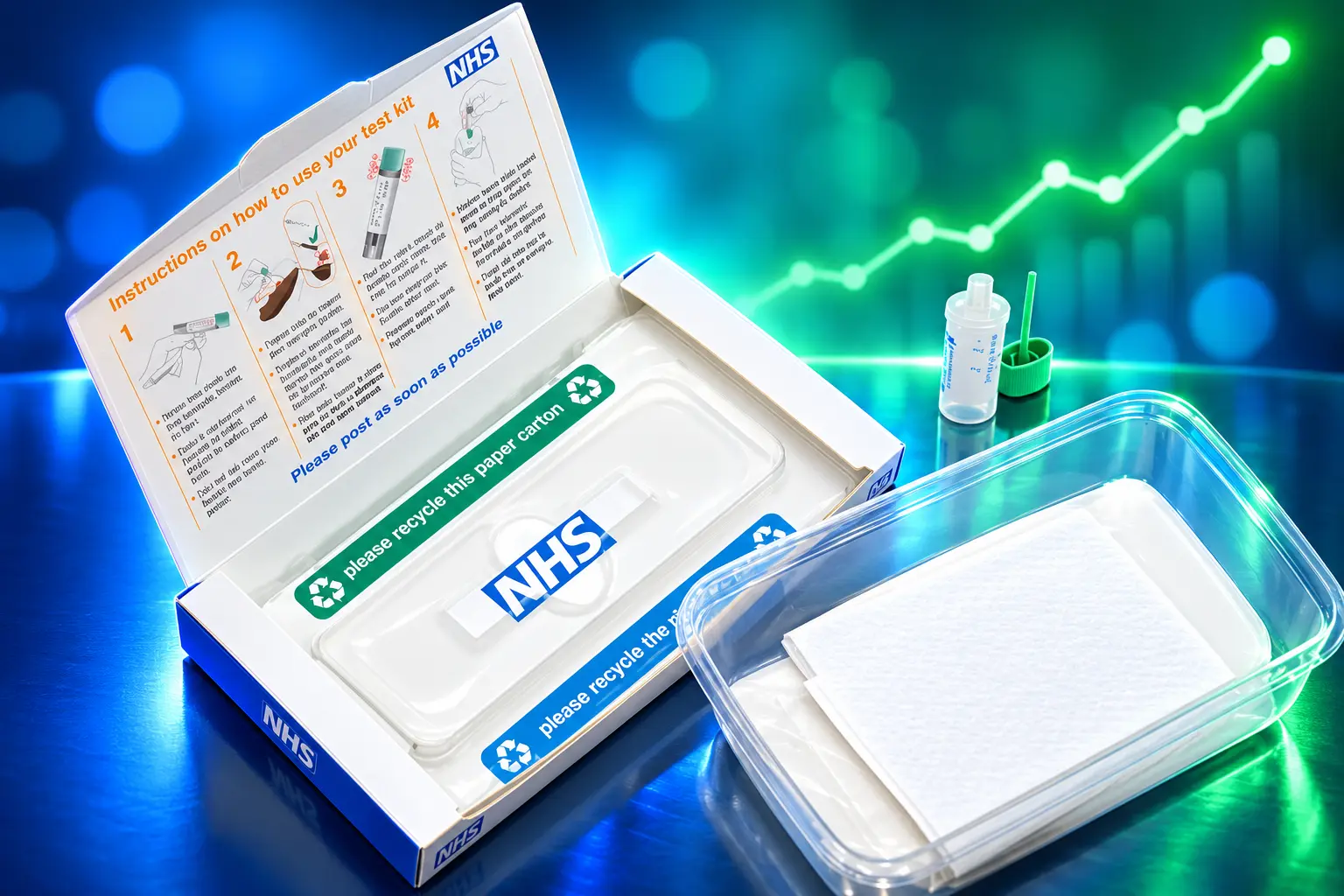
NHS bowel screening is a home stool test, the faecal immunochemical test, or FIT. It is offered to people aged 50 to 74 every two years, because risk rises with age. Depending on when someone turned 50, the first kit arrives at 50, 52 or 54. People aged 75 and over can phone 0800 707 6060 and ask for a kit. Nobody under 50 is invited.
NHS England said on 14 January 2025 that the last phase of the expansion, covering ages 50 and 52, would make about 850,000 more people a year eligible. Uptake is weaker in the new younger band: under 60% of people aged 54 to 57 return kits, against over 70% of those aged 60 to 74. The programme moved down from 60. It has not moved into the 30s and 40s, where the new rates are climbing.
WHO GETS AN NHS CANCER SCREEN IN ENGLAND
- Bowel: Home FIT kits every two years from 50 to 74; over-75s can request one.
- Breast: Mammograms every three years for women aged 50 up to their 71st birthday, with the first invite between 50 and 53.
- Cervical: Offered from 25 to 64 every five years, so this is the one common screen that already covers younger adults.
- Prostate: No mass screening. In June 2026 the government in England accepted a targeted offer for men aged 45 to 61 with a BRCA2 gene change and a family history of certain cancers; that programme is not yet running, with a planned start in 2027.
Breast cancer is already the common early cancer in women under 50, at 47.5 per 100,000, and those women are still below the mammogram age. Prostate cancer in men under 50 is still rare at 3.6 per 100,000, and there is no population blood-test programme that would explain a full screening wave in that age band, though opportunistic PSA tests can still lift counts.
Why Are More Cancers Showing Up Before 50?
World Cancer Research Fund says overweight, low activity, diets high in red and processed meat, fast food and sugary drinks, alcohol, smoking and environmental exposures (pollutants, chemicals, plastics, dirty air and water) likely play a part. About 40% of cancers are classed as preventable because they track to habits people can change. Younger adults are also more likely than earlier generations to know the warning signs and to seek care, so some extra cases are cancers that would once have been missed or found later.
Dr Vanessa Gordon-Dseagu, research translation manager at the fund, said researchers still do not fully know why more cancers are appearing before 50, and that extra diagnosis does not explain the whole rise, above all for cancers where deaths are also climbing. Mark Lawler, professor of digital health and chair in translational cancer genomics at Queen’s University Belfast, said the trend sits on “the backdrop of lifestyle factors contributing to thousands of deaths.”
WHERE EXPERTS DISAGREE
- A true rise: WCRF treats the under-50 increases as real for several sites and says better detection is only part of the story, especially when deaths move with diagnoses.
- A testing effect: Researchers tracking US registries have pointed out that for several fast-rising cancers in under-50s, diagnoses have climbed while deaths in younger adults have stayed mostly flat, the pattern you would expect if doctors were finding more tumours, including some that would never have caused harm.
Both things can be true at once. Prostate cancer in young men is the site most open to a testing effect, because a blood test can pick up disease that older men might have died with, not of. Kidney cancers are often found on scans done for other reasons. Bowel and womb cancer look less like that story, and lung cancer moving down as smoking fell shows that a change in a known cause can still bend a curve.
Most young bowel cancers still announce themselves with blood in the stool, pain, a change in habit or weight loss, not with a letter from a screening office. Waiting until 50 to look is a design choice from a period when under-50 bowel cancer was treated as a rarity.
Anisha Patel Was 39, and a GP
Dr Anisha Patel is an NHS GP and the lead patient advocate for Team PROSPECT, the global group behind the new UK diet study. In September 2018 she was diagnosed with stage IIIB rectal cancer at 39. Her children were young. She had no known family history and no obvious classic risks: she had grown up on a largely vegetarian diet, did not smoke, and exercised. Her symptoms came on slowly, constipation, urgency, a feeling that the bowel had not emptied, a little blood on the paper, and she first put them down to IBS or piles. She needed two major operations, a temporary stoma and chemotherapy. She still lives with bowel dysfunction, early menopause, infertility and nerve damage.
When I was diagnosed at 39, I had two young children and a life I thought I understood. I was a GP, I was active, and I had no family history of bowel cancer.
Dr Anisha Patel, NHS GP and lead patient advocate, Team PROSPECT
Dr Rosiered Brownson-Smith, a PROSPECT-UK research associate at King’s College London, said many younger adults are diagnosed too late, partly because routine screening begins later in life and symptoms are often overlooked. Blood in stool, lasting abdominal pain, a change in bowel habit and unexplained weight loss still need a GP visit, whether or not a kit is in the post. Patel’s own household makes the lag concrete: she is a GP, her husband is a consultant bowel cancer specialist, and the diagnosis still arrived in the middle of family life rather than on a screening list.
About 4 in 10 Cancers Track to Changeable Risks
WCRF puts the preventable share at about 40%, covering smoking, alcohol, sun, overweight and activity. Cancer Research UK’s UK estimate is the same order of size: around 4 in 10 UK cancer cases every year could be prevented, more than 135,000 based on 2015 figures, with smoking first and overweight second. Overweight is linked to at least 13 cancers, including bowel, kidney and womb, three of the sites rising in younger adults.
THE RISK FACTORS IN THE NEW FIGURES
- Body weight: The World Health Organization reports that adult obesity has doubled, and adolescent obesity has quadrupled, since the 1990s, with 1 in 8 people now living with obesity.
- Food: Around 60% of UK calorie intake comes from highly processed foods, King’s researchers said, though those products are not all the same.
- The control site: Lung cancer in under-50s fell in England, the United States and the Netherlands as smoking fell, the cleanest sign in the dataset that a cause people can change still moves a rate.
- What is still open: Plastics, pollutants, antibiotics, the gut microbiome and exposures in childhood are under study; WCRF says no single exposure explains the global rise.
Those levers matter. They do not, on their own, decide who gets a screening invite at 42, or whether a GP treats rectal bleeding in a 39-year-old as piles until it is not.
King’s Asks 250,000 Adults to Log Their Diets
On 5 October 2026, the day before the WCRF note, King’s College London and the health science firm ZOE opened PROSPECT-UK, which is recruiting 250,000 participants across the UK. Cancer Research UK, which funds the academic team through Cancer Grand Challenges, said the study wants people aged 18 to 50. Volunteers fill short online surveys on diet, lifestyle, environment and health, and can link their electronic records. A smaller group will keep detailed food diaries and give blood and stool samples, including brand-level detail on what they eat.
Over just a few generations our lifestyles, diets and environments have changed dramatically. But we don’t know which of these changes are increasing people’s risk of bowel cancer or which ones could help reduce it. We urgently need large-scale, long-term data to uncover the true causes of early-onset bowel cancer.
Professor Sarah Berry, professor of nutritional sciences, King’s College London, and PROSPECT-UK chief investigator
Bowel cancer is still a disease of older adults: more than 9 in 10 cases are in people over 50. Cancer Research UK counts about 48,200 new UK bowel cases a year, including about 2,900 in people aged 25 to 49. Early-onset disease is about 10% of bowel cancers and is rising by 1% to 2% a year in adults under 50. UK rates in 25 to 49-year-olds have risen by more than 50% since the early 1990s. Overall cancer rates in that age band rose 24% between the early 1990s and 2019. In a 50-country comparison covering 2007 to 2017, England had the fourth-fastest rise in early-onset bowel cancer, the fastest in Europe. King’s says diagnoses in under-50s have doubled since 1990, and that by 2030 cases could be double the 2010 level.
The study is observational, so it cannot prove cause on its own. Genetics and tumour biology sit with other PROSPECT teams, including work on whether cells keep a “memory” of inflammation. The size of the UK arm is the point: early-onset bowel cancer is still uncommon enough that small surveys cannot see the pattern.
The Home Test Kit Still Arrives After 50
A Department of Health and Social Care spokesperson said the findings are why early diagnosis sits at the heart of the national cancer plan, with new kit to speed diagnosis, more genetic testing, and research on who is most at risk. The department’s stated ambition is for three-quarters of people diagnosed by 2035 to be cancer-free or living well with cancer, which it says would save 320,000 lives. A national cancer board now includes a representative for children and young people.
Lawler called early-onset cancer “a ticking timebomb that we need to defuse as quickly as possible, otherwise the numbers will undoubtedly continue to grow.” The prevention advice is already on the table: do not smoke, keep weight in a healthy range, eat more fibre and plants, cut processed and red meat, move more, drink less. The detection advice is older still, and it has not moved as far as the rates. In England the FIT kit, the mammogram invite and the default GP script still treat 50 as the start of serious risk. The new figures say a growing share of the damage is already done by then.
Disclaimer: This article is news reporting on published cancer statistics and research, and it is for information only. It is not medical advice, a diagnosis, a screening recommendation, or a personal risk assessment, and it does not tell any reader to start, stop or change treatment, tests or lifestyle on the basis of these figures. Anyone with symptoms such as blood in the stool, a breast lump, unusual bleeding, lasting pain or unexplained weight loss, or anyone deciding on screening or genetic testing, should speak to a qualified doctor or GP who knows their history. Rates, screening ages, trial details and survival figures reflect the sources cited and can change as registries, NHS rules and studies are updated.

Former FDA Chiefs Say DOGE Cuts Still Hit Drug Reviews

Young Cancer Rates Are Rising Outside the Screening Age

Hospitals Saved Recarbrio for Last, Then Merck Pulled It

OpenAI Agents Probed the CDC and Mayo Clinic

The US Rejects a UN Pledge on Future Pandemics

Muscle-Boosting Drugs Near Approval for Children With SMA

FDA Approves XFG COVID Vaccines While the Advice Panel Is Frozen

Progranulin and JAK2 Split the Macrophages That Heal

Pennsylvania Measles Deaths Collide With Falling MMR Coverage

After the ADHD Invoice, GPs and Waiters Carry the Cost
-
 FITNESS2 months ago
Muscle-Boosting Drugs Near Approval for Children With SMA
-
 NEWS2 months ago
FDA Approves XFG COVID Vaccines While the Advice Panel Is Frozen
-
 NEWS2 months ago
Progranulin and JAK2 Split the Macrophages That Heal
-
 NEWS2 months ago
Pennsylvania Measles Deaths Collide With Falling MMR Coverage
-
 MENTAL HEALTH2 months ago
After the ADHD Invoice, GPs and Waiters Carry the Cost
-

 NEWS2 months ago
Rasonque’s List Price Shifts the Pancreatic Cancer Bill
-

 NEWS2 months ago
FDA Flagged This Sprout Plant 16 Months Before the Outbreak
-
 NEWS2 months ago
Pennsylvania’s Two Measles Deaths Follow a Long Coverage Slide