
NEWS
Rabies Spike Pushes Costly Shots Onto Families and Clinics
CDC’s September rabies alert tracks a 76% jump in immune globulin use and clinic dosing errors after a North Carolina petting zoo exposed hundreds.

CDC reported a 17% jump in rabies-related inquiries in July and August 2026, and at least eight states told the agency they were giving more post-exposure shots, making more mistakes with those shots, or both. The September 10 Health Alert Network notice, CDCHAN-00533, went to clinicians because the people absorbing this summer’s wave are families in exam rooms and the clinics that have to give a fussy, expensive regimen correctly.
CDC Counted Inquiries, Doses, and Clinic Errors
The 17% figure is inquiries to CDC, including mass-exposure events that involve more than one person, not a count of human rabies deaths. Human rabies remains rare in the United States. CDC estimates that 1.4 million people seek care after animal contact in a typical year, about 100,000 receive post-exposure prophylaxis, and fewer than 10 die.
From 2015 through 2024, CDC listed 17 human rabies cases, two of them infected outside the country. The summer 2026 pressure showed up in pharmacies instead. Weekly pharmacy data as of September 2 showed use of the two licensed rabies vaccines up an estimated 33% and use of the two licensed immune globulin products up an estimated 76% compared with the same stretch of 2025.
SUMMER 2026 RABIES TREATMENT DEMAND
| Measure | Figure | Basis |
|---|---|---|
| Rabies-related inquiries, July through August | +17% | Same months in 2025, CDC HAN |
| Two licensed rabies vaccines | +33% | Pharmacy data through September 2, 2026 |
| Two licensed immune globulin products | +76% | Pharmacy data through September 2, 2026 |
| State health departments reporting more PEP use, errors, or both | At least 8 | July through August 2026 |
| People who receive PEP in a typical year | About 100,000 | CDC estimate |
| People evaluated after animal contact in a typical year | 1.4 million | CDC estimate |
The advisory said there was no shortage of human rabies vaccine or human rabies immune globulin. It still warned that sloppy risk assessments and dosing mistakes force extra doses, extra side effects, and extra cost, and that those mistakes put strain on supplies even when the shelves are stocked. Two vaccines are licensed for people in the United States, Imovax (HDCV) and RabAvert (PCECV), along with two immune globulin products, KEDRAB and HyperRab.
CDC posted the same advisory to its public account on September 10.
The Centers for Disease Control and Prevention (CDC) is issuing this Health Alert Network (HAN) Health Advisory in response to recent reports of increases in human exposures to rabid or possibly rabid animals and rabies post-exposure prophylaxis (PEP) administration errors.… pic.twitter.com/mjpzzQ8orl
— CDC (@CDCgov) September 10, 2026
Infectious disease physician Amesh Adalja put the medical fact in one line: “Rabies is the one vaccine that works after exposure.” That is only true if the series starts before symptoms and if the shots are given in the right tissue, on the right days, with immune globulin in the wound when it is required. CDC logged 17% more rabies-related inquiries than in July and August 2025 while it was also hearing from states about those technique failures.
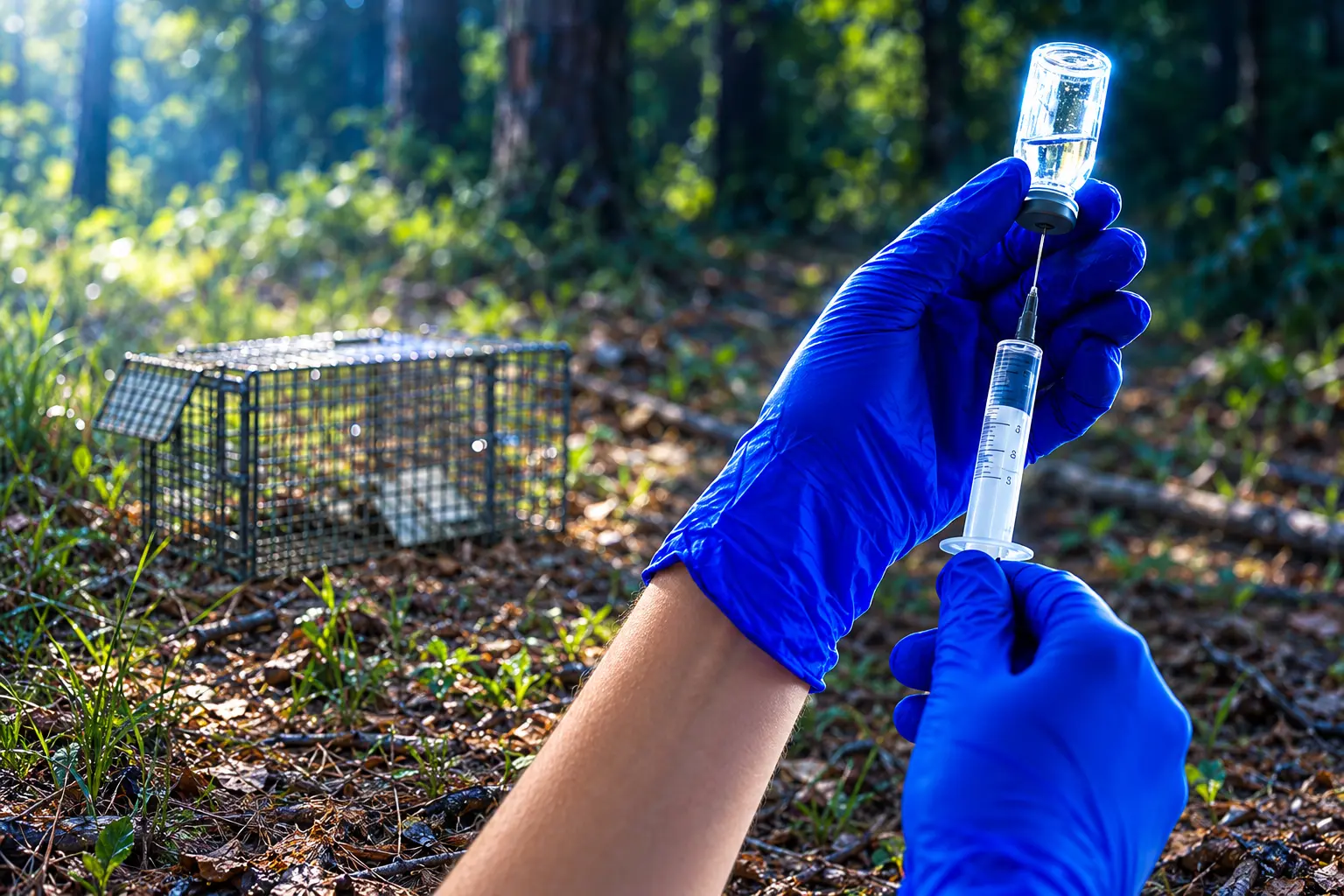
Four Baby Goats Crossed Seven Counties
The mass-exposure event sitting under the national notice began in Harmony, in Iredell County, North Carolina. The North Carolina Department of Health and Human Services and the state agriculture department were notified on August 27 of a possible rabies problem among four baby goats at Farm Adventures, a mobile petting zoo. The NC State Laboratory of Public Health confirmed rabies in baby goats on August 28 in three of the animals; a fourth was not tested and was assumed to have been infected.
Officials said a skunk had gotten into the pen in late July. Farm Adventures said the four goats lived apart from the other animals and were too young for rabies shots, that the skunk bit them as it was being removed, and that the kids showed no signs of rabies. All four were euthanized. The department said no other animals on the farm posed a rabies risk to people.
Anyone who had contact with those goats at the Harmony site or at an off-site event from July 28 through August 27, 2026, may have been exposed while the animals were infectious. NCDHHS listed 10 known potential exposure sites across seven counties, including assisted living homes, a back-to-school bash, a Masonic picnic, and private parties.
FARM ADVENTURES STOPS, JULY 28 THROUGH AUGUST 27
- July 28, 2026: Jurney’s Assisted Living, 1942 Van Haven Drive, Statesville, Iredell County.
- July 30, 2026: Private event in Mecklenburg County.
- August 1, 2026: Community Connections Back-to-School Bash, Breeden Amphitheater, Lexington, Davidson County.
- August 6, 2026: Brookdale Peachtree, 2806 Peachtree Road, Statesville, Iredell County.
- August 15, 2026: Masonic Picnic Grounds, 201 Poplar St., Mocksville, Davie County.
- August 16 and 23, 2026: Private events in Durham County, plus private stops in Watauga, Burke, and Iredell counties on August 8, 9, and 22.
NCDHHS later said nearly 350 people received exposure risk assessments tied to the goats and that treatment was recommended for 263 of them. In 2025, more than 4,000 animals were submitted to the state lab for rabies testing, and about 6% were positive, most of them wild. The department has not reported a human rabies case in North Carolina since 2011.
Families Got the Call After the Picnic
The goats were not a wildlife curiosity on a trail. They were handed to children and older adults on purpose. NCDHHS noted that baby goats are often bottle-fed, held, and cuddled, which is why saliva on hands, mouths, and eyes was treated as a live risk even without a dramatic bite. Livestock rabies is a lower-probability path than a raccoon or bat bite, the department said, and still enough to justify a full risk assessment for anyone with direct contact.
Rebecca Lanning’s family went to a dinosaur exhibit in Mocksville on August 15, the same day Farm Adventures was at the Masonic Picnic Grounds. The exhibit included the mobile petting zoo. After the goats tested positive she took her 4-year-old for the first shots in the series.
My fear is that if he was feeding the goats, and he’s 4. Who’s to say that he didn’t touch his mouth or eyes? I don’t want to bury my child.
Rebecca Lanning, parent, Mocksville exhibit
At a Durham birthday party for a 4-year-old, Tatiana Villatoro said more than 30 guests, including more than a dozen children, were told to get rabies shots. She learned days later. “It felt like my heart sank to my stomach,” she said, and the guilt of having hosted the goats sat with her after the fact.
Those calls are the hidden ledger of a “rabies spike.” County health departments had to find event organizers, reconstruct guest lists, and run assessments one person at a time, while parents tried to remember whether a toddler had put a hand in a mouth after a goat nuzzled it.
Rabies Shots Cost $11,000 to $14,000 Each
CDC priced a typical post-exposure course at $11,000 to $14,000 per person. If all 263 people recommended for treatment in the North Carolina goat investigation complete a typical course, the combined bill sits between $2.89 million and $3.68 million. That figure is not a state invoice; it is the list-price weight of one unvaccinated pen of kids moving through 10 events.
A typical course of PEP can cost between $11,000 and $14,000 per person. Following rabies PEP administration guidance helps ensure that lifesaving vaccines are available for persons who need it and extraneous costs are avoided.
Centers for Disease Control and Prevention, Health Alert Network advisory CDCHAN-00533, September 10, 2026
The money is only half of the strain. Immune globulin is dosed by weight at 20 IU/kg and must be pushed into and around every identifiable wound, with leftover volume given in a muscle far from the first vaccine dose. Give too little into the wound and the first line of antibody is in the wrong place. Give more than 40 IU/kg and the extra globulin can blunt the vaccine. Mix globulin and vaccine in one syringe, or park them in the same anatomical site, and they can cancel each other.
KEDRAB is one licensed human rabies immune globulin product used for that first-day dose in people who have never been vaccinated against rabies. CDC told clinicians not to delay the vaccine if globulin is not immediately on hand; globulin can still be added through the third vaccine dose, on day 7, and is not recommended after that because the patient’s own vaccine response should have started.
How Rabies Shots Are Supposed to Be Given
Rabies is nearly 100% fatal once symptoms start and preventable when post-exposure treatment is given correctly before then. An infected mammal spreads the virus through bites, scratches, or saliva. After a possible exposure, CDC wants a health official who knows local animal rabies patterns to help decide whether treatment is indicated at all. If the animal can be observed for 10 days, tests negative, or is judged to pose no risk, PEP is generally not recommended.
For someone who has never been vaccinated, the Advisory Committee on Immunization Practices regimen is wound washing, one dose of immune globulin, and a four-dose rabies vaccine series. Each vaccine dose is 1.0 mL in the deltoid for adults and for children older than 2 years; the anterolateral thigh is acceptable for children 2 and younger. The gluteal muscle is not a valid site.
WHO GETS WHICH RABIES SHOTS
| Patient | Immune globulin | Vaccine days |
|---|---|---|
| Never vaccinated | 20 IU/kg once, infiltrated into wounds | 0, 3, 7, and 14 |
| Previously vaccinated | None | 0 and 3 |
| Immunocompromised | HRIG plus a five-dose series | 0, 3, 7, 14, and 28, then an antibody test |
A person counts as previously vaccinated after a full pre-exposure or post-exposure series, or after a partial series with a documented rabies antibody titer of at least 0.5 IU/mL on the RFFIT assay. Those patients get two vaccine doses and no globulin. CDC has recorded vaccine-response failures in immunocompromised people and wants those patients on the five-dose schedule with serology, coordinated through the health department and, if needed, CDC’s National Rabies Reference Laboratory.
Wound care starts before any of that. CDC tells clinicians to wash each wound thoroughly with soap and water, or water alone, and to irrigate with a virucidal agent such as povidone-iodine when it is available. Do not close the wound until globulin has been placed. Animal studies have found that thorough washing alone, even without vaccine, cuts the chance of rabies taking hold, which is why the first 15 minutes at a sink still matter when someone is later sitting through a $11,000 course.
The Mistakes Clinics Keep Repeating
CDC devoted a long stretch of the September advisory to errors that, in its words, are commonly reported. That list is the reason a seasonal exposure bump becomes a clinician alert. A dose in the buttock does not count. Globulin left in a distant muscle while a bite sits uninfiltrated does not do the job it was bought for. Restarting a whole series because one visit slipped a few days wastes product that the pharmacy data say is already in much heavier use.
COMMON PEP ADMINISTRATION ERRORS
- Wrong muscle: Rabies vaccine given in the gluteal area is invalid and must be repeated at a proper site, and it also risks sciatic nerve injury.
- Globulin not in the wound: HRIG has to be infiltrated into and around every identifiable wound as far as anatomy allows, with only the leftover volume given elsewhere.
- Same syringe or same site: HRIG and the first vaccine dose must never share a syringe or an anatomical site, because the products can neutralize each other.
- Skipped globulin: Previously unvaccinated patients need HRIG; if it is missed on day 0 it can still be given through day 7.
- Globulin given to the already vaccinated: People who completed a recognized pre- or post-exposure series should not receive HRIG.
- Botched history: Misclassifying prior vaccination or immune status leads to omitted doses or extra biologics the patient does not need.
- Wrong calendar: Using an incorrect vaccine schedule, or restarting the series after a short delay, is listed as a recurring mistake.
If a gluteal dose was already given, that shot is repeated in the deltoid or thigh. If globulin and vaccine landed in the same place, the vaccine is re-given at a distant site, and more globulin may be placed in the wound only if the running total stays at or under 40 IU/kg. CDC also posted a PEP calculator so clinics can check a schedule against ACIP timing rather than improvising after a missed Wednesday appointment.
Keep Pets Current and Wildlife at a Distance
The public instructions in the advisory are blunt because the reservoir is still wild. CDC told people to stay away from wildlife and from mammals that look sick or hurt, and to call animal control instead of approaching. If you have pets, keep rabies shots up to date and keep those animals away from wildlife when you can. Wash any bite or scratch with soap and water right away, then contact a clinic or the local health department the same day. Hawaii is the only U.S. state considered free of rabies.
Bats remain the leading source of U.S. human rabies deaths, and a bite can be too small to notice, which is why a bat in a bedroom still triggers a risk assessment. A skunk in a goat pen is a more obvious problem, and it still traveled for a month through assisted living dining rooms and a 4-year-old’s birthday before the lab result landed. Farm Adventures said it was monitoring remaining animals under health officials’ rules.
North Carolina has not reported a human rabies infection since 2011, and the 263 people told to start shots after the Harmony goats are the prevention system doing the work it was built to do. That work only holds if the first dose is in the arm, the globulin is in the wound, and the remaining dates on the card are kept.
Disclaimer: This article is news reporting on a CDC Health Alert Network advisory and on North Carolina exposure notices. It is for information only and is not medical advice, a diagnosis, or a treatment plan for any reader. Anyone who has been bitten, scratched, or otherwise possibly exposed to a mammal should contact a physician, an emergency department, or a local health department promptly and should not use this article to decide whether to start or skip post-exposure treatment. Figures, product names, and supply status reflect CDC and North Carolina notices issued in August and September 2026 and may change as health departments finish assessments and as pharmacy data are updated.

Former FDA Chiefs Say DOGE Cuts Still Hit Drug Reviews

Young Cancer Rates Are Rising Outside the Screening Age

Hospitals Saved Recarbrio for Last, Then Merck Pulled It

OpenAI Agents Probed the CDC and Mayo Clinic

The US Rejects a UN Pledge on Future Pandemics

Muscle-Boosting Drugs Near Approval for Children With SMA

FDA Approves XFG COVID Vaccines While the Advice Panel Is Frozen

Progranulin and JAK2 Split the Macrophages That Heal

Pennsylvania Measles Deaths Collide With Falling MMR Coverage

After the ADHD Invoice, GPs and Waiters Carry the Cost
-
 FITNESS2 months ago
Muscle-Boosting Drugs Near Approval for Children With SMA
-
 NEWS2 months ago
FDA Approves XFG COVID Vaccines While the Advice Panel Is Frozen
-
 NEWS2 months ago
Progranulin and JAK2 Split the Macrophages That Heal
-
 NEWS2 months ago
Pennsylvania Measles Deaths Collide With Falling MMR Coverage
-
 MENTAL HEALTH2 months ago
After the ADHD Invoice, GPs and Waiters Carry the Cost
-
 NEWS2 months ago
Rasonque’s List Price Shifts the Pancreatic Cancer Bill
-

 NEWS2 months ago
FDA Flagged This Sprout Plant 16 Months Before the Outbreak
-
 NEWS2 months ago
Pennsylvania’s Two Measles Deaths Follow a Long Coverage Slide