
FOOD
California’s Non-Ultraprocessed Seal Exports a School Food Test
AB 2244 would put a state Non-Ultraprocessed Certified seal on grocery packages, tying supermarket labels to California’s school-food UPF rules before a.

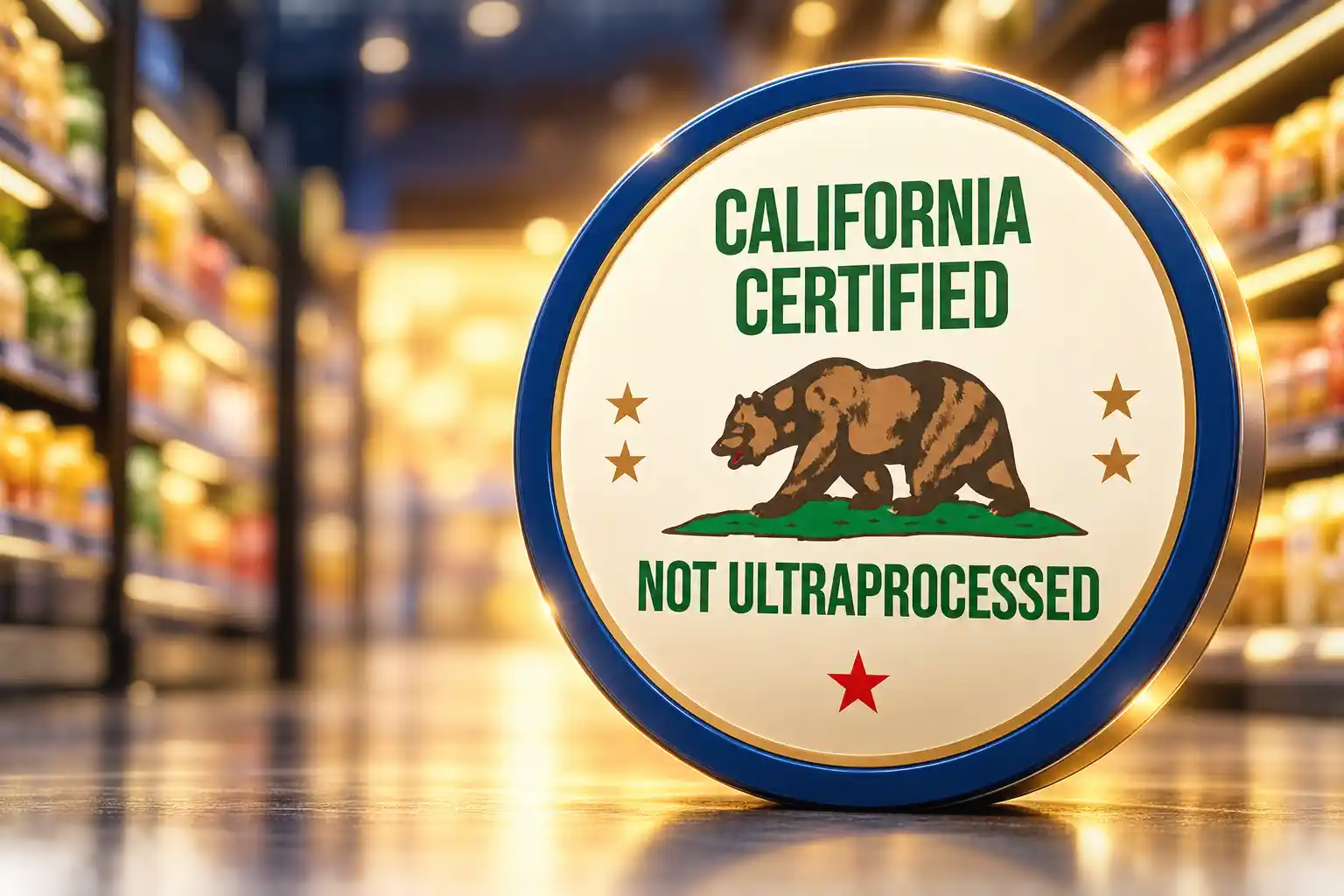
California enrolled a first-in-the-nation Non-Ultraprocessed Certified food seal on September 2, 2026, and sent it to Governor Gavin Newsom. The mark is optional on packages. Large grocers would have to make a handful of certified items easy to spot if they already stock more than 25 of them.
The standard behind that seal is the state’s school-food definition of ultra-processed products, not a finished federal rule. If Newsom signs AB 2244 by September 30, 2026, California would start building a supermarket certification market against cafeteria law while Washington is still reviewing what “ultra-processed” means.
Lawmakers Sent Newsom a Unanimous Food Seal
Assembly Member Jesse Gabriel, a Democrat from Encino, wrote the bill and moved it through both houses without a floor no vote. The Senate passed it 32-0 on August 27, 2026. The Assembly concurred 72-0 the next day, after an earlier May 27 floor vote of 74-0.
Gabriel has spent three years stacking food rules in Sacramento, from additive bans to school meals. He pitched AB 2244 as a glanceable shortcut for parents and as a California answer to delay in Washington. “Parents shouldn’t need a Ph.D. in chemistry to understand what they’re feeding their kids,” he said when he introduced the measure. After the final vote he added that Republicans and Democrats were “joining forces to empower consumers to avoid harmful ultra-processed foods.”
The Environmental Working Group sponsored the bill. Bernadette Del Chiaro, the group’s senior vice president for California, said families “deserve a simple way to tell which foods are closer to what comes from a kitchen rather than a factory.” Scott Faber, who testified for EWG before the Senate Health Committee, called the seal voluntary and said it would apply the school-era definition to the grocery aisle.
THE BILL AT A GLANCE
- Enrolled: September 2, 2026, after unanimous Senate and Assembly floor votes.
- Governor’s clock: Newsom has until September 30, 2026, to sign or veto.
- Agent deadline: The state health department must accredit certifiers no later than June 1, 2029.
- Grocery trigger: Stores above $10 million in annual sales must make at least three certified items clearly identifiable if they sell more than 25.
That last number is the part of the pitch that changed most from March to enrollment. Early descriptions talked about high-traffic endcaps. The enrolled text is more limited, and it is the piece national brands will actually staff against.
The $10 Million Grocery Display Trigger
Manufacturers may print the seal only after an accredited agent certifies the product. Nothing in the bill forces a brand to apply. The floor duty lands on grocery stores, and only some of them.
Once the state creates the standardized seal, a grocery store with gross annual store sales of more than $10 million must make at least three Non-Ultraprocessed Certified items “clearly identifiable” if it offers more than 25 certified items. Clearly identifiable means a reasonable shopper can tell those products apart from the rest of the set, including by physical separation, signage, or other visual cues. Gas stations with a limited grocery line, and convenience stores that mainly sell milk, bread, soda, and snacks, are carved out.
WHO HAS TO DO WHAT
| Party | Duty | Force of the rule |
|---|---|---|
| Food makers | May put the seal on a certified UPC | Optional; false use can be enjoined |
| Grocery stores over $10 million | Make at least 3 certified items clearly identifiable if they sell more than 25 | Injunction by the attorney general or local prosecutors |
| California Department of Public Health | Accredit agents, design the seal, keep a public product list, set fees | Deadline of June 1, 2029, for accreditation |
A grocer that misses the display rule can be sued for an injunction, not a Retail Food Code misdemeanor. The store is treated as in compliance if it shows a good-faith effort, including policies, procedures, or staff training. Isolated gaps from restocking, customer handling, or ordinary operations do not count as a violation. The whole grocery chapter sunsets on January 1, 2040.
That is a light floor duty, not a forced reset of every endcap in the state. The harder pull sits one layer up. A state-backed mark, a public list of every certified UPC, and a right for consumers, businesses, and nonprofits to enjoin misuse give brands a reason to chase the seal even when the aisle rule asks for only three faces.
What the Non-Ultraprocessed Seal Requires
The enrolled bill tells the State Department of Public Health to accredit certification agents by June 1, 2029. Agents register with the department, complete its training, and renew each year. They must report, for every certified product, the name, ingredients, nutrition facts, manufacturer and brand, GTIN and UPC, and the date certified. The department keeps a public webpage of products currently certified and may audit an agent’s files at any time.
The seal itself may carry the phrase “Non-Ultraprocessed Certified Food Standard” or “Non-UPF Certified,” plus images and themes tied to California and whole foods. It can sit on the principal display panel, the information panel, or elsewhere, as long as it does not cover the nutrition facts or the statement of identity. A product must be recertified no less often than every three years. If a maker reformulates a sealed product, it has to obtain recertification before putting the mark on the new recipe.
Fees for agent registration and product certification cannot exceed the reasonable cost of running the program. The money goes into a new Public Health Food and Nutrition Education Fund, which can pay for implementation and for public education about the label, food products, and nutrition, after the Legislature appropriates it.
WHAT BARS A PRODUCT FROM THE SEAL
- Additive screen: An agent may not certify a food that meets the additive criteria for ultraprocessed food in Health and Safety Code section 104661.
- School “of concern” list: A product classified as an ultraprocessed food of concern is ineligible.
- Restricted school food: The same bar applies to foods CDPH later restricts for school sale.
- False use: Printing the seal without certification is unlawful and can be enjoined by the department, prosecutors, a consumer, a business, or a nonprofit.
Faber told senators the point was to help shoppers tell ordinary processed food from the industrial kind. He named olive oil, nuts and pasteurized milk as the sort of minimally processed items that could qualify. Mexico and Canada, he noted, went the other way and put mandatory warnings on unhealthy processed foods. California is building a positive mark instead, closer to the USDA Organic seal Gabriel has used as his model.
School-Meal Rules Become a Marketplace Test
AB 2244 does not invent a new scientific definition from scratch. It borrows the architecture California already wrote for cafeterias. On October 8, 2025, Newsom signed Gabriel’s Real Food, Healthy Kids Act, AB 1264, which put the first statutory U.S. definition of ultraprocessed food into the Health and Safety Code for school purposes.
Under that law, a food or beverage is ultraprocessed if it contains a listed additive with an FDA-defined technical effect and either high saturated fat, sodium, or added sugar, or a nonnutritive sweetener or named sugar substitute. High, in the statute, means 10 percent or more of total energy from saturated fat, a milligrams-of-sodium to calorie ratio of at least one to one, or 10 percent or more of total energy from added sugars. The additive list covers surface-active agents, stabilizers and thickeners, propellants, colors other than natural colors, emulsifiers, flavoring agents, flavor enhancers, and nonnutritive sweeteners. Named substitutes include D-sorbitol, erythritol, hydrogenated starch hydrolysates, isomalt, lactitol, monk fruit concentrate, maltitol, stevia glycosides, thaumatin, and xylitol. Class 1 milk, alcoholic beverages, medical foods, and infant formula are excluded from that school definition.
CDPH still has to adopt regulations by June 1, 2028, defining “ultraprocessed foods of concern” and “restricted school foods.” Schools must start phasing those products out by July 1, 2029. Vendors cannot offer them after July 1, 2032. Reimbursable breakfasts and lunches, and competitive foods, must be clear of them by July 1, 2035. AB 2244 would put the same vocabulary on a supermarket seal on a parallel clock, with agents due one year after those school regulations.
HOW CALIFORNIA BUILT THE UPF STACK
- 2023: The California Food Safety Act, AB 418, bans brominated vegetable oil, potassium bromate, propylparaben, and red dye 3 from foods manufactured or sold in the state beginning January 1, 2027.
- 2024: The California School Food Safety Act, AB 2316, bars Blue 1, Blue 2, Green 3, Red 40, Yellow 5, and Yellow 6 from foods sold at K-12 schools beginning December 31, 2027.
- October 8, 2025: Newsom signs AB 1264, defining ultraprocessed food and setting the 2028 through 2035 school phase-out.
- February 19, 2026: Gabriel introduces AB 2244, later amended into the Non-Ultraprocessed Certified standard enrolled on September 2, 2026.
A support letter in the Senate Judiciary file said ultraprocessed products now supply more than half of adult calories in the United States and nearly two-thirds of calories eaten by children. The same coalition cited a 2025 national survey in which 72 percent of Americans said they were trying to cut ultra-processed intake, yet fewer than half could pick out common ultra-processed products. That gap is the political opening for a front-of-pack mark. It is also why a school statute is about to become a commercial sorting tool.
A Federal UPF Definition Still in Review
Gabriel has framed California as moving while Washington stalls. The federal file is not empty, but it is not a label rule. On July 25, 2025, the Food and Drug Administration and the Department of Agriculture asked for public information to help write a uniform definition of ultra-processed foods. Comments closed on September 23, 2025.
On August 10, 2026, the Department of Health and Human Services said it had submitted, with USDA, the federal government’s first proposed definition of ultra-processed foods for final review, in the same package as a proposed rule that would make GRAS notifications mandatory. HHS Secretary Robert F. Kennedy, Jr. tied the work to the administration’s Make America Healthy Again campaign.
Nearly 60% of the American diet is made up of ultra-processed foods, and childhood obesity now affects more than one in five American children. We cannot reverse America’s chronic disease epidemic without transforming our food system.
Robert F. Kennedy, Jr., HHS Secretary, August 10, 2026, HHS press release
Acting FDA Commissioner Kyle Diamantas said the proposed definition was meant to create a stronger base for nutrition research. The FDA’s Human Foods Program list of 2026 priorities still describes the next step as work to develop a federal government definition of UPFs, building on the 2025 request for information. That is a research and policy foundation, not a seal a shopper can see on a California shelf in 2029.
If Newsom signs AB 2244, national brands that want one recipe and one package for the largest state market will be measuring formulas against California’s additive screen and against whatever CDPH later calls a food of concern. A later federal definition that does not match would leave those companies holding two maps.
Why Trade Groups Call the Bill Premature
The bill drew a long public-health support list, including the American Academy of Pediatrics of California, the American Diabetes Association, the American Heart Association, the California Medical Association, Consumer Reports, and the Consumer Federation of America. Four trade groups opposed the bill in the Senate Judiciary analysis: the California Manufacturers & Technology Association, the Calorie Control Council, the Consumer Brands Association, and the Food Ingredient Safety Coalition.
WHERE EXPERTS DISAGREE
- The sponsor’s case: EWG and allied health groups say shoppers cannot tell ultra-processed products from ordinary processed foods at a glance, and a state-backed seal plus a grocer display duty would fix that without banning products.
- The trade-group case: The four opponents told the committee the program is premature because certification turns on “ultraprocessed food of concern” and “restricted school food,” terms CDPH is not required to finish until June 1, 2028, and because those terms were written for school meals, not the full grocery set.
- The mismatch they flag: They wrote that alcoholic beverages are excluded from the school UPF definition, so a spirit or flavored malt drink could theoretically take a health seal, while a low-fat yogurt with a nonnutritive sweetener, or a packaged salad whose dressing pairs an emulsifier with added sugar, could be denied it.
They also warned that a California-only definition would have to be rewritten if federal standards land somewhere else, forcing repeat reformulation and recertification. A separate objection in the same file said private “Non-UPF” marks already exist, and that a close look-alike state seal, paired with a right for any consumer, business, or nonprofit to seek an injunction, invites confusion suits. The author and sponsor replied that the remedy is injunction only, with no penalties or attorney’s fees, and that abuse should be limited.
Those fights will not be settled on Newsom’s desk. They will be settled in CDPH’s 2028 school regulations, in the 2029 accreditation round, and in the first wave of products that do or do not make the public list.
Newsom’s Deadline Falls on September 30
The enrolled bill is on the governor’s desk with a September 30, 2026 sign-or-veto date. Newsom already signed the school definition that AB 2244 would carry into stores. He has not yet said whether he will put a certification market on top of it.
If he signs, the first visible objects will not be seals. They will be agent applications, fee schedules, and a blank public webpage waiting for UPCs. The grocery duty does not start until that seal exists, and even then it asks large stores only to make three certified items easy to tell apart, with a good-faith defense and a 2040 sunset. The durable piece is the standard itself: a school-meal test, administered by private agents, printed on packages sold to everyone.
If he vetoes, California still has the 2028 school rulemaking and the 2035 cafeteria ban. The supermarket aisle stays with private non-UPF marks and ordinary nutrition panels, and the federal definition stays in review. The choice on his desk is whether a cafeteria statute becomes the country’s first government-backed Non-Ultraprocessed Certified seal.

Europe’s Heat Killed 50,391 in Cities Official Counts Still Miss

Caesarean Surge Puts 20 England Maternity Units at Risk

The Protective Ring Around Care Homes Never Existed

Cooper Prioritises Children’s Corridor Care Without an Age Count

Oxford’s Ebola Vaccine Reaches Uganda as Doses Sit Unused

Pennsylvania Measles Deaths Collide With Falling MMR Coverage

FDA Approves XFG COVID Vaccines While the Advice Panel Is Frozen

Muscle-Boosting Drugs Near Approval for Children With SMA

Progranulin and JAK2 Split the Macrophages That Heal

After the ADHD Invoice, GPs and Waiters Carry the Cost
-
 NEWS2 months ago
Pennsylvania Measles Deaths Collide With Falling MMR Coverage
-
 NEWS2 months ago
FDA Approves XFG COVID Vaccines While the Advice Panel Is Frozen
-
 FITNESS2 months ago
Muscle-Boosting Drugs Near Approval for Children With SMA
-
 NEWS2 months ago
Progranulin and JAK2 Split the Macrophages That Heal
-
 MENTAL HEALTH2 months ago
After the ADHD Invoice, GPs and Waiters Carry the Cost
-
 NEWS2 months ago
Rasonque’s List Price Shifts the Pancreatic Cancer Bill
-
 NEWS2 months ago
Pennsylvania’s Two Measles Deaths Follow a Long Coverage Slide
-
 NEWS2 months ago
FDA Flagged This Sprout Plant 16 Months Before the Outbreak