
NEWS
Rasonque’s List Price Shifts the Pancreatic Cancer Bill
Rasonque lists at $39,800 a month after FDA approval, yet Medicare’s $2,100 Part D cap can close a patient’s share after one fill.

Rasonque, a new pancreatic cancer pill, lists at $39,800 for 30 days, about $477,600 for a year of treatment.
The Food and Drug Administration approved the once-daily RAS blocker on August 26, 2026, for metastatic disease after chemo, or when combination chemo is not an option. Most of that sticker will not land on Medicare patients. The 2026 Part D cap is $2,100, so one fill can close a patient’s share for the year, while plans, employers, and the manufacturer pick up the rest.
Rasonque Nearly Doubled Survival After Chemo Failed
The approval rests on RASolute 302, a randomized, open-label trial of 500 adults with metastatic pancreatic adenocarcinoma whose cancer had already progressed on one line of systemic therapy. Half received daraxonrasib, the drug sold as Rasonque. Half received physician’s choice of standard chemo.
The agency’s review found a median overall survival of 13.2 months on the pill, against 6.7 months on chemo. The hazard ratio for death was 0.40, a 60% lower hazard during follow-up, with a p-value under 0.0001. Those extra 6.5 months of median life are why oncologists treated the data as a break in a disease that had barely moved.
RASOLUTE 302 SURVIVAL RESULTS
| Endpoint | Rasonque | Chemo |
|---|---|---|
| Median overall survival | 13.2 months | 6.7 months |
| Hazard ratio for death | 0.40 | – |
| Median progression-free survival | 7.2 months | 3.6 months |
| Objective response rate | 30% | 11% |
Progression-free survival, scored by blinded independent review, was 7.2 months versus 3.6 months (hazard ratio 0.49). Tumors shrank in 30% of patients on the pill and 11% on chemo. The same pattern held in the RAS G12 subgroup and in the full trial population.
Mark Lewis, director of GI oncology at Intermountain, described the ASCO presentation of those numbers as cheers, chills, and a standing ovation, and wrote that RAS targeting had arrived. The recommended dose is 300 mg by mouth once daily, taken until the cancer grows or the side effects become too much. That dose is two 150 mg tablets once a day, not a morning-and-night split.
9800 year bill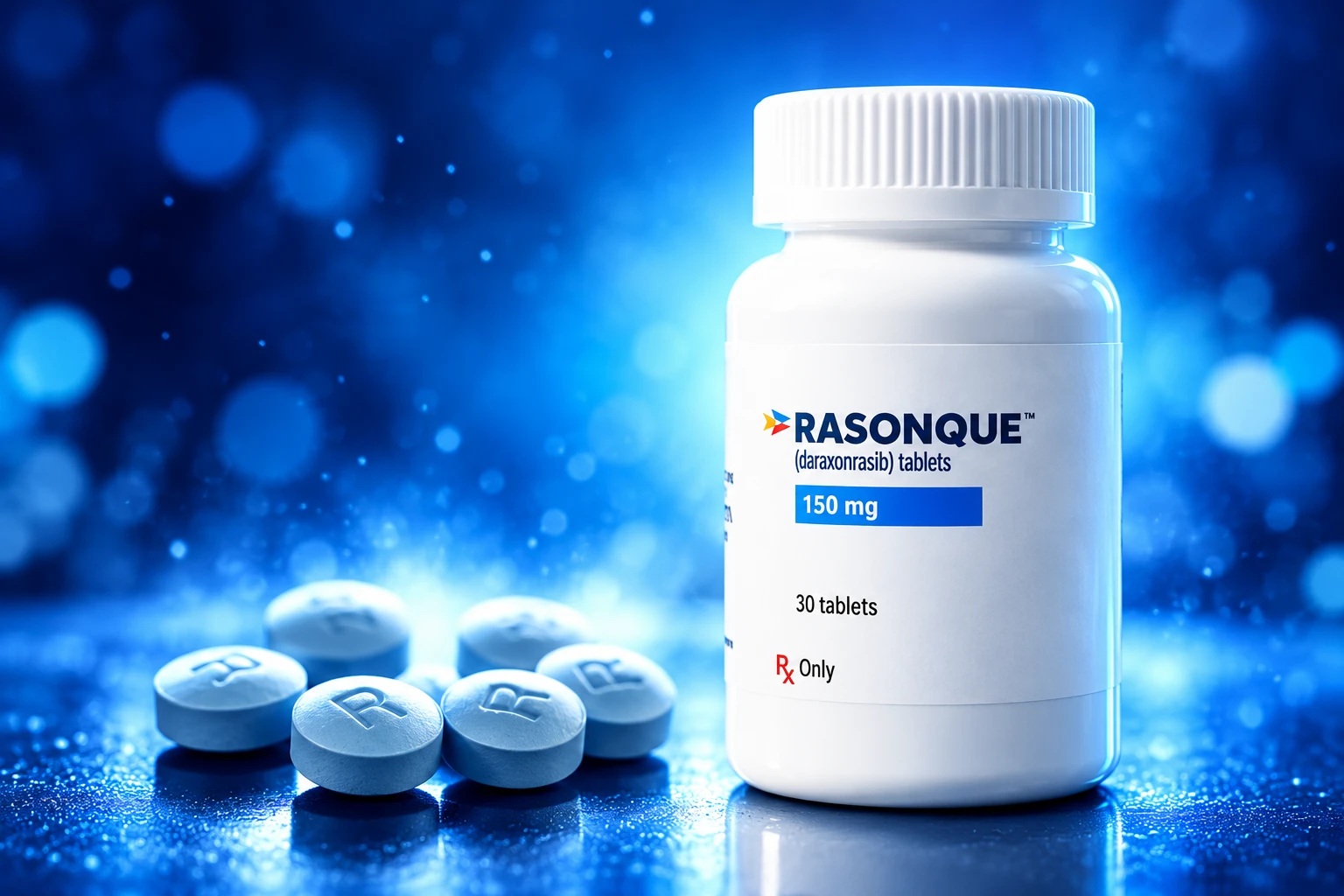
A $39,800 Price on a 30-Day Supply
Revolution Medicines, based in Redwood City, California, told the Securities and Exchange Commission that once-daily Rasonque tablets were available in the United States the day of approval, at a wholesale acquisition cost of $39,800 for a 30-day supply at the recommended daily dose. Twelve of those fills come to $477,600 before discounts, rebates, or aid. Split across 60 tablets, the list is about $663 a tablet.
RASONQUE LIST PRICE SNAPSHOT
- 30-day WAC: $39,800 for the recommended daily dose, the figure in the company’s August 26, 2026 8-K.
- Twelve fills: $477,600 at list, before plan discounts, rebates, or patient aid.
- Per tablet: About $663, based on two 150 mg tablets each day.
- Median course: $286,560 at list if a patient stays on drug only through the 7.2-month median time to progression.
The year-price assumes a full year on therapy. Median time to progression in the trial was 7.2 months, so a typical course at list is closer to $286,560 unless the person stays on treatment longer. Median overall survival was 13.2 months, which means some patients will keep filling past that midpoint.
Jack Anders, the company’s chief financial officer, told investors that Medicare Part D would cover eligible patients and that extra government discounts would cut the price by an estimated 20% to 30%. Faisal Khurshid, an analyst at Jefferies, put the net closer to $28,000 to $32,000 a month and called the $39,800 wholesale figure mostly in line with Wall Street. The company’s (ON)Path program says eligible commercially insured patients may pay as little as $0 with copay help. That path does not rewrite the bill for a Medicare plan.
One Fill Can Exhaust the Medicare Cap
Pancreatic cancer skews older, so a large share of the people who will take this pill sit on Medicare. Pharmacy pills run through Part D. Clinic infusions run through Part B. That split, not the sticker on the bottle, decides what a patient actually writes a check for.
THE 2026 PART D CLOCK
- May 1, 2026: The FDA issues a “safe to proceed” letter so Revolution Medicines can start an expanded-access protocol for previously treated metastatic disease.
- July 17, 2026: The agency receives the new drug application, NDA 220910, 40 days before approval.
- August 26, 2026: The FDA approves Rasonque, 6.5 months ahead of its goal date, and the company puts commercial bottles on the market at $39,800 per 30 days.
For 2026, CMS set an out-of-pocket threshold of $2,100 under the Inflation Reduction Act redesign. The standard deductible is $615. After that, the enrollee pays 25% coinsurance on covered Part D drugs until spending hits $2,100. Then cost sharing drops to zero for the rest of the year.
The $2,100 Cap
On a $39,800 fill at list, a patient who still owes the deductible pays $615, then only $1,485 more in coinsurance before the cap closes. That is the full $2,100, often on the first bottle. Later fills in the same year can cost the patient nothing at the pharmacy counter, even as the plan is still buying a drug listed at $39,800 a month.
The manufacturer discount program typically covers 10% of an applicable brand in the initial phase and 20% once the patient is in catastrophic coverage. The plan’s share jumps in that later phase, and CMS pays reinsurance. The person swallowing the tablet is no longer the payer of record.
After the First Fill
Original Medicare still bills many infused regimens under Part B, with 20% coinsurance and no annual cap unless the patient has Medigap or a Medicare Advantage out-of-pocket maximum. FOLFIRINOX and gemcitabine given in a chair live in that world. Rasonque lives in Part D. For a Medicare patient who has not yet hit $2,100 on other pharmacy drugs, the expensive oral option can be the cheaper one at the counter, even though its list price dwarfs generic chemo.
Commercial copay cards can drive a privately insured patient’s share to $0. Employers and insurers still see the negotiated claim. The sticker is not fake. It has been moved.
Oncologists Do Not Bill for a Swallowed Pill
Infused chemo pays the clinic twice: once for the drug, if the practice buys and bills, and again for the hours in the chair. A specialty pill is dispensed by a pharmacy. The oncologist writes the script, manages rash and diarrhea, and watches scans. The administration fee does not follow the bottle home.
That is a quiet brake on a drug everyone wants on medical grounds. Practices that built their margins on infusion volume give that revenue up when they switch a progressing patient to Rasonque, even though RASolute 302 showed a 6.5-month median survival gain and fewer of the worst chemo toxicities in the trial’s comparison. The clinical case is not the same as the billing case.
Hospitals that ran expanded access are already making that turn. About 40 patients at University Hospitals in Cleveland received daraxonrasib through the pre-approval protocol. Those bottles were free. Commercial and Medicare claims replace that pipeline now, and the people who stayed on drug will be the first test of prior authorization, specialty-pharmacy shipping, and the $2,100 cap in real time.
Who Can Start Rasonque Now?
The label is wider than the trial’s front door. RASolute 302 enrolled people who had already received one prior line. The FDA also cleared the pill for adults who are not candidates for multiagent systemic therapy, a group the 500-person study was not built to define. Timothée Olivier, an oncologist writing after the approval, argued that the label goes beyond the data. The second-line survival result is solid. The “cannot take combo chemo” clause is a clinical judgment, not a second randomized plot.
This drug showed unprecedented results in an area of high unmet need. The approval was granted 6.5 months before the user fee deadline, demonstrating the FDA’s commitment to accelerating the approval of new cancer treatments for patients with serious and life-threatening conditions.
Angelo de Claro, M.D., director, FDA Oncology Center of Excellence
WHO THE APPROVAL COVERS
- The cancer: Adults with metastatic pancreatic adenocarcinoma, the form the FDA says accounts for about 90% to 95% of U.S. pancreatic cancers.
- Prior treatment: At least one prior systemic therapy, matching the RASolute 302 population.
- The extra clause: Adults who are not candidates for multiagent systemic therapy, a group the Phase 3 trial did not randomize on its own.
- The dose: 300 mg orally once daily until disease progression or unacceptable toxicity, as two 150 mg tablets.
Acting FDA Commissioner Kyle Diamantas said the approval gives a critical new option for a historically hard-to-treat cancer and credited a fast, thorough review. The application carried Breakthrough Therapy, Orphan Drug, and Priority Review designations, and it moved under the Commissioner’s National Priority Voucher pilot, Real-Time Oncology Review, and Project Orbis.
The label warns about skin and soft-tissue toxicity, mouth sores, diarrhea, gastrointestinal perforation, interstitial lung disease or pneumonitis, and harm to a fetus. Common effects in the agency’s announcement include rash, diarrhea, stomatitis, nausea, fatigue, vomiting, abdominal pain, swelling, loss of appetite, and bleeding. Those are real limits on who stays on a $39,800 bottle long enough to cash in the survival curve.
RAS Stayed Out of Reach for a Generation
SEER’s 2026 estimates put 67,530 new pancreatic cancer cases and 52,740 deaths in the United States. That death count is third among cancers, behind lung and colorectal. The FDA, citing the National Cancer Institute, notes that pancreatic adenocarcinoma is about 3.2% of diagnoses and a much larger share of deaths, because it is found late and has had few drugs that change survival.
The American Cancer Society still lists a five-year relative survival rate of 13% for all stages combined, based on people diagnosed from 2015 to 2021. Distant disease, the group this label treats, sits at 3%. Localized disease is 44%. Regional disease is 17%. Those figures predate Rasonque and will not move until later cohorts age through the tables.
RAS mutations drive most of these tumors. Drugmakers spent decades failing to lock the protein down. Daraxonrasib uses a molecular-glue approach, binding the chaperone cyclophilin A and forming a three-part complex that blocks active RAS. That chemistry, not a new tax on cancer care, is what finally produced a randomized survival gain. The price is the part the 2022 drug-cap law did not try to stop at launch. It only stopped the patient’s share from rising with the list.
Scripts are moving from expanded-access stock to billed specialty pharmacies this month. The people who already tolerated the rash and the loose stools will be the first to find out whether their plan treats a protected oncology class as a rubber stamp, or as a prior-auth maze in front of a $39,800 claim.
Frequently Asked Questions
What tablet strengths does Rasonque come in?
Drugs@FDA lists two oral tablets under NDA 220910, 100 mg and 150 mg. The labeled dose is 300 mg once daily, so the usual fill is two 150 mg tablets taken together, not a 100 mg tablet three times a day. Strength selection is a pharmacy and prescriber decision when a dose reduction is needed for toxicity.
Is Rasonque approved for lung cancer or other RAS tumors?
No. The August 26, 2026 approval is only for adults with metastatic pancreatic adenocarcinoma who have had at least one prior systemic therapy or who are not candidates for multiagent systemic therapy. RAS is mutated in other tumor types, and the company is testing the drug more broadly, but those uses are not on the U.S. label.
How should Rasonque tablets be stored?
The FDA approval letter sets a 24-month expiry from the date of manufacture when the bottles are kept at 20°C to 25°C (68°F to 77°F), with excursions permitted between 15°C and 30°C. That dating is a manufacturing limit, not a promise that every patient will stay on treatment for two years.
What extra review programs did the FDA use?
The file moved under Breakthrough Therapy, Orphan Drug, and Priority Review designations, plus the Commissioner’s National Priority Voucher pilot and Real-Time Oncology Review. Project Orbis paired the FDA with Health Canada; the European Medicines Agency and Japan’s PDMA sat as observers. Orphan designation for pancreatic cancer was granted on October 21, 2025.
Who makes Rasonque, and where is the company based?
Revolution Medicines, Inc. makes the drug. The FDA approval letter and the company’s 8-K list the sponsor at 700 Saginaw Drive, Redwood City, California. Mark A. Goldsmith, M.D., Ph.D., the president and chief executive, signed the filing that disclosed the $39,800 wholesale price.
Disclaimer: This article is news reporting and analysis of an FDA approval and a published list price. It is informational only and is not medical advice, a treatment recommendation, or a determination of anyone’s insurance coverage. It does not tell readers to start, stop, or switch cancer therapy, and it does not estimate a personal bill. Patients and caregivers should talk with their oncologist and their plan’s specialty pharmacy team before acting on coverage or dosing questions. Figures and program rules reflect the FDA label, the company’s August 26, 2026 filing, and CMS Part D parameters for 2026, and those terms can change.

Europe’s Heat Killed 50,391 in Cities Official Counts Still Miss

Caesarean Surge Puts 20 England Maternity Units at Risk

The Protective Ring Around Care Homes Never Existed

Cooper Prioritises Children’s Corridor Care Without an Age Count

Oxford’s Ebola Vaccine Reaches Uganda as Doses Sit Unused

Pennsylvania Measles Deaths Collide With Falling MMR Coverage

FDA Approves XFG COVID Vaccines While the Advice Panel Is Frozen

Muscle-Boosting Drugs Near Approval for Children With SMA

Progranulin and JAK2 Split the Macrophages That Heal

After the ADHD Invoice, GPs and Waiters Carry the Cost
-
 NEWS2 months ago
Pennsylvania Measles Deaths Collide With Falling MMR Coverage
-
 NEWS2 months ago
FDA Approves XFG COVID Vaccines While the Advice Panel Is Frozen
-
 FITNESS2 months ago
Muscle-Boosting Drugs Near Approval for Children With SMA
-
 NEWS2 months ago
Progranulin and JAK2 Split the Macrophages That Heal
-
 MENTAL HEALTH2 months ago
After the ADHD Invoice, GPs and Waiters Carry the Cost
-
 NEWS2 months ago
Pennsylvania’s Two Measles Deaths Follow a Long Coverage Slide
-

 NEWS2 months ago
FDA Flagged This Sprout Plant 16 Months Before the Outbreak
-
 NEWS2 months ago
The New Heart Attack Definition Recodes Women’s Missed Cases